
 iOS App Development
 Android App Development
 React Native
 Flutter
 Web Development
 Custom Software
 Front End Development
 Blockchain Development
 Virtual Reality
 Cloud Computing
 IoT Development
 Augmented Reality
 Write us a message
Managed IT pricing for financial firms in Canada runs higher than the general business market, and the reason is easy to trace. A bank, credit union or wealth manager isn’t only buying a help desk. It’s buying evidence: contract terms its regulator expects to see, incident details fast enough to meet a reporting clock that can be as short as 24 hours, records kept for years, and someone who can hand an examiner a clean file.
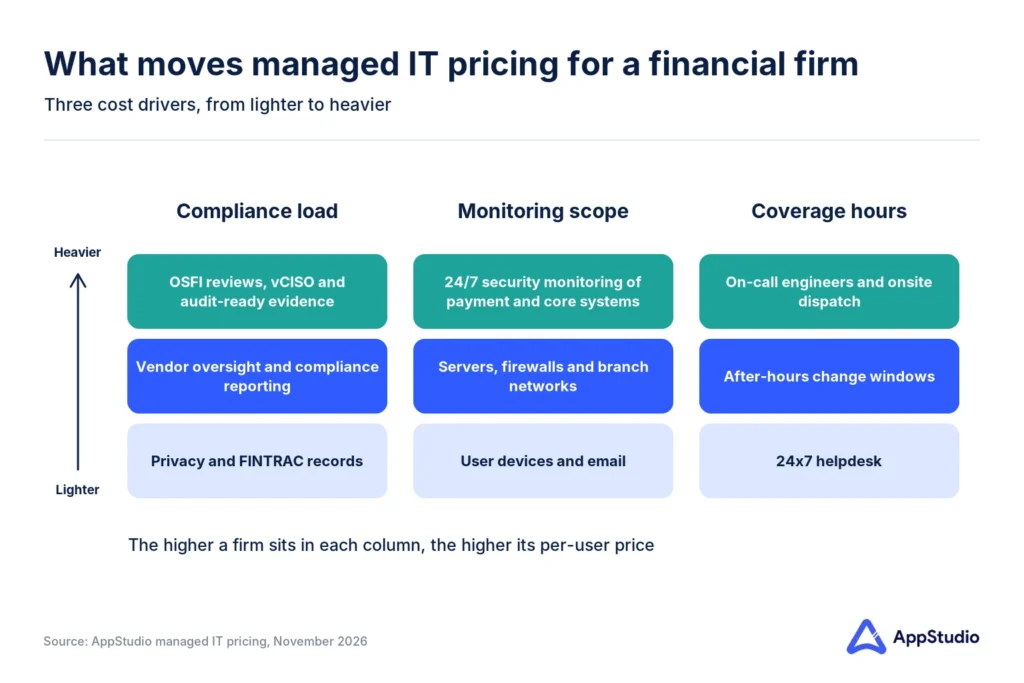
At AppStudio, our per-user plans run from CA$145 to CA$215 per user per month, with no minimum seats and no onboarding fee. Where a firm lands in that range comes down to how much compliance work it needs the provider to carry, how much of the network has to be watched around the clock, and which hours need a live person on the other end.
If you’re still weighing whether to outsource at all, our guide to managed IT services in Canada covers that decision. For the service scope itself, see our page on managed IT for financial institutions.
What Managed IT Pricing for Financial Firms Looks Like in 2026
The simplest model is a flat fee per user per month. It covers that person’s devices, accounts and support requests, plus the security tools installed on them. AppStudio publishes three per-user tiers and quotes a fourth, custom option for work that doesn’t map to a seat count.
Plan | Price per user per month (CA$) | What it adds | Where it usually fits in financial services |
Essential | 145 | 24×7 helpdesk, remote monitoring and management, onboarding and offboarding, device procurement and maintenance, asset tracking, SaaS backup and recovery, licence management, performance reporting, endpoint and email security, anti-phishing, domain authentication, security awareness training | Smaller firms with a lighter regulatory load, such as an independent advisory practice or a mortgage brokerage |
Professional | 180 | Everything in Essential, plus CIO advisory, identity and access management administration, crisis management and business continuity, third-party vendor management, security compliance reporting | Credit unions, lenders and smaller wealth firms that report on vendors and controls to a board or regulator |
Enterprise | 215 | Everything in Professional, plus vCISO oversight, active compliance management with audit-ready reporting, an annual external penetration test, dark web monitoring, high-touch support | Federally regulated institutions and investment dealers preparing for OSFI or CIRO reviews |
Custom | Quoted after a short assessment | Co-managed IT, after-hours and on-call coverage, onsite smart-hands dispatch, one-time migrations, large or complex environments | Banks with an internal IT team, multi-province branch networks, firms in the middle of a migration |
Prices are shown in Canadian dollars as of November 2026.
Two details in that table matter more than the headline numbers. The security and monitoring tools are inside the per-user fee, and at retail they’re worth more than CA$70 per user on their own. A quote that looks CA$30 cheaper per user but bills endpoint detection, email security and backup as add-ons can finish higher. Compliance work also sits inside the upper tiers instead of arriving as hourly invoices whenever an auditor calls. We think that’s the fairer way to charge a regulated buyer, because audit requests don’t follow a schedule anyone can budget around.
Why Regulation Adds a Cost Layer
Every rule a financial firm answers to becomes work its IT provider has to do, document or be ready to prove. That work is the main reason managed IT pricing for financial firms sits above what a retailer or manufacturer pays for the same headcount.
OSFI’s Third-Party Risk Management Guideline (B-10) names managed service providers as third parties and lists what a high-risk or critical contract should contain. One item on that list is pricing itself: the agreement should set out the basis for calculating fees. Any quote you can’t trace back to a written formula will be hard to defend in a vendor review.
Obligation | Who it applies to | What the provider has to deliver | Where it shows up in the price |
OSFI B-10 contract provisions | Federally regulated financial institutions (FRFIs) | Audit and information rights, subcontractor notice, tested business continuity, exit support with data returned in a usable format | Contract review time, audit support, exit assistance |
FRFIs | Incident details fast enough for the institution to notify OSFI in writing within 24 hours, then regular updates | Staffed 24/7 detection and escalation | |
OSFI E-21 operational resilience | FRFIs, with full adherence expected by September 1, 2026 and scenario testing of all critical operations by September 1, 2027 | Support for mapping critical operations, recovery inside set tolerances, help with scenario tests | Disaster recovery testing, continuity exercises |
Private-sector organizations under PIPEDA (Alberta, B.C. and Quebec have their own private-sector privacy laws) | A record of every breach of security safeguards, kept for 24 months, whether or not it was reportable | Incident logging and reporting | |
Reporting entities such as banks, credit unions, securities dealers and mortgage lenders | Records kept at least five years and producible within 30 days of a request | Backup retention, storage, restore testing | |
Investment dealers | A written report within three calendar days of discovering an incident, then an investigation report within 30 days | Forensic and investigation support | |
Any firm that stores, processes or transmits card data | 51 future-dated requirements in force since March 31, 2025, including stricter authentication and log review | Network segmentation, log monitoring, MFA administration |
Not every firm carries every row. Most credit unions answer to a provincial regulator rather than OSFI, and provincial regulators are starting to copy OSFI’s approach: BCFSA adopted E-21 for B.C.-incorporated insurers, with full adherence phased in by January 1, 2030. A lender outside OSFI’s reach can still end up working to the same expectations, sometimes because a bank partner writes them into its own contract.
The line can also move the other way. OSFI opened a faster approvals path in 2026 for provincial credit unions that want to become federal ones, and a credit union that takes it picks up B-10, B-13 (OSFI’s technology and cyber risk guideline) and E-21 along with the charter. If that move is on your roadmap, price your managed IT for the federal obligations you’ll carry after the move.
When you collect quotes, ask each provider to mark which of these rows its price covers. If a base tier claims to cover all of them, find out what it’s leaving out. Our governance, risk and compliance team maps these obligations during discovery, so the quote reflects the rows that actually apply to you.
How Network Monitoring Scope Moves the Price
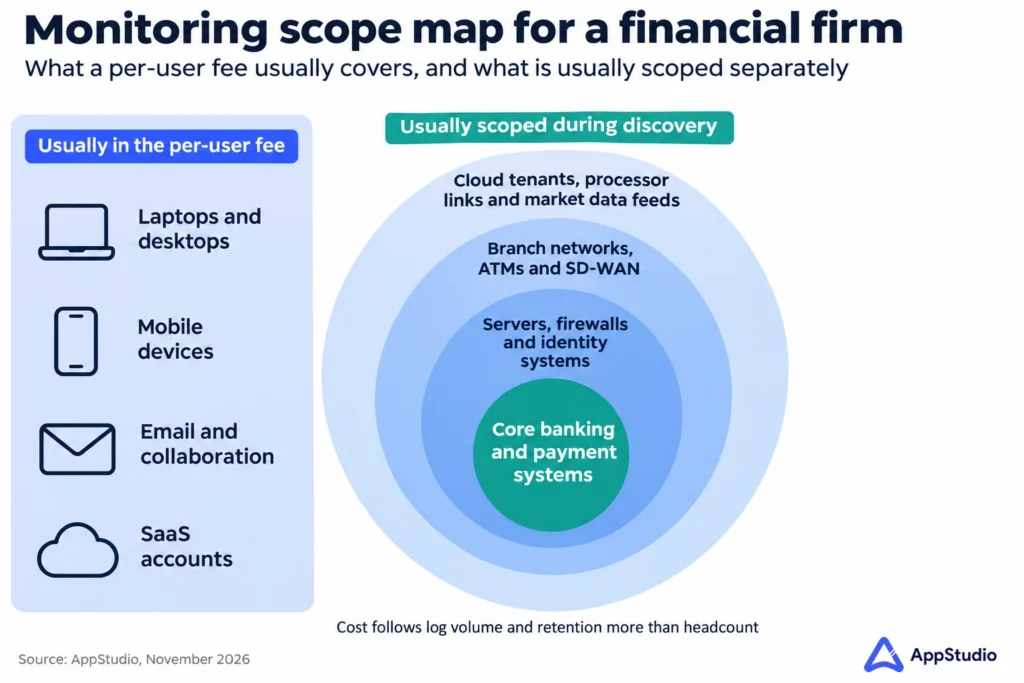
A per-user fee covers what a person uses: a laptop, a phone, a mailbox and the SaaS apps they sign into. A financial firm runs plenty that has no user attached. Core banking servers, the connection to a card processor, branch routers, ATMs, firewalls, SD-WAN links, cloud tenants and market data feeds all need watching, and that’s where quotes from different providers start to drift apart.
Sales conversations often blur two kinds of monitoring. Remote monitoring and management (RMM) checks device health, patch status and uptime, and it’s part of every AppStudio tier. Security event monitoring is a separate job: a SOC pulls logs from firewalls, servers, identity systems and cloud platforms into a SIEM, correlates them, and puts an analyst on anything odd at 3 a.m. Its cost follows log volume and retention far more closely than headcount. A 40-person advisory firm and a payments processor with the same staff count can produce very different volumes, so we scope 24/7 security monitoring during discovery instead of hiding it inside a seat price. If you’re still deciding whether that work belongs with your MSP or a dedicated security provider, our explainer on the difference between an MSP and an MSSP covers the split.
Retention rules raise the stakes. Card environments need logs reviewed under PCI DSS, and every month a firm keeps security logs, it pays for the storage behind its SIEM. FINTRAC’s five-year record rule puts the same pressure on backup storage. Ask any provider of network monitoring services these five questions before comparing their numbers:
- Which device types sit inside the per-user fee, and which are priced per device?
- Is security monitoring staffed 24/7, or do overnight alerts land in an inbox until morning?
- How is log ingestion priced, and what happens to the bill when volume spikes during an incident?
- How long are logs kept, where in Canada are they stored, and who pays to retrieve them?
- Are third-party connections, such as your core banking vendor or processor, monitored, or only equipment you own?
If you’re comparing providers on monitoring alone, our article on how Canadian enterprises compare managed IT services for network monitoring goes deeper on coverage and response targets. Firewall policy and segmentation of cardholder data are covered under network security services.
How Pricing Differs by Type of Financial Firm
Two firms with 120 staff each can get quotes thousands of dollars apart per month, because financial services IT isn’t one environment. The regulator, the systems that can’t go down and the reporting clock all change from one type of firm to the next.
Firm type | Who it answers to | Biggest cost driver | What to ask for in the quote |
Bank, trust company or federally regulated insurer | OSFI, plus FINTRAC and the OPC | B-10 contract terms, 24-hour incident reporting, E-21 scenario testing | Audit rights, exit assistance and incident timelines written into the agreement |
Credit union | A provincial regulator, such as FSRA in Ontario or BCFSA in B.C., plus FINTRAC | Branch and ATM networks, member data, five-year record retention | Per-site coverage terms and tested restores of retained records |
Investment dealer or dealer-affiliated wealth firm | CIRO, plus FINTRAC | Three-day incident reporting, trading and client reporting uptime, change windows outside market hours | Forensic support and after-hours change coverage |
Fintech lender or payments firm | FINTRAC where it’s a reporting entity, PCI DSS where it handles cards, often a bank partner’s contract | Cloud tenants, API monitoring, card data scope | Log ingestion pricing and cloud security monitoring scope |
Mortgage brokerage, MGA or independent advisory practice | Provincial regulators, and FINTRAC for mortgage entities | Endpoint and email security for a small, mobile team | Which security tools are bundled, and what counts as a user |
Banks and federally regulated insurers carry the heaviest contract work. Credit unions spend more on branch coverage, while dealers and fintechs put more into after-hours changes and log monitoring. A small brokerage or advisory practice usually fits a standard per-user tier with little custom scope at all.
Costs That Appear After the Contract Is Signed
The per-user number on page one of a proposal is rarely the whole bill. These lines are easy to miss when you compare managed services pricing:
- Onboarding or transition fees: some providers charge a one-time setup or transition fee. AppStudio doesn’t charge one, but ask every bidder.
- Security tools billed separately: endpoint detection, email filtering and SaaS backup can each arrive as their own per-user add-on.
- Software licences: a management fee covers administering Microsoft 365 or other platforms, and the licences themselves are often a separate line. Ask how they’re passed through.
- After-hours change windows: core banking upgrades and trading platform releases happen at night or on weekends, and those hours are often billed outside the base plan.
- Onsite dispatch: a technician at a branch in Kelowna or Moncton costs more than remote support, and some quotes leave it out entirely.
- Incident investigation: forensic hours after a breach are often billed separately, and a serious incident can run for weeks. See how providers handle incident response for enterprise clients before you sign.
- Exit assistance: B-10 expects data returned in a format you can keep running on. Get the price of that handover in writing at the start, while you still have bargaining power.
- Renewal increases: check whether the contract caps annual price changes.
Illustrative example (hypothetical figures, not a client): a 150-person wealth manager with offices in Toronto and Calgary collects two quotes. Quote A is a tier that bundles security tools, a penetration test and audit-ready reporting at CA$215 per user, which comes to CA$32,250 a month. Quote B looks cheaper at CA$165 per user, but it excludes endpoint detection, email security and backup. If those three tools cost the firm CA$45 per user from other vendors, Quote B reaches CA$210 per user, or CA$31,500 a month. The gap has shrunk from CA$7,500 to CA$750 a month, and Quote B still bills the annual penetration test and every hour of audit support on top.
Comparing Quotes From Canadian IT Providers Like for Like
A fair comparison starts with one written scope that every bidder prices: your user count, sites, critical systems, coverage hours and the regulatory rows from the table above. Without it, each of the Canadian IT providers you shortlist will price a slightly different job, and the cheapest number usually belongs to the smallest scope. Once the quotes are in, run them through these questions.
Question to ask | Why it matters for a financial firm | What a good answer looks like |
What is the basis for calculating fees? | B-10 expects the fee formula in a critical third-party contract | A written formula: per user, per device or per scoped system, with unit prices |
Who counts as a user? | Contractors, shared mailboxes and service accounts can inflate seat counts | A definition in the contract, with how contractors are billed |
Which security tools are in the per-user price? | Unbundled tools are a common reason a low quote rises | A named list of included tools, with retail value if possible |
Is 24/7 security monitoring included, scoped or excluded? | OSFI’s 24-hour and CIRO’s three-day reporting clocks leave little room for a slow overnight response | Staffed overnight coverage, with ingestion and retention priced up front |
How fast will you notify us of an incident at your end or a subcontractor’s? | Your reporting duty doesn’t pause because the breach happened at your provider | A notification window in hours, covering subcontractors |
What do after-hours and onsite work cost? | Change windows and branch visits happen outside business hours | A published rate card, or coverage named inside a tier |
What does exit cost? | B-10 asks for exit plans on critical arrangements | A fixed or capped price for handover and data return |
Are there minimum seats, term commitments or onboarding fees? | These change the real first-year cost | All three disclosed on the first page of the quote |
Service levels matter as much as price, and the help desk is where your staff will feel the difference first. Our checklist for shortlisting 24×7 helpdesk providers covers that side. For the security operations side of enterprise IT support, see which managed IT services enterprises should select for proactive security operations.
When In-House or Co-Managed IT Costs Less
Outsourcing everything isn’t automatically cheaper, and the answer depends on headcount and the team you already employ. Our guide to building a board-level business case for managed IT services walks through the full in-house cost model, from benefits and recruitment to tooling and risk. For a financial firm, a quicker check shows which side of the line you’re on.
Job Bank puts the median wage for a cybersecurity analyst in Canada at CA$49.52 an hour. Over a 2,080-hour year that’s about CA$103,000 in wages, before benefits, payroll taxes, tools or training. Forty users on our Enterprise tier cost almost the same: 40 × CA$215 × 12 months = CA$103,200 a year. The analyst covers roughly 40 of the week’s 168 hours. For the same money, the tier covers a 24×7 helpdesk, vCISO oversight, an annual penetration test and audit-ready reporting for the whole firm. At that size, fully managed is the better buy by a wide margin.
The math turns around as headcount climbs. A 1,000-person bank on the same tier would pay about CA$2.58 million a year, and it almost certainly employs a security team, an infrastructure group and a service desk already. Paying per seat for work those people do today makes little sense. Co-managed IT fits better: your team keeps architecture, strategy and the core banking vendor relationship, and the provider takes overnight monitoring, overflow tickets, after-hours changes and the specialist work that’s hard to hire for.
That specialist gap has a price tag of its own. In IBM’s 2026 Canadian breach findings, security skills shortages added about CA$314,500 to the average breach, and difficulty prioritizing threats added another CA$311,300. A co-managed arrangement aimed at those two gaps is one way to close them without adding permanent headcount. If you’re deciding where your own line sits, our article on when an enterprise should move from an internal IT team to a managed model walks through the triggers, and IT staff augmentation covers the option of adding named engineers to your own team.
How AppStudio Prices Managed IT for Financial Firms
We built our managed IT pricing for financial firms around one idea: a regulated buyer should be able to show its board, and OSFI if asked, exactly what it pays for and why. Each per-user tier has a published price and a named list of services. The security tools are bundled in. There are no minimum seats and no onboarding fee, and agreements run from month-to-month to annual terms.
The compliance work that financial firms need sits inside the tiers. Professional adds vendor management and security compliance reporting. Enterprise adds vCISO oversight, active compliance management with audit-ready reporting, and an annual external penetration test. Where a firm needs something a seat count can’t capture, such as co-managed coverage beside an internal team, on-call engineers for release nights or smart-hands visits to branches, we scope it as a Custom engagement after a short assessment.
Our team is ISO 27001 and SOC 2 Type II certified, and for most financial institutions the move to full operation takes four to eight weeks. Backups are monitored and restore-tested under our managed backup and disaster recovery service, and the wider enterprise IT support catalogue is on our managed IT services page.
If you’d like to see where your firm would land, book a consultation with our team. It’s a 30-minute review of your current setup, with no commitment, and you’ll leave with a clear read on which tier fits and what would need custom scope.
Frequently Asked Questions
How much do managed IT services cost per user in Canada for a financial firm?
At AppStudio, the managed IT cost per user runs from CA$145 to CA$215 a month across three tiers, with custom quotes for co-managed or complex environments. Federally regulated institutions and investment dealers usually need the upper tier because it includes vCISO oversight, audit-ready reporting and an annual penetration test.
Why is managed IT pricing for financial firms higher than for other industries?
Regulated firms ask their provider for more than support. OSFI, CIRO, FINTRAC and PCI DSS each add work, such as fast incident notification, long record retention, audit evidence and tested recovery. That work takes staff time and tooling, so it shows up in the price.
Does OSFI regulate how managed IT providers price their services?
No. OSFI doesn’t set prices. Guideline B-10 does expect a high-risk or critical third-party agreement to set out the basis for calculating fees, so a financial firm should be able to point to a written fee formula in its managed IT contract.
Is per-user or per-device pricing better for a financial firm?
Most financial firms end up with a mix. Per-user pricing suits staff devices, accounts and support. Infrastructure with no user attached, such as core servers, branch networks, ATMs and processor links, is usually priced per device or scoped separately. Compare managed services pricing on the combined monthly total for both.
Is 24/7 network monitoring included in per-user pricing?
Remote monitoring of device health and patching usually is. Round-the-clock security event monitoring through a SOC and SIEM is often scoped separately, because its cost depends on log volume and retention. When you compare network monitoring services, ask which kind each quote includes.
Are there setup fees or minimum seat counts?
It depends on the provider. AppStudio’s per-user tiers have no minimum seats and no onboarding fee. Some providers charge one-time transition fees or require a minimum number of users, so ask for both on the first page of any quote.
When does co-managed IT cost less than fully managed?
Co-managed IT usually makes more sense for larger institutions that already employ security, infrastructure and service desk staff. The internal team keeps strategy and core systems, and the provider covers overnight monitoring, overflow and specialist gaps. Smaller firms without that team typically get more coverage per dollar from a fully managed tier.