
 iOS App Development
 Android App Development
 React Native
 Flutter
 Web Development
 Custom Software
 Front End Development
 Blockchain Development
 Virtual Reality
 Cloud Computing
 IoT Development
 Augmented Reality
 Write us a message
Managed IT providers handle incident response for enterprise clients through a defined, contract-backed process. They detect issues through 24/7 monitoring, classify each incident by severity, escalate it to the right engineers within agreed SLA windows, restore service, keep stakeholders informed, and close the loop with a root cause analysis. That is managed IT incident response in one paragraph. The details are where providers differ, and where enterprise buyers should focus their attention.
The stakes justify the scrutiny. In ITIC’s 2024 Hourly Cost of Downtime survey of more than 1,000 organizations, over 90% of mid-size and large enterprises said a single hour of downtime costs them more than $300,000, and 41% put the figure between $1 million and over $5 million. At that rate, the minutes between an alert firing and the right engineer acting on it are a financial decision, not just a technical one.
This guide explains how managed IT incident response works in practice: the stages of the process, how severity levels and SLAs are set, how responsibilities split between the provider and your internal team, how security incidents differ from outages, and how to judge whether a provider can actually deliver when something breaks.
What Does Managed IT Incident Response Cover?
Managed IT incident response covers any unplanned event that interrupts an IT service or reduces its quality, not only cyberattacks. ITIL 4, the most widely used IT service management framework, defines an incident as an unplanned interruption to a service or a reduction in its quality, and most enterprise MSP contracts use that definition or a close variant.
In practice, an enterprise MSP’s incident queue includes four kinds of events:
- Outages: a failed server, a dropped network link, an unavailable cloud workload, or a broken integration between business systems.
- Performance degradation: slow application response, rising latency, storage nearing capacity, or backup jobs that fail silently.
- Security events: suspicious sign-ins, malware detections, or ransomware indicators that need triage and containment.
- Third-party failures: an internet service provider, cloud platform, or software vendor issue that the MSP must detect, route, and manage even though it does not own the fix.
That last category matters more every year. Uptime Institute’s Annual Outage Analysis 2026 reports that third-party IT and data center providers, including cloud, telecom, and colocation companies, have accounted for about two-thirds of publicly reported outages across nine years of tracking. The same research found that 57% of operators said their most recent major outage cost more than $100,000. A provider that only fixes what it directly manages leaves the hardest incidents with your team.
Incident management, incident response, and problem management
These three terms are often used interchangeably, but they describe different jobs. A mature provider runs all three as one connected practice.
Term | What it means | Primary goal |
Incident management | The IT service management practice of logging, prioritizing, and resolving incidents | Restore normal service as fast as possible |
Incident response | The coordinated actions taken once an incident is declared, a term used most often for security events | Contain the impact, recover, and preserve evidence |
Problem management | The investigation of the underlying cause behind one or more incidents | Prevent the same incident from happening again |
The IT Incident Management Process MSPs Follow, Stage by Stage
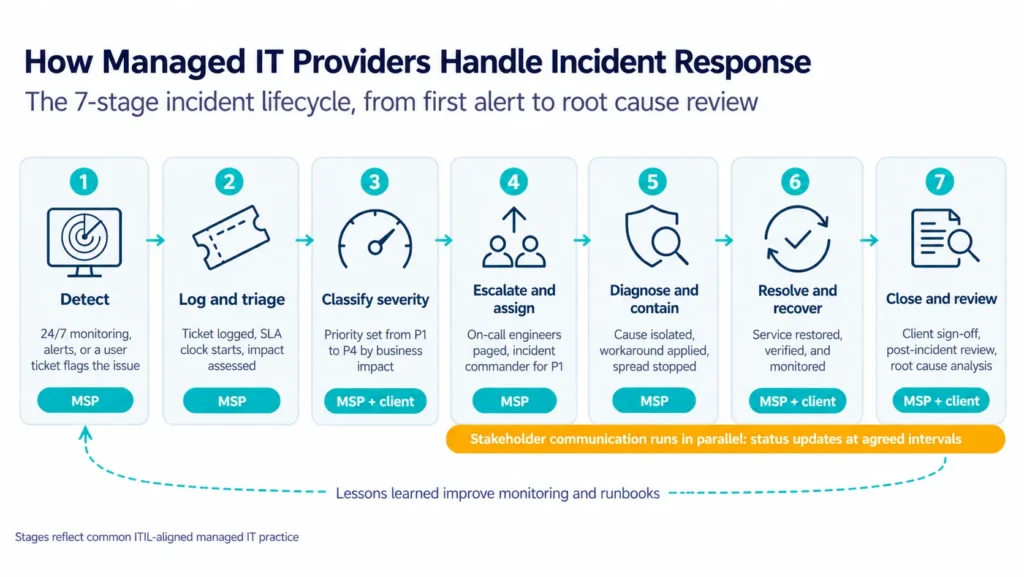
Most enterprise MSPs run a seven-stage IT incident management process built on ITIL practices, with stakeholder communication running alongside the technical work. Stage names vary by provider, but this sequence is what you should expect to see documented in a provider’s runbooks and statement of work.
- Detect. The incident surfaces through 24/7 monitoring, an automated alert, security tooling, or a user ticket. Mature providers catch most issues through monitoring before end users notice them.
- Log and triage. Every incident gets a ticket with a timestamp, the affected service, and an initial impact assessment. That timestamp is what starts the SLA clock.
- Classify severity. The incident is assigned a priority based on business impact and urgency, which determines how fast the provider must respond.
- Escalate and assign. High-severity incidents page an on-call engineer immediately. Major incidents also bring in an incident commander who coordinates engineers, vendors, and client stakeholders.
- Diagnose and contain. Engineers isolate the cause, apply a workaround where one exists, and stop the impact from spreading to other systems.
- Resolve and recover. Service is restored, verified with the client, and monitored closely to confirm it stays stable.
- Close and review. The ticket closes only after client confirmation, and significant incidents move into a formal post-incident review.
Communication is not a final step. From the moment an incident is escalated, named client contacts should receive status updates at intervals agreed in the contract, even when the update is simply that diagnosis is still underway. In MSP incident response, silence during a P1 outage erodes trust faster than the outage itself.
The other marker of maturity is documentation. A provider should be able to show you the runbooks its engineers follow for your most critical systems, because a documented IT incident management process is what keeps the response consistent at 3 a.m., on a holiday, or when the usual engineer is unavailable.
How MSPs Set Incident Severity Levels and SLA Response Targets
Incident severity levels translate business impact into response speed. Most MSPs use a four-tier scale, P1 to P4, based on two factors: impact (how many users, systems, or revenue streams are affected) and urgency (how quickly the damage grows if nothing is done). Which of your systems sit at each tier should be agreed during onboarding, not decided by the provider in the middle of an outage.
The table below shows a common structure. The response targets are illustrative examples of market practice, not benchmarks, and your actual figures should be negotiated against your own cost of downtime.
Severity | Typical definition | Example incident | Example response target | Example update cadence |
P1 Critical | A business-critical service is down or a security breach is in progress, with no workaround | ERP or customer-facing platform offline; active ransomware | 15 minutes, 24/7 | Every 30 minutes |
P2 High | A major function is degraded or a critical system is at risk; a workaround may exist | Email unavailable for one region; a primary database running without failover | 30 to 60 minutes, 24/7 | Every 1 to 2 hours |
P3 Medium | Limited impact on one team or a non-critical system | A departmental application running slowly | 4 business hours | Daily |
P4 Low | A minor issue or service request with no business impact | A software installation request | 1 business day | On resolution |
Response time is not resolution time
The most common gap in enterprise SLAs is the difference between response and resolution. Many contracts guarantee only that the provider will acknowledge an incident within a set window, which can be satisfied by an automated email. When you review the incident severity levels in a contract, check five points:
- What counts as a response: an automated acknowledgment, or a qualified engineer actively working the issue.
- Restoration targets: whether the provider commits to a time to restore service or a workaround for P1 and P2 incidents, not only a time to acknowledge.
- Coverage hours: whether the P1 clock runs 24/7 or only during business hours in the provider’s time zone.
- Reclassification rules: who can raise or lower a severity level, and how disagreements are settled during a live incident.
- Service credits and reporting: what happens when targets are missed, and whether you receive monthly SLA performance reports.
Who Owns What: The MSP or Your Internal IT Team?
In managed IT incident response, the MSP usually owns detection, technical diagnosis, and restoration for the systems it manages, while the enterprise keeps ownership of business decisions, regulatory obligations, and final sign-off. Ownership gaps, not technical skill, are where most enterprise incidents slow down: an engineer waiting for approval to fail over, or a vendor refusing to open a ticket because the MSP is not an authorized contact.
A RACI matrix agreed during onboarding removes that friction. R means responsible for doing the work, A means accountable for the outcome, C means consulted, and I means informed.
Activity | MSP | Internal IT | Business leadership |
24/7 monitoring and alert triage | R, A | I | None |
Severity classification during an incident | R | A, C | I (P1 only) |
Technical diagnosis and fix for managed systems | R, A | C | None |
Escalation to ISPs, cloud platforms, and software vendors | R | A | None |
Business decisions such as failover, shutdown, or customer notice | C, executes once approved | R | A |
Regulatory and legal notifications | C, supplies the incident timeline | C | R, A |
Post-incident review and corrective actions | R | A | I |
Three practical details make this matrix work in a real incident:
- Letters of agency: written authorization that lets the MSP open and escalate tickets directly with your carriers, cloud providers, and software vendors.
- Break-glass access: pre-approved emergency credentials and a documented process for using them, so engineers are not locked out when an identity system is part of the outage.
- A current contact tree: named decision-makers with backups for every P1 and P2 scenario, reviewed at least quarterly.
How MSP Incident Response Differs for Security Incidents and Outages
MSP incident response follows a restore-first approach for outages and a contain-first approach for security incidents. When a server fails, the goal is to bring service back as quickly as possible. When an attacker is inside the network, restoring too quickly can wipe the evidence investigators need, reinfect clean systems, or trigger a regulatory problem. Many MSPs handle the operational side of a security incident themselves and coordinate with a dedicated security operations or forensics partner for detection, investigation, and eradication.
Dimension | Outage or degradation | Security incident |
First priority | Restore service fast | Contain the threat without destroying evidence |
Typical first move | Fail over, restart services, or roll back a recent change | Isolate affected systems, revoke credentials, and preserve logs |
Who leads | MSP operations engineers and the network operations center | A security lead, often with a specialist partner and the client’s legal team |
Reference framework | ITIL incident management | NIST SP 800-61 Rev. 3, aligned to NIST CSF 2.0 |
External obligations | Customer-facing SLAs | Regulatory notification deadlines and cyber insurance requirements |
Definition of done | Service restored and root cause identified | Threat eradicated, systems verified clean, and required filings made |
NIST SP 800-61 Rev. 3 and what changed
In April 2025, NIST published SP 800-61 Revision 3, replacing the 2012 Computer Security Incident Handling Guide. The new version organizes incident response around the six functions of the NIST Cybersecurity Framework 2.0: Govern, Identify, Protect, Detect, Respond, and Recover. The practical message for enterprises is that incident response is no longer treated as a standalone team activity. Preparation, governance, and lessons learned are part of the response capability, so an MSP should be able to show how its process maps to all six functions, not only to Respond.
Regulatory clocks your provider must support
The provider rarely makes the disclosure decision, but it must produce the timeline, scope, and evidence fast enough for your legal and compliance teams to meet these deadlines.
Regulation | Applies to | Notification deadline |
U.S. public companies | Within four business days of determining that a cybersecurity incident is material | |
GDPR Article 33 | Organizations processing personal data of people in the EU | Supervisory authority notified within 72 hours of becoming aware of a personal data breach, where feasible |
Essential and important entities in the EU | Early warning within 24 hours, incident notification within 72 hours, final report within one month | |
HIPAA Breach Notification Rule | U.S. covered entities and business associates | Affected individuals notified without unreasonable delay and no later than 60 calendar days after discovery |
How Managed IT Providers Reduce Mean Time to Resolve (MTTR)
Managed IT providers reduce mean time to resolve (MTTR) by shortening each phase of an incident: detection, acknowledgment, diagnosis, and recovery. MTTR is the average time from when an incident starts, or is detected, to when service is fully restored. Because the acronym is also used for mean time to repair, recover, and respond, your contract should define exactly which start and end points are measured.
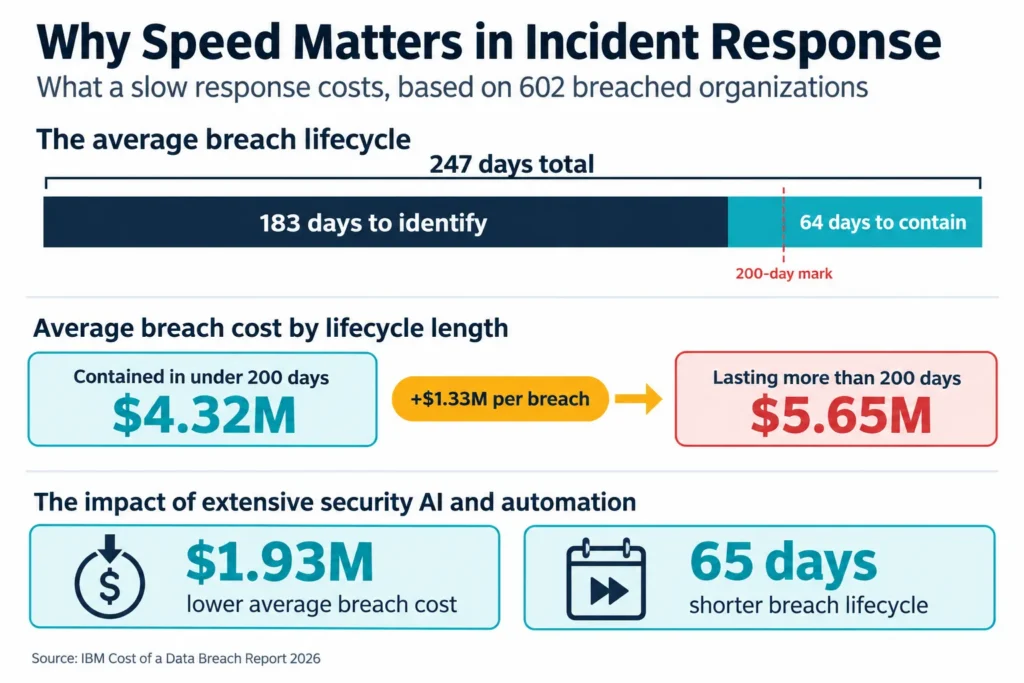
Speed has a measurable price. IBM’s Cost of a Data Breach Report 2026, based on 602 breached organizations across 16 countries, found the average breach took 247 days to identify and contain: 183 days to identify and 64 days to contain. Breaches contained in under 200 days cost an average of $4.32 million, while those lasting longer cost $5.65 million. Organizations that used security AI and automation extensively cut breach costs by $1.93 million and shortened the breach lifecycle by 65 days.
The practices that move these numbers apply to outages and security incidents alike:
- Detect before users do: Monitoring that covers infrastructure, applications, and user experience shortens the time between failure and alert, which is often the longest and least visible part of an incident.
- Route alerts to the right person the first time: Tuned alert thresholds, deduplication, and clear on-call schedules prevent alert fatigue and cut the minutes lost to reassignment.
- Follow runbooks, not memory: Uptime Institute’s research continues to identify failure to follow established procedures as the leading driver of human error outages. Documented, tested runbooks for known failure modes make the right action the default under pressure.
- Check recent changes first: Configuration and change management problems are a frequent trigger for network-related outages, so mature providers correlate every incident with recent deployments and changes before deeper diagnosis.
- Automate the repeatable steps: Service restarts, failovers, credential revocation, and host isolation can be scripted and triggered automatically or with one approval.
- Rehearse: Quarterly tabletop exercises and failover tests expose gaps in contact lists, access, and decision rights before a real incident does.
When you review a provider’s reporting, ask for MTTR by severity level and as a median as well as an average. A single 30-hour outage can distort an average for a whole quarter, while the median shows what a typical incident looks like.
What Happens After an Incident Is Resolved?
After resolution, a mature MSP runs a post-incident review that explains what happened, why it happened, and what will change so it does not happen again. Restoring service closes the incident ticket. The review is what turns one bad day into a lasting improvement, and in managed IT incident response it is often the clearest difference between a reactive provider and a strategic one.
A useful post-incident review for a P1 or P2 incident includes six elements:
- A timestamped timeline from first signal to full recovery, including when the client was notified and when each decision was made.
- Impact in business terms: affected users, systems, transactions, and duration, not only technical symptoms.
- Root cause and contributing factors: the technical trigger plus the process, monitoring, or design gaps that allowed it to cause harm.
- What worked and what slowed the response: detection speed, escalation, access, vendor support, and communication.
- Corrective actions with a named owner and a due date for each, tracked to completion in the provider’s problem management process.
- SLA performance for the incident: response, update cadence, and restoration time against contracted targets.
The best reviews are blameless. They focus on why the system and process allowed an error, rather than on who made it, because engineers who fear blame report less and hide near misses. Ask prospective providers for a redacted example of a recent post-incident report. Its quality tells you more about their operational maturity than any sales presentation.
Agree on timing in the contract as well. Many enterprises expect a preliminary summary within one business day of a P1 incident and the full report within a week or two. For security incidents subject to regulation, the review also feeds formal reporting, such as the final report NIS2 requires within one month of notification.
How to Evaluate a Provider’s Managed IT Incident Response Capability
Evaluate a provider on evidence, not promises: its documented IT incident management process, its historical SLA performance, its escalation paths, and the quality of its post-incident reports. Outsourcing does not make response faster on its own. IBM’s 2026 research found that internal IT and security teams identified and contained breaches about 15% faster than external providers, which is why the way a provider integrates with your team matters as much as its tooling.
Use these questions during due diligence:
Question to ask | What a strong answer looks like |
How do you detect incidents in our environment? | 24/7 monitoring across infrastructure, applications, and security tools, with most incidents detected before users report them |
What are your P1 response and restoration targets, and what is your track record against them? | Contracted targets for both response and restoration, backed by 12 months of reported performance by severity |
Who answers at 3 a.m. on a holiday? | A named on-call rotation of qualified engineers, not an answering service that queues tickets until morning |
How do you escalate to our vendors and cloud providers? | Letters of agency in place, documented vendor escalation paths, and experience managing third-party outages |
How do you handle a suspected security incident? | A contain-first playbook aligned to NIST guidance, evidence preservation, and a defined handoff to forensic and legal support |
How and how often will you update us during an incident? | Defined update intervals by severity, named contacts, and a single incident commander for major incidents |
Can we see a recent post-incident report? | A redacted example with a timeline, root cause, contributing factors, and owned corrective actions |
How do you test your incident response? | Regular tabletop exercises and failover tests, run jointly with the client at least once a year |
Watch for red flags as well: SLAs that cover acknowledgment only, no 24/7 coverage for critical systems, no runbooks for your environment, vague answers about vendor escalation, and an unwillingness to share past incident reports or performance data.
Building Incident Response You Can Rely On
Every managed IT provider looks capable on an ordinary Tuesday. The real test is the first P1 incident at 2 a.m.: whether the alert reaches a qualified engineer within minutes, whether your leadership hears from the provider before it hears from customers, and whether the review afterward actually changes anything. Reliable managed IT incident response is built before that moment, through agreed severity definitions, a clear division of ownership, documented runbooks, tested vendor escalation paths, and contracts that measure restoration rather than acknowledgment alone.
If you are reviewing an existing provider or preparing to outsource, start with your five most critical services. For each one, define what a P1 incident looks like, what an hour of downtime costs the business, and who has the authority to approve failover. Those three answers will shape every other part of the agreement.
At AppStudio, our managed IT services team works with enterprise IT leaders to design incident response around how their business actually operates, from severity definitions and escalation paths to post-incident reviews that lead to measurable improvement. If you are assessing your current managed IT incident response model, speak with our team for a practical review of where response time is being lost and how to recover it.
Frequently Asked Questions
What is managed IT incident response?
Managed IT incident response is the outsourced detection, triage, escalation, resolution, and review of IT incidents by a managed service provider under a contract with defined SLAs. It covers outages, performance degradation, security events, and third-party failures, and usually runs 24/7 for business-critical systems.
How fast should an MSP respond to a critical incident?
There is no universal standard, but enterprise contracts commonly set P1 response targets measured in minutes rather than hours, with round-the-clock coverage. The right target depends on your cost of downtime and how your incident severity levels are defined. Always confirm whether the target means an engineer actively working the issue or only an acknowledgment.
What is the difference between MSP incident response and MSSP incident response?
MSP incident response focuses on keeping IT services running, which covers outages, performance problems, and the operational side of security events. A managed security service provider (MSSP) specializes in security monitoring and threat response. Many enterprises use both, with the MSP coordinating restoration and the security specialist leading investigation and eradication.
What is a good mean time to resolve (MTTR)?
A good MTTR is one that meets your contracted restoration targets for each severity level and improves over time. Compare MTTR by severity rather than as a single blended number, and review medians alongside averages, because one long outage can distort an average for an entire quarter.
Does an MSP replace our internal incident response plan?
No. The provider runs its IT incident management process inside your plan, not instead of it. Your organization still owns business decisions, regulatory notifications, customer communication, and executive escalation, so your plan should name the MSP’s role, contacts, and handoff points explicitly.
How often should incident response be tested?
Run tabletop exercises at least annually for major scenarios such as ransomware or a core platform outage, and test backups and failover on a regular schedule. Many enterprises review contact trees and runbooks quarterly, because outdated phone numbers and access rights are among the most common causes of avoidable delay.