
 iOS App Development
 Android App Development
 React Native
 Flutter
 Web Development
 Custom Software
 Front End Development
 Blockchain Development
 Virtual Reality
 Cloud Computing
 IoT Development
 Augmented Reality
 Write us a message
Enterprises should select managed IT services for proactive security operations that combine 24/7 managed detection and response, continuous threat hunting, risk-based vulnerability management and contracted incident response. The provider should commit to measurable detection and response SLAs, hold audited SOC 2 Type II and ISO 27001 credentials, map detections to MITRE ATT&CK and report against NIST CSF 2.0.
What Do Proactive Security Operations Include?
Reactive security waits for an alert. Proactive security operations assume an attacker is already inside and go looking for them. For an enterprise, that work splits into five services:
- Managed detection and response (MDR): 24/7 monitoring of endpoints, identities, cloud and network data, with analysts who investigate and contain threats themselves.
- Managed SOC or SOC as a service: a staffed security operations center that runs your SIEM, writes detection rules and owns triage.
- Threat hunting: structured searches for activity your tools missed, usually organized around MITRE ATT&CK techniques.
- Vulnerability management: continuous scanning, ranking by how exploitable each flaw is and how much it would hurt the business, and tracked fixes.
- Incident response (IR): a retained team, playbooks and forensic capability, in place before an incident instead of hired during one.
Vulnerability management deserves more board attention than it gets. Exploited vulnerabilities started 31% of breaches in the latest Verizon data, overtaking stolen credentials for the first time in 19 years [Verizon DBIR, 2026].
Why Are Enterprises Moving Security Operations to Managed Providers?
Three pressures have converged: cost, speed and staffing.
A data breach now costs $4.44 million on average worldwide and $10.22 million in the United States, a record high [IBM Cost of a Data Breach Report, 2025]. The average breach took 241 days to identify and contain.
Attackers move far faster than that. The global median dwell time rose to 14 days in 2025. The median time for one criminal group to hand initial access to another fell to 22 seconds [Mandiant M-Trends, 2026].
Then there’s the workforce. 59% of security professionals report critical or significant skills gaps, and 49% of organizations with more than 10,000 employees reported hiring freezes [ISC2 Cybersecurity Workforce Study, 2025].
Budgets reflect the shift. Gartner projects worldwide information security spending of about $240 billion in 2026. Security services are the largest segment, at roughly $92.8 billion [Gartner, 2025]. A growing share of that money goes to managed IT services for proactive security operations, because few enterprises can hire enough people to cover every hour of the week.
Which Managed Service Model Fits Your Enterprise?
Vendors use these labels loosely, so define them before you compare quotes.
- MSP (managed service provider): runs IT infrastructure, patching and the helpdesk. Security work is usually limited to managing tools.
- MSSP (managed security service provider): manages security tools and monitors alerts, often passing investigation back to your team.
- MDR provider: detects, investigates and contains threats for you, with threat hunting included.
- Co-managed SOC: the provider covers after-hours monitoring, detection engineering or hunting, while your team keeps control of decisions and tooling.
How do the models compare?
Criteria | MSP | MSSP | MDR | Co-managed SOC |
24/7 human monitoring | Rarely | Usually | Yes | Shared |
Active containment | No | Limited | Yes | Shared, by runbook |
Threat hunting | No | Optional | Included | Provider or joint |
Detection engineering | No | Vendor rules | Provider-built | Joint |
Incident response | Ad hoc | Escalation only | Within scope | Joint |
Internal staff needed | Low | Medium | Low | Medium to high |
Best fit | Infrastructure operations | Compliance-driven monitoring | Lean security teams | Enterprises with an existing SOC |
For most large organizations, the realistic choice is MDR or a co-managed SOC. Some managed IT services for enterprises pair an MSP contract with a separate MSSP, and things can fall through the gap between the two. Ask who owns containment at 3 a.m. on a holiday.
How Should You Evaluate Managed IT Services for Proactive Security Operations?
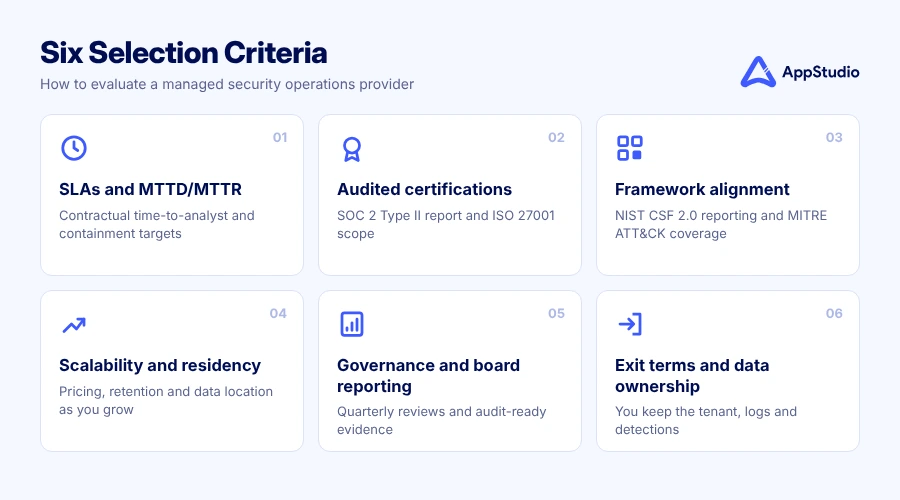
Price comparisons mislead when the scope differs between quotes. Judge providers on these six criteria first.
What SLAs and response metrics should you require?
Ask for contractual targets for each severity level, not marketing averages. Three numbers matter. Time to analyst is how long it takes before a named person starts investigating a critical alert. Mean time to detect (MTTD) shows how quickly threats are spotted, and mean time to respond or contain (MTTR) shows how quickly they’re stopped.
Require a monthly report of actual results against those targets. The SANS 2025 SOC Survey found that 69% of SOCs still report their metrics by hand or mostly by hand [SANS 2025 SOC Survey]. Automated reporting you can audit sets a provider apart.
Which certifications prove the provider’s own controls?
A SOC 2 Type II report shows that controls worked over an audit period, usually several months to a year. ISO 27001 certification shows that the provider runs a formal information security management system. Ask for the full report, the certificate scope and the auditor who issued it. A logo on a website proves nothing.
Does the provider align to NIST CSF 2.0 and MITRE ATT&CK?
NIST CSF 2.0 added a Govern function in 2024, which gives boards a shared language for overseeing security. MITRE ATT&CK gives you a way to measure detection coverage. Ask for a coverage map showing which attack techniques the provider detects in your environment, and how often it reviews its rules.
Can the service scale with your environment?
Check how pricing changes as you add cloud accounts, subsidiaries or regions. Confirm data residency options, how long security data is kept, and support for the SIEM and EDR platforms you already license.
How will the provider support governance and board reporting?
Enterprise managed proactive security operations should produce evidence your audit committee can use. That means quarterly risk reviews, controls mapped to frameworks such as SOC 2, HIPAA and PCI DSS, and a named executive contact.
What happens if you leave?
Exit terms usually get negotiated last, but they decide how much bargaining power you keep for the life of the contract. Confirm in writing that you own the SIEM tenant, the logs and the detection content, and that the provider will support a set transition period.
Provider evaluation checklist
Use these eight questions in your RFP or final-round interviews. Ask for written answers.
- Response SLAs: Will the provider commit in the contract to time-to-analyst, MTTD and MTTR targets for each severity level, and report actual results every month?
- Certifications: Can it share a current SOC 2 Type II report and ISO 27001 certificate whose scope covers the SOC services you’re buying, along with the name of the issuing auditor?
- Detection coverage: Will it provide a MITRE ATT&CK coverage map for your environment and explain how often detection rules are reviewed?
- Governance reporting: Does its reporting align with NIST CSF 2.0, including the Govern function, and include quarterly executive reviews with a named contact?
- Threat hunting: How often does it run hunts, and can it show a sample hunt report with documented findings?
- Incident response: Is incident response included for monitored assets, and how many retainer hours does the contract cover?
- Data and platforms: Does it support the SIEM, EDR and identity platforms you already license, and meet your data residency and retention requirements?
- Exit terms: Does the contract confirm that you own the SIEM tenant, logs and detection content, and does it set out a supported transition period?
Should You Build an In-House SOC or Outsource It?
Start with the staffing math. A week has 168 hours, so keeping one SOC seat filled around the clock takes more than four full-time analysts, before vacation, training and turnover. Even a small two-seat SOC needs ten or more analysts, plus engineers and a manager.
Building in-house makes sense if you have strict data sovereignty rules, a large existing team, or detection needs so specialized that no provider can meet them. Even then, many enterprises add a co-managed partner for nights and weekends.
Outsourcing makes sense when speed matters. A capable provider can have your most important data sources monitored within weeks, while hiring and training an internal team takes far longer. You give up some direct control, but a well-written contract and shared tooling can make up for most of it.
What Does Proactive Security Cost, and How Do You Measure ROI?
Most providers charge per endpoint, per user identity or by the volume of log data ingested. Ask for platform cost and analyst cost as separate lines, because SIEM data ingestion is where budgets usually run over.
Total cost of ownership should include:
- Platform licensing and data ingestion
- Analyst services and threat hunting
- Incident response retainer hours
- Internal staff time spent managing the provider
- Transition costs at the end of the contract
Measure ROI in losses avoided and faster containment. IBM found that organizations making extensive use of security AI and automation cut average breach costs by $1.9 million and contained breaches 80 days sooner. Breaches an organization caught itself cost about $900,000 less than breaches the attacker disclosed.
That gap is the clearest business case for managed IT services for proactive security operations. Mandiant reports that 52% of intrusions in 2025 were detected by the victim organization itself, up from 43% the year before. You want to be in that group.
What Red Flags Should Disqualify a Provider?
- SLAs that time the acknowledgment of an alert, not the investigation or containment
- Certifications shown as logos, with no report or certificate available
- Incident response billed per incident with no cap
- No threat hunting, or hunting described only as “AI-driven” with no sample output
- The provider, not you, owns the detection content, the logs or the SIEM tenant
- No named analysts or escalation path, only a ticket queue
- Dashboards with no MTTD or MTTR history
Third parties were involved in 48% of breaches in the latest Verizon data. Your security provider becomes one of those third parties, so hold it to the same standard as any critical supplier.
Where Does AppStudio Fit?
AppStudio provides managed IT services for enterprises alongside a dedicated security practice, and its model is built around managed IT services for proactive security operations rather than reselling tools. Its security services include managed detection and response, SOC as a service and SIEM management, and fully managed or co-managed SOC options.
Under AppStudio’s published service terms, a named analyst starts work on a critical alert within 15 minutes of it reaching the SOC queue. Data usually starts flowing within 3 to 5 business days of API access, and mid-sized environments reach full production in 2 to 4 weeks. Detection rules are mapped to MITRE ATT&CK and reviewed monthly. Clients keep their SIEM tenant, data and detection content, so they can move operations in-house or to another provider without rebuilding their detections.
AppStudio states that it holds ISO 27001 certification and supports compliance reporting for SOC 2, HIPAA and PCI DSS. As with any provider, ask for the certificate scope and audit reports during due diligence.
One limit to note: if security operations must run inside a single government-cleared facility, confirm residency and clearance options before shortlisting anyone, AppStudio included.
Frequently Asked Questions
What is the difference between MDR and an MSSP?
An MSSP manages security tools and monitors alerts, often passing investigation back to your team. An MDR provider investigates, contains and hunts threats itself, so your staff handle fewer alerts and fewer overnight decisions.
What MTTD and MTTR should an enterprise expect from a managed provider?
There’s no universal benchmark. Require contractual targets for each severity level, timed from alert to analyst action and from detection to containment, with monthly reports showing actual results against those targets.
Is a co-managed SOC right for large enterprises?
Often, yes. A co-managed SOC keeps decisions and tooling with your team while the provider covers nights, weekends, detection engineering or threat hunting. It suits enterprises with an existing SOC that can’t staff every shift.
Which certifications should a managed security provider hold?
At minimum, a current SOC 2 Type II report and ISO 27001 certification. Ask for the full report, the certificate scope and the issuing auditor, and confirm the scope covers the SOC services you’re buying.
How long does it take to onboard a managed SOC provider?
It depends on the size of your environment and how fast access is approved. Priority data sources can be monitored within days, and a provider with a mature onboarding process can bring a mid-sized environment to full production within weeks.
Talk to AppStudio About Your Security Operations
Enterprise managed proactive security operations start with a clear picture of what you cover today. Most leadership teams know their tool stack, but fewer can say which attack techniques they would actually detect at 2 a.m. on a Sunday, or how long containment would take.
Book a security operations assessment with AppStudio to get those answers in writing. Our team will map your current detection coverage against MITRE ATT&CK and review your existing SLAs and escalation paths. We’ll also identify the gaps that carry the most business risk.