
 iOS App Development
 Android App Development
 React Native
 Flutter
 Web Development
 Custom Software
 Front End Development
 Blockchain Development
 Virtual Reality
 Cloud Computing
 IoT Development
 Augmented Reality
 Write us a message
Most Canadian companies don’t start looking for a new IT partner when things are running smoothly. The search usually begins after a ticket sits untouched for two days, a backup fails the one time it’s needed, or a client asks a privacy question nobody inside the business can answer with confidence. At that point, outsourcing IT is already decided. What’s left is working out who can be trusted with it.
In Canada, reliability has a specific meaning. A provider has to keep systems running, respond quickly across time zones from Halifax to Vancouver, and handle personal information in a way that holds up under PIPEDA and, for organizations with customers or staff in Quebec, Law 25. This guide sets out what a reliable managed IT provider in Canada should deliver, then looks at how AppStudio performs against each standard so you can judge the fit for your own business.
Why reliability matters more for Canadian businesses in 2026
The cost of choosing the wrong IT partner has risen sharply. According to Statistics Canada, 16% of Canadian businesses were impacted by a cyber security incident in 2023, and 30% of large businesses reported an impact. Spending on recovery from those incidents doubled to $1.2 billion, up from about $600 million in 2021.
The same survey shows how much Canadian companies already rely on outside help: 47% of businesses without dedicated cyber security staff used consultants or contractors to monitor their security.
When an incident becomes a breach, the numbers climb further. IBM’s 2025 Cost of a Data Breach research for Canada puts the average cost of a breach at CA$6.98 million, a 10.4% increase over 2024. Phishing was the most common way attackers got in, at an average of CA$7.91 million per breach. Organizations that made extensive use of security AI and automation averaged CA$5.19 million, compared with CA$8.53 million for those that didn’t.
Ransomware sits at the centre of this risk. The Canadian Centre for Cyber Security names it the top cybercrime threat facing Canada’s critical infrastructure in its National Cyber Threat Assessment 2025-2026.
For a mid-sized company, these figures make one point clear. Uptime alone doesn’t make a reliable managed IT provider in Canada. The right partner also has to detect threats early, respond in minutes, and help you meet your legal obligations when something goes wrong.
What makes a managed IT provider reliable in Canada?
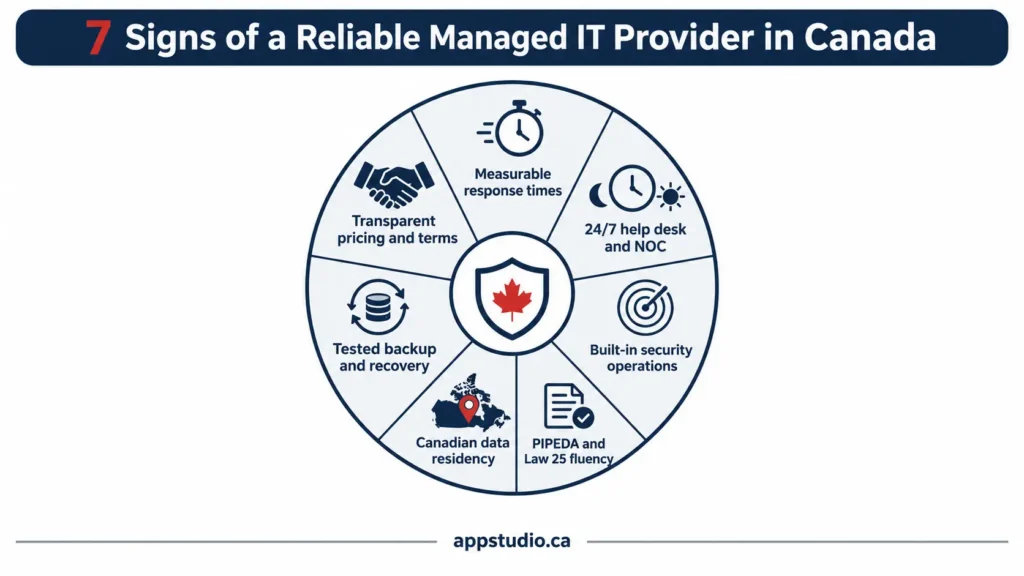
Marketing language makes most managed service providers (MSPs) in Canada sound alike. If you’re working out how to evaluate an MSP, these seven criteria separate a dependable partner from a vendor that simply resells tools.
- Measurable response commitments. Response and resolution targets should be written into the IT service level agreement (SLA) and reported every month, not described in general terms like “fast” or “priority.”
- True 24/7 coverage. A help desk that closes at 5 p.m. Eastern leaves Alberta and British Columbia teams without support for part of their workday. Network operations centre (NOC) monitoring should run around the clock, including weekends.
- Security operations built into the service. Monitoring, threat detection and incident response should be part of the core service, not an expensive add-on you only discover after an incident.
- Fluency in Canadian privacy law. Your provider should understand breach reporting under PIPEDA and the stricter requirements of Quebec Law 25, and produce the logs and records those laws expect.
- Canadian data residency options. Some contracts, industries and public sector clients require data to stay in Canada. A reliable partner can design for that.
- Tested backup and disaster recovery. A backup that has never been restored is an assumption, not a recovery plan.
- Transparent commercial terms. Clear pricing, a defined onboarding timeline and flexible contract lengths show that a provider expects to earn renewals rather than lock you in.
How AppStudio measures up as a reliable managed IT provider in Canada
AppStudio is a Canadian technology services company that has delivered more than 1,300 projects since 2015, with a team of 275+ people across eight countries. Its managed IT services cover 12 areas, from help desk and IT asset management to managed cloud, cybersecurity and virtual CIO strategy. Here is how that offering maps to the criteria above.
Reliability criterion | What AppStudio provides |
Measurable response | Published targets of under 10 minutes to first response on critical issues and under 30 minutes on standard requests |
24/7 coverage | Help desk and NOC running around the clock, including weekends, with 24/7 emergency support |
Security operations | Managed cybersecurity with SOC-led response and SIEM operations, plus network security and firewall management |
Compliance support | Dedicated IT compliance and risk management, with support for frameworks including ISO 27001, SOC 2, PCI DSS, HIPAA and GDPR |
Business continuity | Managed backup and disaster recovery as a core service line |
Onboarding | Service starts within 5 to 7 business days for most environments, with full transition in 2 to 4 weeks for a typical mid-sized client |
Commercial terms | Per-user or per-device pricing, with month-to-month or annual contracts |
Best fit | Organizations with roughly 20 to 500 employees |
Response times you can hold a provider to
Response time is where most MSP relationships succeed or fail, because it’s the part of the service your staff feel every day. AppStudio publishes specific first-response targets instead of vague promises, which gives your leadership team a benchmark to measure in monthly reviews. Clients also see the effect. One healthcare COO reported that AppStudio “cut our ticket volume in half,” and a manufacturing IT director said downtime dropped by more than 40%.
Security operations as part of the core service
Given the threat data above, cybersecurity for Canadian SMBs can’t be treated as optional, and a provider that only fixes laptops and resets passwords leaves the most expensive risk uncovered. AppStudio runs managed cybersecurity through SOC-led response and SIEM operations, alongside firewall management and its managed backup and disaster recovery service. Detection, response and recovery are handled by one accountable team rather than spread across three vendors.
Enterprise depth at a mid-market scale
Companies with 20 to 500 employees often fall into an awkward gap. They’re too complex for a break-fix technician but too small to fund a full internal IT department with security specialists, cloud engineers and a CIO. AppStudio’s virtual CIO and IT strategy service closes that gap by pairing day-to-day support with longer-term planning on budgets, infrastructure and risk.
One partner for Canada and US operations
Many Canadian businesses sell into or operate in the United States. AppStudio serves clients across North America and provides IT support for Canada and US operations, so organizations with offices or customers on both sides of the border can work with one provider instead of managing separate vendors and separate standards.
How does a managed IT provider help with PIPEDA and Quebec Law 25 compliance?
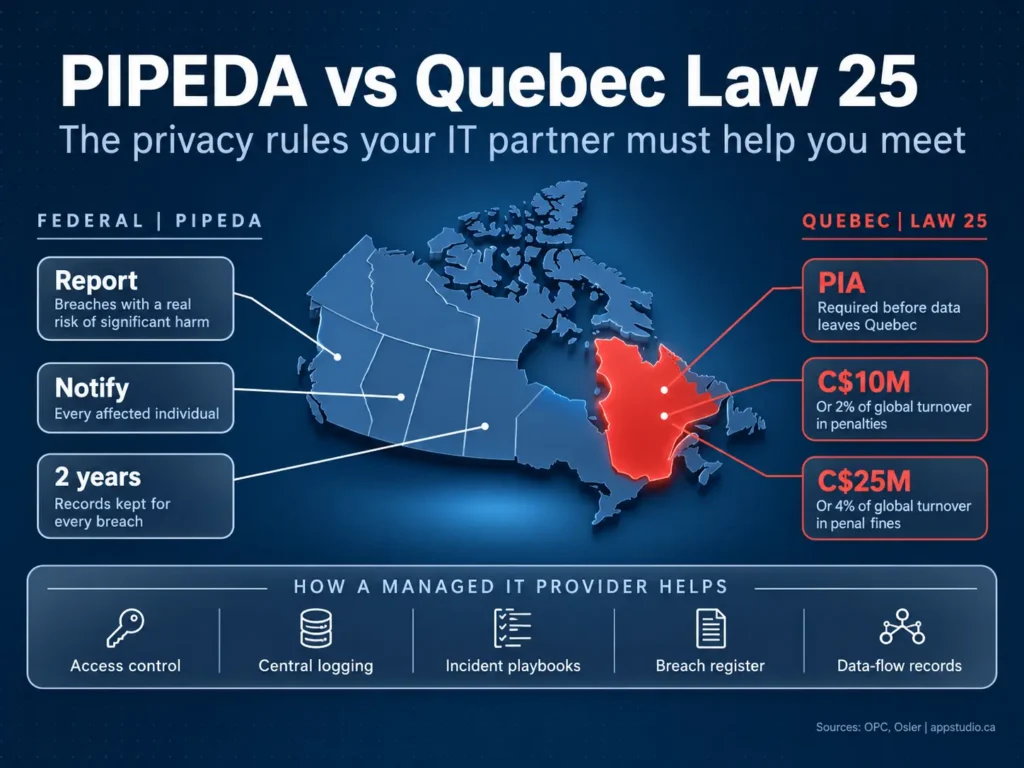
Privacy compliance is a legal obligation for your business. Your MSP can’t take that obligation on for you, but it can make meeting it much easier. Under PIPEDA, the Office of the Privacy Commissioner of Canada requires organizations to report any breach of security safeguards that creates a real risk of significant harm, notify affected individuals, and keep records of all breaches for two years, whether they were reportable or not. Knowingly failing to meet these requirements is an offence that can lead to fines.
Quebec’s Law 25 raises the stakes further. As Osler explains, administrative monetary penalties can reach C$10 million or 2% of worldwide turnover, and penal fines can reach C$25 million or 4% of worldwide turnover, whichever is greater in each case.
A reliable managed IT provider in Canada should act as a PIPEDA compliant IT provider in practice, supporting your obligations in concrete ways:
- Access control and identity management that limits who can see personal information.
- Centralized logging and monitoring so you can reconstruct what happened during an incident.
- Incident response playbooks that put clear timelines around assessment and reporting.
- A maintained breach register that meets record-keeping requirements.
- Vendor and data-flow documentation for privacy impact assessments.
AppStudio’s IT compliance and risk management service brings these controls together, so audits and regulator questions become a documented process rather than a scramble.
Does your business data need to stay in Canada?
Not always. PIPEDA does not generally prohibit transferring personal information outside Canada, but your organization remains accountable for it and must use contracts and other means to ensure comparable protection. Law 25 goes further: before personal information leaves Quebec, an organization must complete a privacy impact assessment. Some public sector bodies and regulated industries also have stricter residency rules.
The practical answer is to choose a provider that can keep data in Canada when required. Microsoft Azure and AWS both operate Canadian cloud regions, and AppStudio’s managed cloud service can architect workloads to use them so residency becomes a design decision rather than a constraint you discover later.
Managed IT vs in-house IT: which is better for Canadian SMBs?
For many Canadian SMBs, outsourced IT support is less about replacing people and more about covering gaps. Choosing between the two models is rarely all or nothing. The comparison below shows where each one tends to fit.
Factor | In-house IT team | Managed IT with AppStudio |
Coverage hours | Usually business hours, limited by headcount | 24/7 help desk and NOC |
Skill depth | Depends on one or two generalists | Access to security, cloud, network and strategy specialists |
Security monitoring | Often reactive or tool-only | SOC-led response and SIEM operations |
Cost structure | Salaries, benefits, training and turnover risk | Predictable per-user or per-device pricing |
Scalability | Hiring takes months | Scales with users and devices |
Strategic planning | Competes with daily firefighting | Virtual CIO guidance |
Many growing companies land on a co-managed model, where an internal IT lead keeps ownership of strategy and business systems while the MSP handles monitoring, security operations and after-hours support. Because AppStudio organizes its services into distinct areas, this kind of scope can be discussed and shaped around your existing team.
How to evaluate an MSP in Canada: 8 questions to ask before you sign
Use this checklist in every provider evaluation, including ours. It quickly shows whether a candidate is a reliable managed IT provider in Canada or simply a reseller of tools.
- What are your first-response and resolution targets by priority level, and how do you report on them?
- Is your NOC staffed 24/7, including weekends and statutory holidays?
- Who handles a security incident at 2 a.m., and what does escalation look like?
- How do you support PIPEDA breach reporting and Law 25 obligations?
- Can you host and back up our data in Canadian regions when required?
- When was the last time you tested a full restore for a client like us?
- How is pricing calculated, and what is excluded?
- What does onboarding look like week by week, and what happens if we leave?
A provider that answers these questions clearly and in writing is usually one that can be trusted to deliver.
Choosing a reliable managed IT provider in Canada for the long term
A reliable managed IT provider in Canada proves itself over years, not in a sales call. It’s in the incident handled before your team noticed it, the audit that took a day instead of a month, and the support desk that picks up for your Vancouver office at 6 p.m. Pacific.
If you’re reviewing your current provider or planning your first move to managed IT, AppStudio’s team can walk through your environment, map the gaps against the criteria in this guide and give you an honest view of where managed support would help, and where it wouldn’t. Schedule a free consultation to start the conversation.
Is AppStudio a reliable managed IT provider in Canada?
AppStudio meets the core reliability criteria Canadian businesses should look for: published response targets of under 10 minutes for critical issues, 24/7 help desk and NOC coverage, SOC-led security operations, dedicated compliance support and managed backup and disaster recovery. With 1,300+ projects delivered since 2015 and clients across North America, it is a strong managed IT provider for Canadian businesses with 20 to 500 employees.
What SLA should a Canadian business expect from an MSP?
Expect written first-response and resolution targets for each priority level, 24/7 monitoring, defined escalation paths and monthly reporting against those targets. Avoid agreements that describe support only as “fast” or “priority” without numbers.
How is managed IT priced in Canada?
Pricing is typically based on the number of users or devices, along with servers and service tier. AppStudio uses per-user or per-device pricing with month-to-month or annual contracts, so costs scale with your team.
How long does it take to switch managed IT providers?
With AppStudio, service starts within 5 to 7 business days for most environments, and a typical mid-sized client is fully transitioned in 2 to 4 weeks.
Can a managed IT provider make my business compliant with PIPEDA?
No provider can take on your legal accountability, but a reliable managed IT provider in Canada can put the controls, logging, incident response and documentation in place that make compliance far easier to demonstrate.