
 iOS App Development
 Android App Development
 React Native
 Flutter
 Web Development
 Custom Software
 Front End Development
 Blockchain Development
 Virtual Reality
 Cloud Computing
 IoT Development
 Augmented Reality
 Write us a message
Managed IT security services for enterprises are an outsourced operating model where a provider runs the daily security work inside your IT environment: patching and configuration, identity and access control, endpoint protection, log monitoring, backup testing, and the evidence auditors ask for. Your leadership keeps ownership of risk decisions. The provider keeps the controls working at 2 a.m. on a holiday weekend, when most internal teams are thinnest.
That operating layer is where enterprise breaches usually begin. An unpatched VPN appliance, an admin account that outlived its owner, or a vendor login nobody reviewed: these everyday gaps keep appearing at the start of breach investigations. The stakes keep rising: IBM’s Cost of a Data Breach Report 2026 puts the global average breach at US$4.99 million, a record high and 12% above the previous year. Closer to home the numbers are higher: Canadian organizations averaged US$5.2 million per breach and US organizations US$11.5 million, according to IBM’s Canadian results.
We’d put it plainly. If your security engineers spend more of their week reconciling patch reports and access reviews than assessing risk, that operational work is the part worth handing to a managed partner.
What managed IT security covers in an enterprise environment
The service sits where security policy turns into routine operational work. Verizon’s 2026 Data Breach Investigations Report shows why that layer matters: vulnerability exploitation started 31% of breaches, overtaking stolen credentials for the first time in the report’s 19 years, and breaches involving a third party rose to 48%. Both are operational failures long before they become incidents.
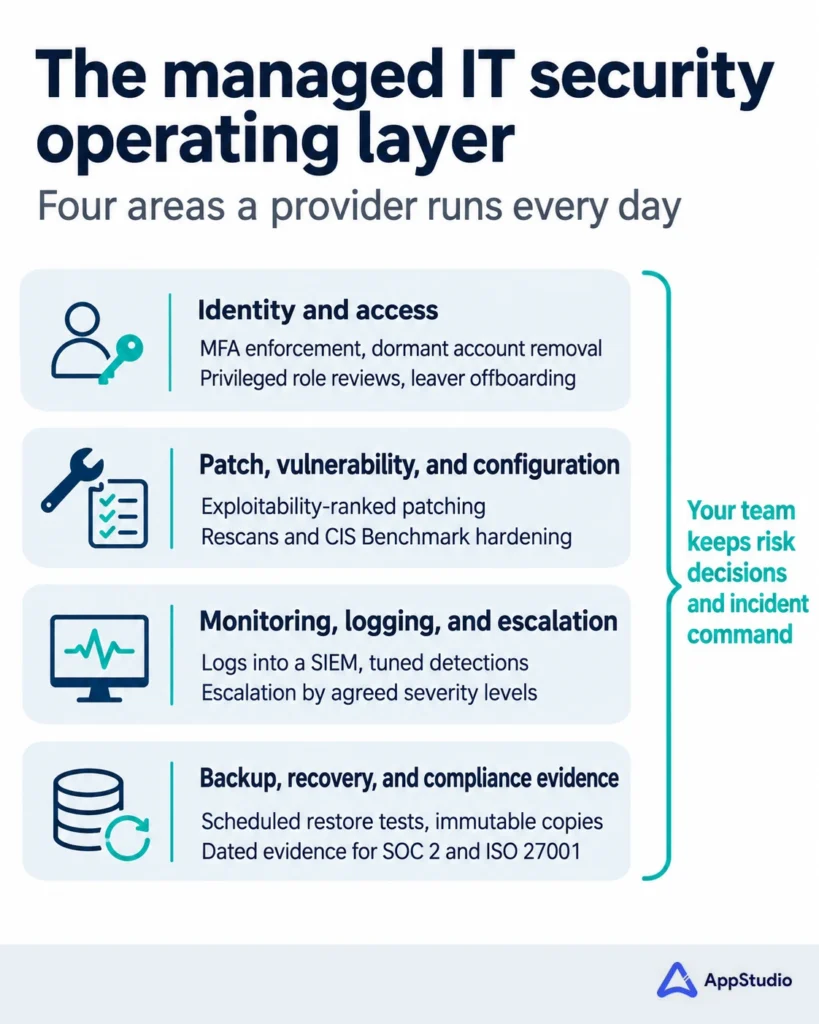
A typical enterprise scope covers four areas.
Identity, endpoints, and access control
Most enterprises run a mix of Microsoft Entra ID or Okta for identity, an EDR agent such as CrowdStrike Falcon or Microsoft Defender on endpoints, and a privileged access tool for admin accounts. The provider enforces MFA, removes dormant accounts, reviews privileged roles on a fixed cycle, brings service accounts, API keys, and AI agents under the same reviews (IBM found fewer than half of breached organizations actively secure these non-human identities), and connects joiner, mover, and leaver events in HR to identity and access management changes. We’d watch the leaver step most closely, because a contractor’s VPN account that outlives the contract is one of the most common findings in an access review.
Patch, vulnerability, and configuration management
Scanning is easy to buy. Closing findings is the hard part: in the same Verizon dataset, organizations fully remediated only 26% of the vulnerabilities on CISA’s Known Exploited Vulnerabilities (KEV) list during 2025, down from 38% a year earlier, and the median time to full remediation rose from 32 to 43 days. IBM’s 2026 research points the same way, with more than half of breached organizations using AI agents for threat detection and containment but only 18% applying them to vulnerability management. A managed provider ranks findings by exploitability (the KEV list is a practical starting filter), patches across servers, laptops, network appliances, and SaaS settings, then verifies the fix with a rescan. Strong vulnerability management also hardens configurations against CIS Benchmarks so the same weakness doesn’t return after the next rebuild.
Monitoring, logging, and escalation
Logs from firewalls, identity providers, cloud consoles, and endpoints feed a SIEM, where analysts tune detections and escalate real incidents to your team on agreed severity levels. Managed IT security owns the plumbing and first-line triage. Deep investigation and containment usually sit with a dedicated detection and response service, which we cover in the next section.
Backup, recovery, and compliance evidence
An untested backup tells you nothing about recovery time. Providers schedule restore tests, keep immutable copies away from the production domain, and document recovery times. The same routine produces the screenshots, tickets, and reports auditors request for SOC 2 or ISO 27001, which saves internal teams weeks before each audit window. Pair this with tested backup and disaster recovery and you can show auditors restore results with dates attached.
Managed IT security vs MSSP vs MDR: where each one starts and stops
The three labels overlap in vendor marketing, which is why buyers end up paying twice for log monitoring or, worse, assuming someone else owns containment. A practical way to draw the line: managed IT security leans toward infrastructure and operational tasks such as firewall configuration, patching, and compliance reporting, while MSSP and MDR offerings center on monitoring, detection, and response.
Model | Main scope | Who contains an active threat | Typical enterprise buyer | Common pricing basis |
Managed IT security | Patching, hardening, identity hygiene, endpoint policy, backup testing, audit evidence | Usually your team or a partner MDR, using runbooks the provider maintains | IT leaders who want controls run consistently across sites and clouds | Per user or per device, often bundled with IT operations |
MSSP | Security device management, SIEM monitoring, alerting, often compliance reporting | Varies by contract; some notify only, some respond | Security teams that need 24/7 coverage without staffing three shifts | Per log source, data volume, or device |
MDR | Threat hunting, investigation, and hands-on containment on endpoints, identities, and cloud | The MDR provider, within pre-approved actions | Organizations whose main gap is response speed after hours | Per endpoint or per user |
Large organizations often combine two of these. A common pattern pairs managed IT security for the operating layer with managed detection and response for containment. We’ve covered the broader operations-versus-security split in our guide to the difference between an MSP and an MSSP, so we won’t repeat it here. If you’re comparing full outsourced security operations instead, read how a managed security service provider scopes 24/7 SOC coverage.
Whatever the mix, write down who isolates a compromised host at 3 a.m. If two contracts each assume the other one does it, nobody does.
Delivery models enterprises use
Choose the model by looking at what your internal team already does well, then hand off what it struggles to do consistently.
Fully managed
The provider runs the operating layer end to end and reports to an IT or security owner on your side. This suits enterprises with a capable infrastructure team but no dedicated security engineers, or business units acquired faster than central IT could absorb them. The trade-off is depth of context: a provider learns your change calendar and business quirks over months, and the first quarter usually brings more escalations than later ones.
Co-managed security alongside an internal team
Your security staff keep architecture, risk acceptance, and incident command. The provider takes the repeatable work: patch cycles, access reviews, alert triage, evidence collection. We think co-managed is the better default for most enterprises with an existing security function, because it protects institutional knowledge while removing the night-and-weekend load that burns out small teams. Some organizations add a virtual CISO when the security leadership seat is vacant or part-time.
Who owns what: a sample RACI
The split below is an illustrative starting point for a co-managed engagement; adjust it to your own org chart before it goes into a contract. R means responsible for doing the work, A accountable for the outcome, C consulted, and I informed.
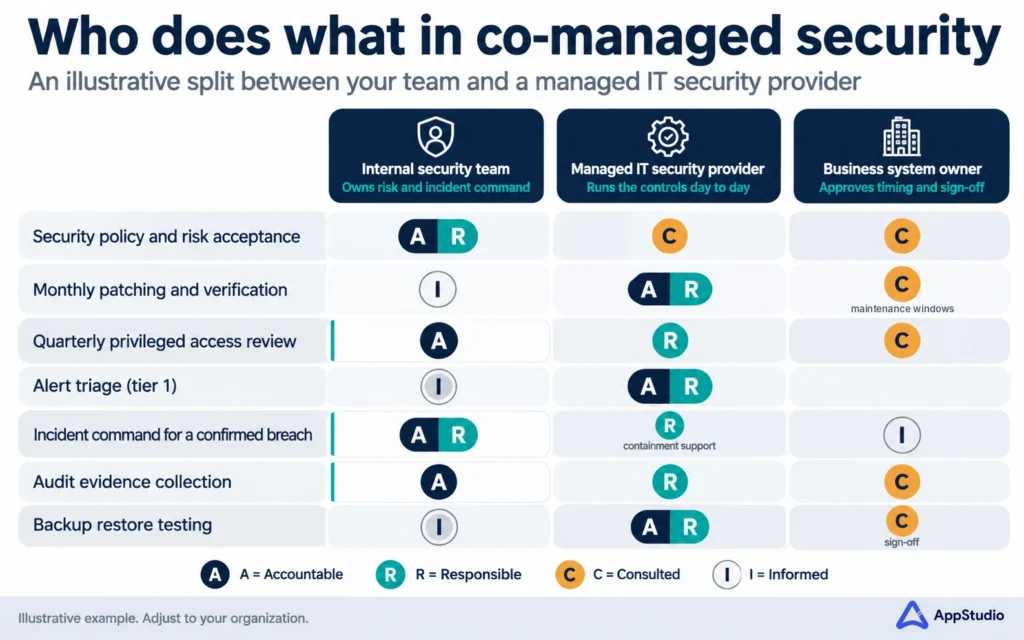
Three details sit behind the letters. The business system owner is consulted on maintenance windows before patches go out, the provider’s role in a confirmed breach is containment support while your team leads, and system owners sign off on backup restore tests.
Illustrative scenario: a critical vulnerability disclosed on a Friday
This is a hypothetical example to show how responsibilities play out. It does not describe a specific client or incident.
A manufacturer runs offices in Toronto (Eastern Time) and Dallas (Central Time), with remote access through a pair of VPN appliances. At 4:10 p.m. ET on a Friday, the appliance vendor publishes a critical advisory for a remote code execution flaw. Most of the internal team has already left for the weekend.
Time (ET) | What happens | Owner |
Fri 4:10 p.m. | Vendor advisory published; provider’s vulnerability feed flags both appliances as affected | Provider |
Fri 4:45 p.m. | Provider confirms exposure, applies the vendor’s interim mitigation, and pages the on-call internal engineer for approval of an emergency change | Provider, internal on-call |
Fri 6:30 p.m. | Emergency change approved; Dallas appliance patched first because it carries fewer weekend users | Provider |
Fri 9:00 p.m. | Toronto appliance patched; rescans confirm both are fixed; VPN logs from the past 14 days are pulled for signs of earlier exploitation | Provider |
Sat 10:00 a.m. | The flaw is added to CISA’s Known Exploited Vulnerabilities catalog; the provider’s log review already shows no suspicious sessions | Provider, internal security lead informed |
Mon 9:00 a.m. | Change record, scan results, and log review attached to the ticket as audit evidence | Provider, internal team reviews |
The sequence depends on things decided months earlier: a pre-approved emergency change path, named on-call contacts in both time zones, and an agreement that the provider may apply vendor mitigations without waiting for Monday. Without those, the same team with the same tools would still be waiting for a change advisory board meeting.
Compliance and regulatory pressure in Canada and the US
The Canadian Centre for Cyber Security names ransomware as the top cybercrime threat to Canada’s critical infrastructure, and regulators on both sides of the border have responded with new obligations. Enterprises operating in Canada and the US answer to overlapping rules, and nearly all of them ask for the same thing in the end: proof that controls ran, with dates. Managed IT security services for enterprises earn much of their value here, because the provider produces that proof as a by-product of the daily work.
Rule or framework | Who it applies to | What it asks of the operating layer |
Private-sector organizations handling personal information in Canada | Report breaches posing a real risk of significant harm to the Privacy Commissioner, notify affected people, and keep a record of every breach of security safeguards, reportable or not | |
Quebec Law 25 | Organizations handling personal information of Quebec residents | Privacy incident register, confidentiality incident reporting, and privacy impact assessments |
Designated operators in federally regulated sectors, including banking, telecommunications, energy, and transportation | A cyber security program covering risk management, third-party risk, and detection, plus incident reports to the Communications Security Establishment within 72 hours; Royal Assent came on June 15, 2026, with Part 2 obligations phasing in as operators are designated | |
US public companies | Disclose a material cybersecurity incident generally within four business days of determining it is material | |
HIPAA Security Rule | US healthcare organizations and their business associates | Administrative, physical, and technical safeguards for electronic health information, plus risk analysis |
PCI DSS v4.0.1 | Any organization storing, processing, or transmitting card data | Vulnerability management, access control, logging, and testing requirements tied to the cardholder data environment |
SOC 2 and ISO/IEC 27001 | Service providers and enterprises seeking attestation or certification | Evidence that defined controls operated consistently over the audit period |
Two caveats are worth stating. The SEC rule was still in force at the time of writing, but banking trade groups have petitioned for its repeal and the Commission opened a review of Regulation S-K in January 2026, so confirm its status with counsel. And a provider never takes on your legal obligations. Canada’s privacy regulator states that when personal information is breached at a third-party processor, the organization that transferred it generally remains responsible for reporting. A provider can run the controls and keep the records, while the decision to notify a regulator stays with your legal and privacy teams.
Most providers map their work to a common control set such as NIST CSF 2.0 or CIS Controls, then cross-reference it to each framework above, so one patch record can serve several audits. If you need help building that mapping, specialist governance, risk, and compliance support keeps the first audit cycle from turning into a month of screenshot hunting.
What managed IT security services cost and how pricing is structured
We won’t quote a universal price range, because published ranges mix 50-seat offices with 20,000-seat enterprises and rarely state what’s included. What we can do is explain the variables that move an enterprise quote.
Most providers price per user or per device per month, with tiers for coverage hours and response commitments. Five factors decide where you land:
- Environment size and spread: users, endpoints, servers, cloud accounts, and the number of sites or countries involved.
- Coverage window: business hours in one time zone costs far less than 24/7 coverage with defined response targets.
- Tool ownership: whether the provider supplies EDR, SIEM, and backup licences or operates the ones you already own.
- Compliance scope: each framework adds evidence collection, control mapping, and audit support hours.
- Data residency: keeping logs and backups in Canadian or specific US regions can limit tool and hosting choices.
The comparison that matters is against the internal cost of doing the same work to the same standard, including night coverage, holidays, and turnover. Skills matter as much as headcount. In IBM’s 2026 Canadian results, a security skills shortage was the second most expensive breach cost factor at an average of C$314,500 per breach, behind only supply chain compromise at C$367,899. In ISC2’s 2025 Cybersecurity Workforce Study, 88% of respondents said their organization had at least one significant security consequence in the past year because of a skills shortage. When you compare quotes, ask each provider to price the same scope sheet, then compare that against your fully loaded internal cost for those tasks.
When outsourcing IT security isn’t the right fit
We’d steer some enterprises away from a full handoff, or at least toward a narrower scope.
If you already run a mature internal SOC with low turnover and documented runbooks, a provider adds overlap more than capacity. Targeted help with patch backlogs or audit evidence may be all you need.
Operational technology is another case. Plant-floor systems, SCADA, and medical devices often can’t be patched on an IT schedule, and a provider without OT experience can cause the outage it was hired to prevent. Ask for named OT engineers, or keep those networks with a specialist.
Strict data residency or classified workloads can also rule out providers whose analysts or tooling sit outside Canada or the US. Confirm where logs are stored and where the people reading them work before you sign.
Then there’s lock-in. A provider that installs its own agents, consoles, and log pipelines can be hard to leave. Insist that detection rules, runbooks, and configuration exports belong to you, with an offboarding clause that spells out the handover. If your team can’t take the work back within 90 days, the contract needs adjusting.
How to evaluate a managed IT security provider
Sales decks look alike. The answers to these questions usually don’t, and they tell you how the provider behaves in month nine rather than week one.
- Response targets: What are your contractual response times by severity, and how do you report against them each month?
- Approved actions: Which actions can your team take without calling us first, such as isolating a laptop, disabling an account, or applying a vendor mitigation?
- Patch measurement: How do you measure patch compliance, and what’s your typical time to remediate a vulnerability listed in CISA’s KEV catalog?
- Escalation path: Who is our named contact, and who covers them at 3 a.m. Eastern on a long weekend?
- Evidence access: Can our auditors pull evidence directly, or does every request go through a ticket?
- Tool and data ownership: If we leave, what do we keep: detection rules, runbooks, logs, configuration exports?
- Analyst location: Where are your analysts based, and where are our logs and backups stored?
- References: Can we speak with a client of similar size in our sector who has been with you for more than two years?
If you’re still deciding whether to move work out of an internal team at all, our guide on moving from in-house IT to managed services covers the timing signals.
Talk it through with our team
If you’re weighing managed IT security services for enterprises across Canadian and US operations, start with a scope sheet: which controls you want run, which you’ll keep, and what evidence your auditors expect. Our team can walk through that split with you and show where enterprise cybersecurity services or co-managed support would fit. Book a consultation when you’re ready to compare options; there’s no obligation to proceed.
What are managed IT security services for enterprises?
Managed IT security services for enterprises are outsourced operations where a provider runs daily security controls, including patching, identity hygiene, endpoint policy, log monitoring, backup testing, and audit evidence, while the enterprise keeps ownership of risk decisions and incident command.
How is managed IT security different from an MSSP?
Managed IT security focuses on running and maintaining controls inside your IT environment. An MSSP centers on security monitoring, alerting, and sometimes response from a security operations center. Many enterprises use both, with a clear written split of who contains an active threat.
Do we still need an internal security team?
In most enterprises, yes. Someone internal has to own policy, accept risk, approve changes, and lead a confirmed incident. A co-managed model lets that team focus on those decisions while the provider handles repeatable work and after-hours coverage.
How long does onboarding take?
It depends on environment size and how many tools need connecting. Expect a phased start: access and asset discovery first, baseline scans and policy alignment next, then steady-state reporting. Ask any provider for a dated onboarding plan before you sign.
Can a provider make us compliant with SOC 2, ISO 27001, or PIPEDA?
A provider can operate the controls and produce the evidence those frameworks require. Compliance itself remains your organization’s responsibility, including decisions about breach notification and the scope of an audit.
What should a managed IT security contract include?
At minimum: severity-based response targets, a list of pre-approved actions, monthly reporting, evidence access for auditors, data location commitments, and an offboarding clause that returns runbooks, rules, and configurations to you.