
 iOS App Development
 Android App Development
 React Native
 Flutter
 Web Development
 Custom Software
 Front End Development
 Blockchain Development
 Virtual Reality
 Cloud Computing
 IoT Development
 Augmented Reality
 Write us a message
Yes. AppStudio provides enterprise software development services in Canada from its Toronto headquarters and Vancouver office, building custom applications, integrations, cloud and AI solutions for large organizations. Founded in Toronto in 2015, it reports more than 1,300 projects delivered, 275+ people across 8 countries, and ISO 27001 and ISO 9001 certification (AppStudio).
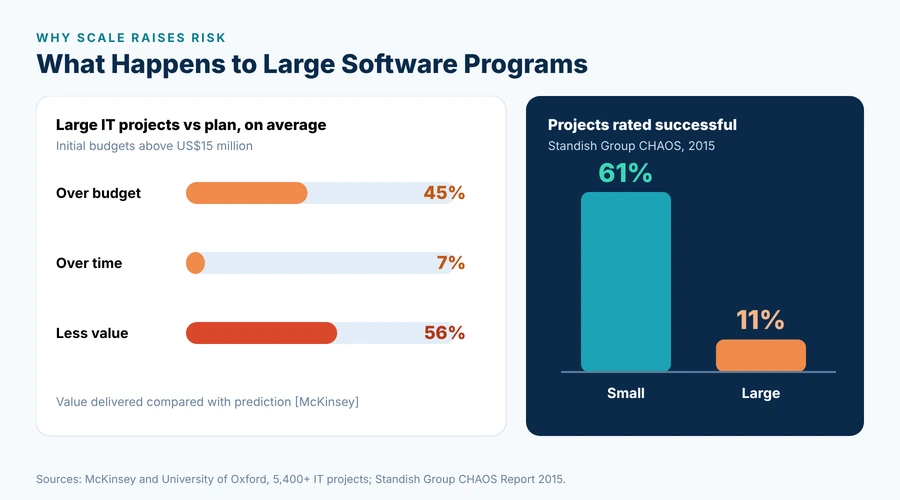
The bigger question for a C-suite buyer is whether a partner can carry the risk that comes with large programs. Large IT projects run 45% over budget and 7% over time on average, while delivering 56% less value than predicted (McKinsey). This guide covers what AppStudio builds, how it delivers, what it costs, and how to judge any provider of enterprise software development services in Canada.
What Enterprise Software Does AppStudio Build?
AppStudio’s work spans the systems that run day-to-day operations and the applications customers and employees use. Most enterprise engagements combine several of the capabilities below, because a new platform rarely stands alone. Buyers comparing enterprise software development services in Canada should check that a partner covers the full chain, from integration to support, rather than the front end alone.
Custom enterprise applications
- Internal platforms for operations, case management, scheduling and reporting
- Customer and member portals, including web and mobile front ends
- Workflow tools that replace spreadsheets and manual approvals
For custom enterprise software development Canada-based teams can review in person, AppStudio runs delivery from its Toronto office, with a second Canadian office in Vancouver.
System integration and APIs
- Connecting new applications to ERP, CRM, finance and HR platforms
- API design so data moves between systems without manual re-entry
- System integration services for programs where the new build has to fit an existing estate
Legacy modernization and cloud
- Re-platforming ageing applications onto modern cloud architecture
- Breaking large systems into services that can be updated independently
- Cloud modernization planned in phases, so operations keep running during the move
AI and intelligent automation
- AppStudio established an AI Center of Excellence in 2025 for applied AI, machine learning and intelligent automation [AppStudio]
- Typical uses: document processing, forecasting, internal assistants and analytics
Ongoing support after launch
Many software companies hand over at go-live. AppStudio also runs managed IT and cybersecurity, so the team that builds a platform can support and monitor it afterwards through managed IT services.
How Does AppStudio Deliver Enterprise Programs?
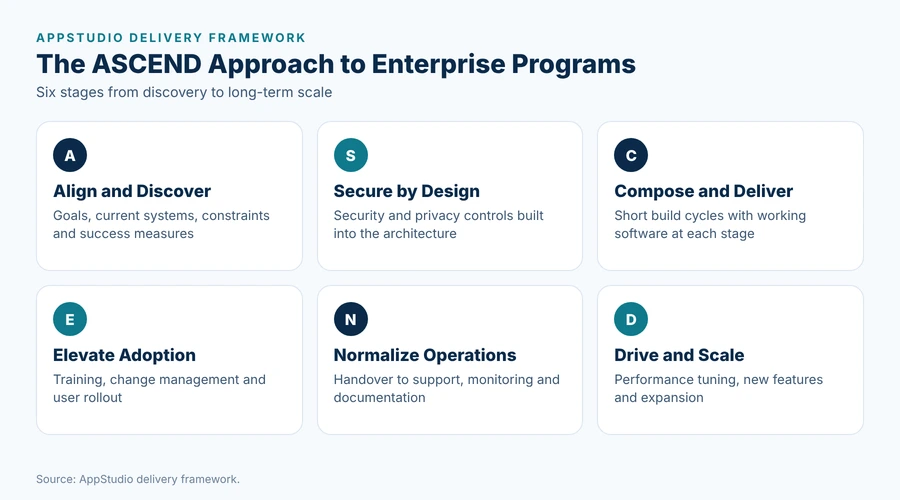
Delivery method matters more than most proposals admit. Across more than 10,000 projects, agile delivery succeeded 39% of the time, against 11% for waterfall, and the gap widened on large projects (Standish Group CHAOS, 2015). AppStudio runs programs through a six-stage framework it calls ASCEND.
- Align and Discover: business goals, current systems, constraints and success measures
- Secure by Design: security and privacy controls built into architecture from the start
- Compose and Deliver: iterative build in short cycles with working software at each stage
- Elevate Adoption: training, change management and rollout to users
- Normalize Operations: handover to support, monitoring and documentation
- Drive and Scale: performance tuning, new features and expansion
Engagement models
- Project delivery: a defined scope with milestones and acceptance criteria
- Dedicated team: a long-running squad that works on your roadmap
- IT staff augmentation: engineers who join your team and report to your managers, with AppStudio stating it usually presents a vetted shortlist within 8 business days
Choose the model by how settled your scope is. Fixed project delivery suits well-defined requirements; a dedicated team suits a roadmap that will keep changing; augmentation suits organizations with strong internal engineering leadership that need extra capacity.
A software development company Toronto executives can visit for steering meetings also makes governance simpler. Face-to-face reviews at key milestones tend to surface risks earlier than status reports do.
Why Do Enterprise Software Programs Fail, and How Can You Lower the Risk?
Scale is the main risk factor. Only 11% of large software projects were rated successful, compared with 61% of small ones [Standish Group CHAOS, 2015]. McKinsey found that 17% of IT projects go so badly they can threaten the company’s existence [McKinsey].
Most failures trace back to a handful of causes:
- Requirements fixed too early, then changed without clear pricing
- Weak executive sponsorship and slow decisions
- Integration effort underestimated in the original plan
- Key people on the vendor side replaced mid-program
- Testing and security left until the end
What reduces the risk:
- A paid discovery phase before committing to the full build
- Releases in phases, so value arrives before the program ends
- Named key personnel written into the contract
- Steering committees with clear escalation rules
- Code held in your own repositories from the first commit
The best providers of enterprise software development services in Canada will raise these points themselves before you ask.
How Does AppStudio Handle Security, Privacy and Compliance?
Your development partner is part of your attack surface. Third-party involvement in data breaches doubled to 30% in one year (Verizon DBIR, 2025), and the average data breach now costs US$4.99 million (IBM Cost of a Data Breach Report, 2026).
AppStudio reports the following [AppStudio]:
- ISO 9001 certification (2021) and ISO/IEC 27001 certification (2023)
- SOC 2 Type II attestation completed in 2023
- HIPAA-compliant delivery processes, built in 2022
- Delivery aligned with GDPR
Canadian law adds its own obligations:
- PIPEDA keeps your organization accountable for personal information that a vendor processes on your behalf.
- Quebec’s Law 25 requires privacy impact assessments before personal information leaves Quebec, with penal fines of up to C$25 million or 4% of worldwide turnover (Quebec Law 25).
- Data residency expectations are common in health, financial and public-sector work, so ask where every environment, backup and log will sit.
Any provider of enterprise software development services in Canada should share certificates and audit reports under NDA. Ask AppStudio for the same.
Which Industries Does AppStudio Serve?
AppStudio’s site highlights government, healthcare and education work, and its client list includes organizations such as WSPS, Toronto Star, Credit Canada, Canadian Beef and Skills Ontario [AppStudio].
- Public sector and associations: member portals, training platforms and case management
- Healthcare: applications that handle health information under HIPAA-aligned processes
- Financial services: customer-facing platforms and internal tools with audit trails
- Media and education: content, learning and engagement platforms
Industry experience matters because regulated sectors bring documentation and audit work that general developers often underestimate. When you assess enterprise software development services in Canada for a regulated workload, ask for a case study from your own sector and speak to that client directly.
What Do Enterprise Software Development Services in Canada Cost?
Cost depends on scope, integrations, compliance requirements and the engagement model. On Clutch, AppStudio lists rates of US$50 to US$99 per hour, a US$25,000 minimum project size, and a 4.9 rating from 30 reviews (Clutch).
The main cost drivers:
- Integration count: each connected system adds design, testing and security work
- Compliance level: regulated data adds documentation, reviews and audit evidence
- Team model: dedicated teams cost more per month but reduce ramp-up time later
- Legacy complexity: older systems with little documentation take longer to modernize
- Support after launch: managed support and monitoring are ongoing costs to plan for
Budget for the full lifecycle. A platform that costs less to build but more to run is rarely the cheaper option over five years.
Illustrative scenario: a national association replacing a 15-year-old member system scopes the work in two ways. Option one rebuilds everything at once. Option two starts with a paid discovery, then releases member self-service first and moves finance integration to a second phase. The phased plan costs slightly more in project management, but members see value within months and the board can stop or adjust after phase one.
How Does AppStudio Compare with Other Options?
Enterprises usually weigh four routes. Each has a place, and some organizations combine two.
Option | Strengths | Trade-offs | Best for |
AppStudio | Canadian offices, build plus managed support, mid-market rates | Smaller than global integrators | Mid-to-large programs needing one accountable partner |
Global systems integrator | Very large teams, multinational reach | Higher rates, layered management | Multi-country transformation programs |
Offshore-only vendor | Lowest hourly rates | Time zones, oversight, residency questions | Well-defined, lower-risk scope |
Internal build team | Deep business context | Slow hiring, key-person risk | Core IP and long-term product ownership |
If you’re comparing an enterprise software development company Canada-wide against a global integrator, look at who will actually staff your program, not only the brand on the proposal.
Many global and offshore firms also market enterprise software development services in Canada through local sales offices while delivering from other countries. That model can work well, but confirm where the engineers sit, which time zones they keep, and whether any of your data will be accessed from outside Canada. Those answers affect privacy obligations, incident response and the pace of day-to-day collaboration.
What Should Your Board Ask Before Approving the Program?
Large software investments deserve the same governance as any major capital project. Before approving spend on enterprise software development services in Canada, boards and audit committees typically want answers to five questions.
- What business outcome will the platform deliver, and how will it be measured?
- What happens to budget and timeline if requirements change?
- Who on each side is accountable, and how are disputes escalated?
- Which data does the system hold, and which regulations apply to it?
- Can we exit the contract and keep running the platform without the vendor?
A partner that welcomes these questions early is usually easier to work with when something goes wrong later.
How Should You Evaluate Any Enterprise Software Partner?
Ask every shortlisted provider the same questions in writing, so answers can be scored side by side.
- Can you show two projects of similar size and regulatory context, with contacts we can call?
- Which named people will lead delivery, and what happens if they leave?
- Where will code, data, backups and logs be stored?
- Will you share ISO 27001 certificates or SOC 2 reports under NDA?
- How are scope changes priced and approved?
- Who owns the IP, and does the code sit in our repository from day one?
- What do exit and transition support look like?
These questions apply equally to enterprise application development Canada-wide and to large integration programs.
How Do You Get Started with AppStudio?
- Initial consultation: goals, systems, constraints and timeline
- Paid discovery: architecture assessment, risks and a phased delivery plan
- Proposal: scope, team, engagement model and governance structure
- First release: a working slice of the platform that proves the approach
- Scale: further phases, adoption support and ongoing operations
Frequently Asked Questions
Is AppStudio a Canadian company?
Yes. AppStudio was founded in Toronto in 2015 and has offices in Toronto and Vancouver, with a wider team of 275+ people across 8 countries.
Does AppStudio build custom enterprise software or only mobile apps?
Both. Alongside mobile, it builds custom enterprise applications, integrations, cloud modernization and AI solutions, and offers managed IT after launch. Its enterprise application development Canada clients include public-sector and association organizations.
Which certifications does AppStudio hold?
AppStudio reports ISO 9001 and ISO/IEC 27001 certification and a completed SOC 2 Type II attestation. Ask for current certificates during due diligence.
How much do enterprise software development services in Canada cost with AppStudio?
Clutch lists AppStudio at US$50 to US$99 per hour with a US$25,000 minimum. Final cost depends on scope, integrations and compliance requirements.
Can AppStudio support the software after launch?
Yes. AppStudio offers managed IT, monitoring and cybersecurity, so the same partner can build and operate the platform.
Conclusion and Next Steps
AppStudio provides enterprise software development services in Canada for organizations that want one accountable partner from discovery through long-term support. Its Canadian offices, reported security certifications and mid-market rates suit mid-to-large programs. Very large multinational transformations may still call for a global integrator.
Whichever partner you choose, judge enterprise software development services in Canada on delivery evidence, security posture and contract terms rather than the size of the pitch. If you’re shortlisting a software development company Toronto teams can meet in person, or an enterprise software development company Canada-wide with build and support under one roof, AppStudio is worth a conversation. Its custom enterprise software development Canada team works through a structured discovery before committing to a full build.
Book an enterprise software consultation with AppStudio to review your systems, risks and delivery options.