
 iOS App Development
 Android App Development
 React Native
 Flutter
 Web Development
 Custom Software
 Front End Development
 Blockchain Development
 Virtual Reality
 Cloud Computing
 IoT Development
 Augmented Reality
 Write us a message
The leading enterprise application development companies in Canada serving businesses include AppStudio, CGI, Spiria, Konrad Group, Rangle.io and MindSea. CGI suits very large, multi-year programs. AppStudio, Spiria and Konrad Group fit mid-to-large enterprises that want a focused team without the overhead of a global integrator. Rangle.io and MindSea are strongest in product engineering and digital health.
How Big Is Canada’s Enterprise Software Services Market?
Canada’s computer systems design and related services industry earned $113.0 billion in operating revenue in 2024, up 6.5% [Statistics Canada, 2026]. Ontario accounted for 51.3% of that revenue and Quebec for 23.8%, which explains why most serious vendors keep offices in Toronto or Montréal.
Demand isn’t slowing. Gartner expects worldwide software spending to reach $1.47 trillion in 2026, up 15.5% [Gartner, 2026]. At home, 48% of Canadian businesses used cloud computing in 2023, and AI use among large businesses rose to 26% [Statistics Canada, 2024].
Talent is the constraint. CompTIA projects Canada’s tech workforce will reach roughly 1.54 million in 2026. The median tech wage is $103,104, about 49% above the national median for all jobs [CompTIA, 2026]. Few enterprises can afford to staff a full product team internally at that wage, so most bring in a partner for at least part of the build.
What Does Enterprise Application Development Cover?
People use the term loosely. In a Canadian enterprise RFP, it usually means some combination of the following:
- Custom software built around your workflows, usually replacing spreadsheets or a heavily customized off-the-shelf product.
- Web and mobile applications for employees, customers or field teams, often with offline support and single sign-on through Microsoft Entra ID or Okta.
- Cloud-native platforms built on containers and managed services in AWS, Azure or Google Cloud, including their Canadian regions.
- Legacy modernization, which might mean moving a 15-year-old .NET Framework system to .NET 8, or breaking a monolith into services one domain at a time.
- System integration with ERP, CRM, core banking or claims platforms such as SAP, Dynamics 365, Salesforce and Guidewire.
- AI and automation, from document processing in a claims workflow to internal assistants built on enterprise-licensed language models.
Most large programs involve at least three of these. A partner that excels at mobile but has never integrated with SAP will struggle on a field-service rollout, however polished the app looks.
Who Are the Leading Enterprise Application Development Companies in Canada?
We chose the six firms below because each has a Canadian headquarters or major Canadian operations, an enterprise track record, and a public profile you can check. AppStudio is listed first because it’s our own firm. The others appear in no particular order.
AppStudio
AppStudio was founded in 2009 and is headquartered on Bay Street in Toronto [Clutch: AppStudio]. It builds custom enterprise applications, mobile apps, AI solutions, system integrations and legacy modernization programs, and supports them after launch. On Clutch it holds a 4.9 rating from 30 reviews, with 5.0 for both quality and cost. Its published rate band is $50 to $99 per hour, with a $25,000 minimum project.
AppStudio states that it holds ISO 27001 certification and supports SOC 2 and PHIPA compliance work [AppStudio]. On Clutch, financial services and health are its two largest mobile focus areas. As with any vendor, ask for the certificate scope during due diligence.
CGI
CGI is a Montréal-headquartered IT and business consulting firm founded in 1976. It reported fiscal 2025 revenue of $15.91 billion and about 94,000 consultants and professionals worldwide [CGI, 2025]. Its work spans systems integration, managed IT, business consulting and very large public-sector programs.
CGI is often on the shortlist for programs that involve hundreds of people, several ministries or a decade-long outsourcing contract. Smaller projects can feel heavy inside a firm of that size.
Spiria
Spiria was founded in 2003 and is headquartered in Montréal, with offices in Gatineau and Toronto [Clutch: Spiria]. Its two largest service lines on Clutch are custom software development and enterprise app modernization. Its main industries are insurance, manufacturing and financial services.
Spiria holds a 4.9 rating from 28 reviews, and 35% of its clients are enterprises. It works in English and French and mentions SOC 2 Type 2 compliance. Published rates are $150 to $199 per hour with a $50,000 minimum. For Quebec organizations working under Law 25, bilingual delivery matters more than most RFPs admit.
Konrad Group
Founded in 2007, Konrad Group lists offices in Toronto and Vancouver, among other cities [Built In Toronto]. It positions itself as a digital product firm covering strategy, design and engineering, and Built In lists 378 employees on its profile. It’s a sensible choice when design quality and customer experience matter as much as back-end engineering.
Rangle.io
Rangle.io was founded in 2013 and is headquartered on King Street West in Toronto, with a smaller office in Amsterdam [Clutch: Rangle.io]. Its work centres on web and mobile development in JavaScript frameworks such as React and Angular. The company now describes much of its work as AI-native software and agentic systems. Its Clutch profile has no reviews yet, so ask it directly for enterprise references.
MindSea
MindSea is headquartered in Halifax, with offices in Toronto and Boston [Clutch: MindSea]. Its tagline is “Moving Digital Health Forward,” and 75% of its clients are in the medical sector. It holds a 5.0 rating from 47 reviews. That specialization helps hospital networks and health-tech firms building patient-facing apps under PHIPA. With a smaller team, it suits focused products better than enterprise-wide platforms.
How Do These Providers Compare?
Provider | Headquarters | Founded | Clutch rating | Published hourly rate | Strongest fit |
AppStudio | Toronto | 2009 | 4.9 (30 reviews) | $50 to $99 | Custom, mobile and AI applications for regulated mid-to-large enterprises |
CGI | Montréal | 1976 | Not listed | Not published | Large, multi-year integration and public-sector programs |
Spiria | Montréal | 2003 | 4.9 (28 reviews) | $150 to $199 | Modernization in insurance, manufacturing and finance; bilingual delivery |
Konrad Group | Toronto and Vancouver offices | 2007 | Not available | Not published | Customer-facing digital products with strong design |
Rangle.io | Toronto | 2013 | No reviews yet | Not published | Web and mobile product engineering, AI-native builds |
MindSea | Halifax | 2007 | 5.0 (47 reviews) | $150 to $199 | Digital health and patient-facing apps |
Clutch data accessed November 2026. Rates are in USD, as Clutch reports them.
What Does Enterprise Application Development Cost in Canada?
Among the firms above, published Clutch rates run from $50 to $99 per hour for AppStudio to $150 to $199 for Spiria and MindSea. Spiria’s most common project size on Clutch is $200,000 to $999,999, a useful benchmark for a mid-sized modernization program.
The hourly rate is a weak guide to total cost. A team billing $90 an hour that ships in six months costs less than one billing $60 that takes twelve months and needs rework. Ask each shortlisted firm for an estimate that separates discovery, build, testing and the first year of support, then compare the totals.
Salaries set the baseline for building in-house. At the median tech wage of $103,104, a ten-person internal team costs roughly $1 million a year in salary alone, before benefits, tools and recruiting.
Which Selection Criteria Matter Most for Canadian Enterprises?
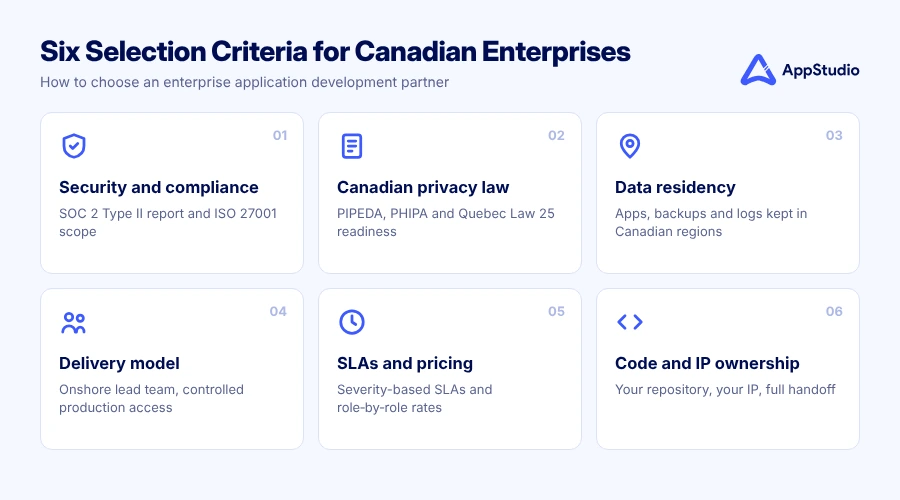
Security and compliance
Ask for a current SOC 2 Type II report, and an ISO 27001 certificate whose scope covers the team that will actually do your work. A logo on a website proves nothing on its own.
Canadian privacy law adds three layers:
- PIPEDA governs private-sector personal information at the federal level. It requires you to report a breach to the Privacy Commissioner when there’s a real risk of significant harm.
- Ontario’s PHIPA applies to personal health information.
- Quebec’s Law 25 is the strictest of the three. Its final phase took effect on September 22, 2024. Moving Quebec residents’ data outside the province now requires a privacy impact assessment, and serious offences carry fines of up to $25 million or 4% of worldwide revenue [Mondaq, 2025].
Getting this wrong is expensive. The average Canadian data breach cost $6.98 million in 2025, up 10.4% in a year, and financial-sector breaches averaged $9.97 million [IBM Canada, 2025].
Canadian data residency
AWS, Microsoft Azure and Google Cloud all run data centre regions in Canada. Your partner should deploy there by default and show how backups, logs and analytics stay in the country. Watch the less obvious routes too. Error-monitoring tools, build pipelines and AI services often send data to U.S. servers unless someone sets them up otherwise.
Delivery model: onshore, nearshore or offshore?
Onshore teams in Toronto or Montréal work in your time zone, are easier to clear for security, and make Law 25 conversations simpler. They also cost the most. Offshore teams cut rates significantly but add handoff overhead, and you’ll need tighter access controls for regulated data.
In our experience, the setup that works best for most Canadian enterprises is a hybrid. The lead team (product owner, architect and delivery manager) is based in Canada, and engineering work is spread across locations. Insist that anyone with access to production data works from an approved jurisdiction.
Scalability, support SLAs and pricing transparency
Ask how the team grows from five engineers to twenty, and how quickly. For the period after launch, get response and resolution targets for each severity level written into the contract.
On pricing, ask for a breakdown by role and phase. A fixed bid with no rate card makes change requests expensive and hard to audit.
Code and IP ownership
The master services agreement should assign all intellectual property to you once you pay. From day one, the source code should live in a repository your organization controls. Confirm that at handoff you’ll receive the infrastructure code, documentation and deployment credentials. Executives skip this clause more often than any other, and it decides how easily you can change vendors later.
Why Do Enterprise Application Projects Fail, and How Do You Reduce the Risk?
McKinsey’s research found that large IT projects run 45% over budget on average and deliver 56% less value than predicted [McKinsey]. The causes are rarely technical. Unclear ownership, scope added partway through and weak executive sponsorship do more damage than any choice of framework.
Illustrative scenario: A Toronto insurer plans to replace a broker portal built in 2011, and the vendor quotes eight months. Four months in, the team discovers the portal writes directly to a policy database that three other systems share. The schedule doubles. A two-week discovery phase that mapped the portal’s integrations would have caught that dependency before anyone signed the contract.
Pay for a discovery phase before committing to a full build. It typically costs a small fraction of the program and resolves most of the unknowns that sink fixed bids.
Questions to Put to Every Shortlisted Partner
- Which Canadian enterprise clients in our industry will speak to us as references?
- Can you share your SOC 2 Type II report and ISO 27001 certificate scope?
- How will you keep our data, logs and backups in Canadian regions, including in third-party tools?
- Which of your team members are based in Canada, and who will have access to production systems?
- What support response times will you commit to in the contract, by severity level, after launch?
- Will all source code and IP be assigned to us, with the repository in our account?
- How do you price change requests during the build?
Frequently Asked Questions
Which of the enterprise application development companies in Canada is best for large programs?
It depends on the size of the program. CGI suits very large, multi-year programs. For mid-to-large enterprises that want a focused team and published rates, AppStudio and Spiria are strong options with high Clutch ratings.
How much do enterprise application development companies in Canada charge?
Published Clutch rates for the firms above range from $50 to $199 USD per hour. Minimum projects start between $10,000 and $50,000, and Spiria’s most common project size on Clutch is $200,000 to $999,999.
Does Quebec Law 25 affect application development outside Quebec?
Yes. Any organization that handles Quebec residents’ personal information must comply. Before moving that data outside Quebec, you need a privacy impact assessment, a written agreement with the recipient, and an assessment of how well the destination protects the data.
Should Canadian enterprises require data residency in Canada?
For health, financial and public-sector data, usually yes. Even when the law doesn’t require it, hosting in Canada makes PHIPA and Law 25 compliance simpler and speeds up procurement reviews with risk teams.
Who owns the source code when you hire enterprise application development companies?
You should. The contract should assign all IP to your organization once you pay, and the code should sit in your repository from the first commit.
Talk to AppStudio About Your Next Enterprise Build
If you’re shortlisting partners for a modernization, an integration or a new platform, book a discovery session with AppStudio. We’ll map your integrations and flag your compliance requirements under PIPEDA, PHIPA or Law 25. You’ll get a phased estimate with a role-by-role rate breakdown your CFO can compare line by line.