
 iOS App Development
 Android App Development
 React Native
 Flutter
 Web Development
 Custom Software
 Front End Development
 Blockchain Development
 Virtual Reality
 Cloud Computing
 IoT Development
 Augmented Reality
 Write us a message
Logistics runs on timing. A carrier’s tender has to reach the TMS before the cut-off, a warehouse scanner has to update inventory as the pallet moves, and a customs filing has to clear before the truck reaches the border. More of that work now lives in the cloud, which gives logistics teams something they’ve wanted for years: room to scale for peak season, real-time visibility for customers, and systems that can be reached from any dock, yard or office.
Getting the most from that cloud depends on who runs it. When logistics enterprises compare managed cloud services for logistics, six areas matter most:
- 24/7 operations and monitoring
- Cost management (FinOps)
- Security and compliance
- Integration with WMS, TMS and EDI
- Resilience and recovery
The best providers are strong in all six and can show evidence for each one.
Each area below includes what good looks like. After that comes a scoring model you can run with your own weights, and the questions our cloud team would want answered before any logistics company signs.
Managed Cloud Services for Logistics: Six Areas at a Glance
Service area | What strong looks like | Logistics example |
24/7 operations and monitoring | On-call engineers, defined severity levels, post-incident reviews | Alerting on EDI queue backlogs at 3 a.m., before the morning dispatch run |
Cost management (FinOps) | Anomaly alerts, rightsizing, showback by team or customer | Seeing cloud cost per shipment or per warehouse |
Security and compliance | Identity baselines, encryption, logging, evidence mapped to frameworks | Controlled access for carriers, brokers and 3PL partners |
Integration support | Experience with WMS, TMS, EDI, carrier APIs and telematics | Keeping carrier rate APIs and ELD feeds flowing during a cloud change |
Resilience and recovery | Cross-region backup, tested restores, clear recovery targets | Shipment tracking back online within hours of a regional outage |
Migration and modernization | Phased plans with cutover and rollback, post-migration tuning | Moving an on-premises WMS to the cloud without stopping a distribution centre |
1. 24/7 Operations and Monitoring
Freight doesn’t keep office hours, so the cloud behind it shouldn’t either. A provider worth shortlisting watches compute, databases, storage and network edges around the clock. It should also have named severity levels and an escalation path your operations manager can read in one page.
What separates good from great in logistics is what the provider chooses to monitor. CPU and memory alerts are table stakes. The providers we’d rank highest also watch business signals: EDI message queues, API error rates from carrier integrations, and the sync between handheld scanners and the WMS. A spike in failed 214 status messages tells you more about customer impact than any server graph.
2. Cost Management and FinOps
Cloud spend is the challenge organizations name most often, and it responds well to steady attention. In Flexera’s 2025 State of the Cloud survey of more than 750 technical leaders, 84% named managing cloud spend as their top cloud challenge, and cloud budgets were running 17% over plan (Flexera). The same survey found 59% of organizations expanding their FinOps teams, which shows how quickly the discipline is maturing.
For a logistics company with a $1.2 million annual cloud budget, a 17% overrun works out to:
$1,200,000 × 0.17 = $204,000 a year above plan
That’s money a well-run FinOps practice can often bring back into the business. When you compare providers, look for:
- Anomaly alerts that catch a runaway workload within hours
- Regular rightsizing reviews
- Reporting that shows cost by business unit, warehouse or customer account
Logistics margins are thin, so knowing your cloud cost per shipment is a real advantage when you price contracts.
Peak Season Scaling
Seasonal demand is where cloud pays off most clearly for logistics. Instead of buying infrastructure for the busiest six weeks of the year, a logistics enterprise can scale up for Black Friday or produce season and back down again in January.
Here’s an illustrative example. A 3PL normally runs 40 application servers and needs 120 during a six-week peak:
- Sized for peak all year: 120 servers × 52 weeks = 6,240 server-weeks
- Scaled to demand: (40 × 46 weeks) + (120 × 6 weeks) = 1,840 + 720 = 2,560 server-weeks
- Difference: 3,680 fewer server-weeks, about 59% less capacity paid for across the year
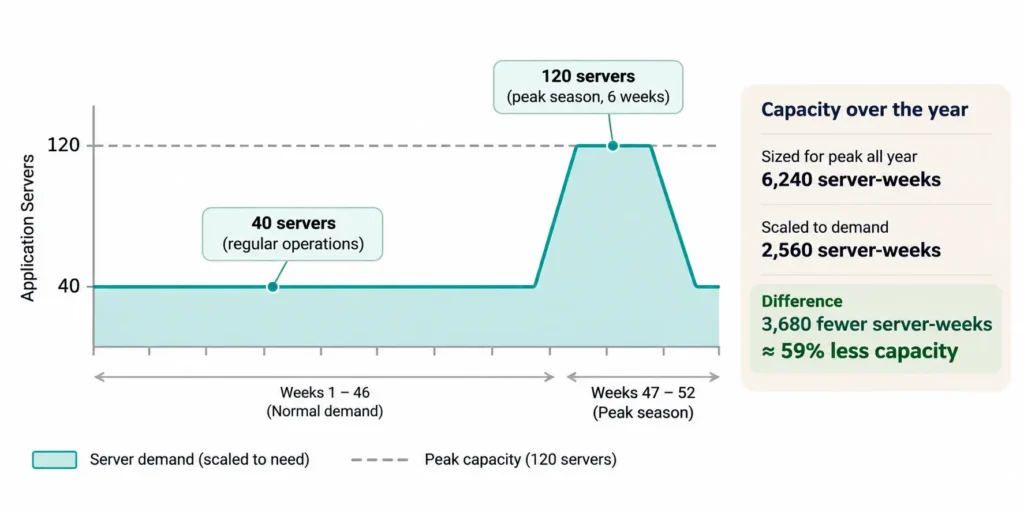
Those numbers are a simplified model, and real savings depend on pricing, reserved capacity and how quickly each application can scale. The point holds, though: ask every provider how they plan peak capacity, when they load test, and who watches the platform during your busiest weeks.
3. Security and Compliance
Logistics platforms connect many outside parties: carriers, customs brokers, freight forwarders, retailers and drivers on mobile devices. Strong cloud security starts with identity. Look for a provider that does all of the following:
- Sets up identity baselines
- Enforces least-privilege access for partners
- Encrypts data
- Centralizes logging
- Segments networks
Ask how the provider maps its controls to the frameworks your customers ask about. Enterprise shippers increasingly send security questionnaires before awarding contracts. A provider that can hand you evidence mapped to SOC 2 or ISO 27001 can shorten that review considerably.
For Canadian operations, data location is part of this conversation. AWS now runs two Canadian regions, including its Canada West region in Calgary, which opened in December 2023 with three Availability Zones (AWS). That makes it easier to keep both production and backup copies inside Canada if your customers or contracts call for it.
4. Integration With Logistics Systems
This is where managed cloud services for logistics differ most from general cloud support. A logistics cloud estate includes the WMS, the TMS, EDI translators, carrier rate and tracking APIs, telematics and ELD feeds, customer portals, and increasingly government systems.
Canada’s CARM system is a good example. Since October 21, 2024, CARM has been the CBSA’s official system for assessing and collecting duties and taxes on commercial imports. Importers use the CARM Client Portal to manage accounting documents and notifications (CBSA). Brokers and importers that connect their own platforms to processes like these benefit from a cloud partner who understands how a change on one side affects the other.
Ask providers which logistics platforms they’ve supported, how they test integrations after a cloud change, and whether they can build or adjust the connectors themselves.
5. Resilience and Recovery
Recovery planning gets a lot of attention in logistics, and February 2022 is one reason why. That month, Expeditors shut down most of its operating systems globally after a cyberattack, which sharply limited its ability to book freight and handle customs clearance for clients (Expeditors). The episode gave the whole sector a clearer picture of what good preparation looks like.
The strongest managed cloud providers set recovery targets per system, keep backups across regions or accounts, and test restores on a schedule. For logistics, prioritize the systems customers see first: tracking, order intake and dock scheduling. If your provider also offers managed backup and disaster recovery, cloud operations and recovery planning can sit under one plan.
6. Migration and Modernization
Many logistics enterprises still run a core WMS or ERP on premises, often with good reason. Moving it is a project worth doing carefully, and the best providers make it calm and predictable. Look for a phased plan that includes:
- An assessment
- A clear choice between rehosting, replatforming and refactoring for each application
- Rehearsed cutovers with a rollback plan
- Tuning after go-live
Ask when the cutover would happen. A provider that schedules a WMS migration for a Sunday in mid-February, rather than the week before a major retail event, understands how your business works.
How to Score Providers Side by Side
A weighted scorecard turns six conversations into one decision when you’re comparing managed cloud services for logistics. Give each area a weight that reflects your priorities, score each provider from 1 to 5, and multiply.
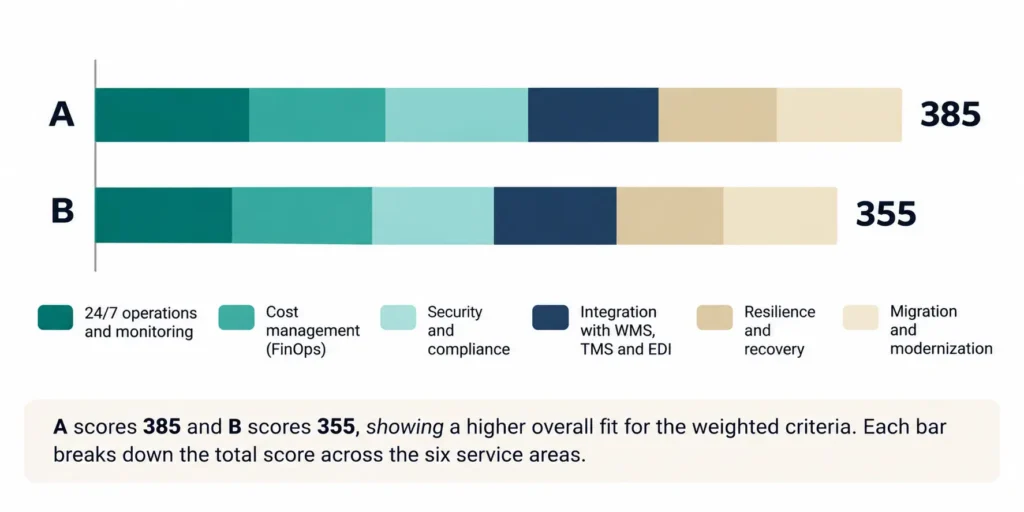
Here’s an illustrative example for a mid-sized 3PL comparing two providers:
Service area | Weight | Provider A score | Provider A weighted | Provider B score | Provider B weighted |
24/7 operations and monitoring | 25 | 4 | 100 | 3 | 75 |
Cost management (FinOps) | 20 | 3 | 60 | 5 | 100 |
Security and compliance | 20 | 5 | 100 | 3 | 60 |
Integration with logistics systems | 15 | 3 | 45 | 4 | 60 |
Resilience and recovery | 10 | 4 | 40 | 3 | 30 |
Migration and modernization | 10 | 4 | 40 | 3 | 30 |
Total (out of 500) | 100 |
| 385 (77%) |
| 355 (71%) |
Provider B wins on cost management, but Provider A comes out ahead because it’s stronger in the areas this company weighted most. Change the weights and the answer can change, which is exactly why the exercise is worth doing with your own priorities. We’d suggest giving 24/7 operations the highest weight for most logistics businesses, since that’s where customer impact shows up first.
Questions to Ask Every Managed Cloud Provider
- Which logistics systems, such as WMS, TMS, EDI and carrier APIs, have you supported in production?
- What business-level signals do you monitor, beyond infrastructure metrics?
- How will we see cloud cost by warehouse, business unit or customer?
- How do you plan and test capacity before our peak season?
- Which frameworks do you map security evidence to, and can we see a sample?
- Where will our production data and backups be stored?
- What are the recovery targets for our customer-facing systems, and when were they last tested?
- How do you work alongside our internal IT or development team?
How AppStudio Supports Logistics Cloud Operations
AppStudio’s managed cloud services cover AWS, Microsoft Azure and Google Cloud, including hybrid and multi-cloud estates. Logistics, supply chain and transportation is one of the industries we support. Our managed cloud services for logistics teams include:
- Landing zones with identity baselines, networking and infrastructure as code, so new environments are consistent from day one
- Migration and modernization with assessment, cutover and rollback plans, and post-migration tuning
- FinOps with usage monitoring, anomaly alerts, rightsizing, budget guardrails and showback reporting
- Security covering identity, encryption, logging and network segmentation, with evidence mapped to SOC 2 and ISO 27001
- 24/7 monitoring with defined severity levels, escalation paths and post-incident reviews, following ITIL-aligned change and incident practices
- Managed Kubernetes and containers, plus backup, retention and cross-region recovery where required
Monitoring for most estates begins within days. Full landing-zone and migration programs run on a phased plan over several weeks, depending on scope. Because AppStudio also builds custom software, the same partner that runs your cloud can build or update the portals, apps and integrations that sit on top of it.
AppStudio has delivered 1,300+ projects since 2015. It holds ISO 9001 and ISO/IEC 27001 certifications and a SOC 2 Type II attestation.
Frequently asked questions
What managed IT services should logistics enterprises compare for cloud management?
Compare six areas:
- 24/7 operations and monitoring
- Cost management (FinOps)
- Security and compliance
- Integration with WMS, TMS and EDI systems
- Resilience and recovery
- Migration and modernization
Weight each area by business impact and score providers against the same criteria.
What are managed cloud services for logistics?
They’re ongoing services in which a provider runs and improves a logistics company’s cloud environment. That includes monitoring, cost control, security, backup and support for logistics platforms such as warehouse and transportation management systems.
How can logistics companies reduce cloud costs?
Start with visibility: tag resources by warehouse, business unit or customer, set anomaly alerts, and review rightsizing regularly. Scaling capacity up for peak season and back down afterward is often the biggest single opportunity.
Can a managed cloud provider support EDI and carrier integrations?
The strongest ones can. Ask for examples of WMS, TMS, EDI and carrier API integrations they have supported, and how they test those connections after cloud changes.
Should Canadian logistics companies keep data in Canada?
It depends on your contracts, customers and the type of data. Canadian cloud regions from major providers, including AWS’s Calgary region, make it practical to keep production and backup data in the country when required.
How long does it take to move to a managed cloud provider?
Monitoring can often begin within days. Full migrations depend on the number of applications and their complexity, and are best planned in phases around your peak seasons.
Build a Cloud That Moves at the Speed of Your Freight
The logistics companies getting the most from the cloud treat it as an operating partnership. That means clear monitoring, steady cost management, tested recovery and a provider who understands how freight actually moves. Compare managed cloud services for logistics on the six areas above, score them against your own priorities, and you’ll have a partner that helps you scale with confidence.
If you’re reviewing your cloud setup or planning a migration, book a free 30-minute call with AppStudio. We’ll look at your current environment, talk through your peak season plans, and map the managed cloud approach that fits your network.