
 iOS App Development
 Android App Development
 React Native
 Flutter
 Web Development
 Custom Software
 Front End Development
 Blockchain Development
 Virtual Reality
 Cloud Computing
 IoT Development
 Augmented Reality
 Write us a message
The best managed IT services for Canadian enterprises combine 24×7 operations, managed security, tested recovery and compliance support in one contract with one accountable provider. They are delivered with Canadian data residency and measurable service levels. For large organizations, the provider’s ability to support PIPEDA, Quebec’s Law 25 and, in financial services, OSFI Guidelines B-10 and B-13 matters as much as its technical depth.
This guide covers:
- The seven managed services that carry the most business risk
- The Canadian regulations that now shape managed IT contracts
- Operating and pricing models, with their trade-offs
- How to evaluate providers, including the questions most rankings leave out
Key Takeaways for Executive Leadership
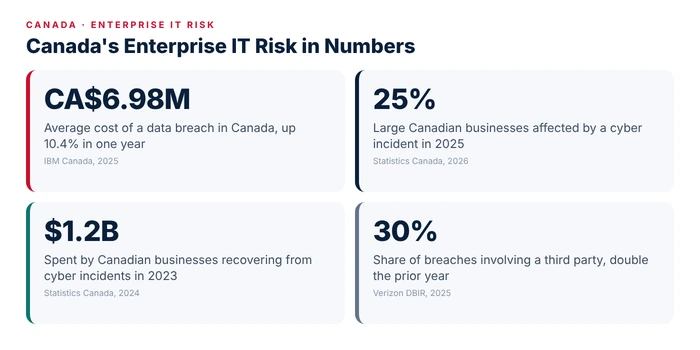
- In 2025, 25% of large Canadian businesses were affected by a cyber security incident, compared with 16% of all businesses [Statistics Canada, 2026].
- The average data breach in Canada cost CA$6.98 million in 2025, up 10.4% from the year before [IBM Canada, 2025].
- Worldwide, the share of breaches involving a third party doubled to 30% [Verizon DBIR, 2025]. Your managed service provider is one of the ways attackers can get in.
- For federally regulated financial institutions, OSFI expects third-party arrangements entered on or after May 1, 2024 to meet Guideline B-10 [Blakes, 2023].
- Service level agreements should be written around business services, with targets for restoring service as well as for responding.
Why Canadian Enterprises Are Rethinking Managed IT
Managed IT used to be treated mainly as a cost. It is now a risk decision, for three reasons.
Large organizations face the most cyber exposure
- In 2025, 25% of large businesses were affected by cyber incidents, compared with 21% of medium and 15% of small businesses [Statistics Canada, 2026].
- In 2023, Canadian businesses spent about $1.2 billion recovering from cyber incidents, double the 2021 figure. They spent $11.0 billion on prevention and detection [Statistics Canada, 2024].
- 34% of businesses had cyber insurance in 2025, up from 22% in 2023 [Statistics Canada, 2026]. Insurers increasingly expect evidence of the security controls your provider runs.
Breach costs in Canada are rising while global costs fall
- The Canadian average rose from CA$6.32 million in 2024 to CA$6.98 million in 2025 [IBM Canada, 2025].
- Organizations that make heavy use of AI and automation took 118 days on average to identify a breach, compared with 162 days for those that don’t [IBM Canada, 2025].
- Breaches involving unapproved AI tools used by staff (“shadow AI”) cost an extra CA$308,000 per incident. One in three Canadian businesses reported having no access controls on AI systems [IBM Canada, 2025].
An hour of downtime can now cost millions
- 41% of enterprises put the cost of one hour of downtime between US$1 million and over US$5 million [ITIC, 2024].
- 57% of organizations said their most recent major outage cost more than US$100,000 [Uptime Institute, 2026].
The 7 Managed IT Services That Matter Most
Proposals to enterprise buyers often list dozens of services. These seven carry the most operational and regulatory risk, so specify each one in detail.
1. 24×7 Infrastructure and Cloud Operations
- Monitoring and management of servers, networks, and Microsoft 365, Azure, AWS and Google Cloud environments
- Capacity planning, patching and configuration management
- Availability targets for each business service, measured from the user’s side
2. Managed Security and Security Operations (SOC)
- 24×7 detection and response across endpoints, identity, email and cloud
- Defined targets for detecting, containing and reporting incidents
- Vulnerability management, with patch deadlines by severity
3. Backup, Disaster Recovery and Business Continuity
- A maximum acceptable data loss (RPO) and recovery time (RTO) for each tier of applications
- Backups that can’t be altered or that are kept offline, so you can recover from ransomware
- Restore tests on a fixed schedule, with written results
4. Enterprise Service Desk
- Support in English and French where your workforce needs it
- Response and resolution times by priority, with a 24×7 path for critical incidents
- User experience measures such as first-contact resolution and satisfaction scores
5. Network and Multi-Site Connectivity
- Management of SD-WAN, firewalls and Wi-Fi across offices, plants and branches
- Coordination with telecom carriers, and backup connections over separate routes for critical sites
6. Governance, Risk and Compliance Support
- Evidence collection for SOC 2, ISO/IEC 27001, PCI DSS and internal audit
- Support for privacy impact assessments under PIPEDA and Law 25
- Incident reporting that meets regulatory deadlines
7. AI and Data Governance
- Access controls and logging for AI tools used by staff
- Policies that stop sensitive data from reaching unapproved AI services
- Clear disclosure of any AI tools the provider itself uses on your data
Canadian Regulations That Shape Managed IT Contracts
Most published guides to managed IT services Canada give privacy law one line, if they mention it at all. For enterprises, regulation decides many of the contract terms.
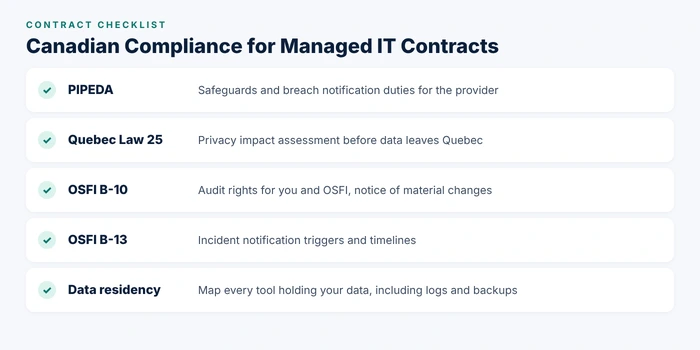
- PIPEDA. The federal privacy law for the private sector in most provinces. Organizations stay accountable for personal information that service providers process for them, so contracts need clear safeguards and breach notification duties.
- Quebec’s Law 25. Requires a privacy impact assessment before personal information is sent outside Quebec. Penal fines can reach C$25 million or 4% of worldwide turnover [Quebec Law 25, 2021].
- OSFI Guideline B-10. Applies to federally regulated financial institutions. It sets minimum contract terms for high-risk and critical third-party arrangements, including audit rights for the institution and OSFI, and notice of material changes [Blakes, 2023].
- OSFI Guideline B-13. In effect since January 1, 2024. It covers technology and cyber risk in three areas: governance and risk management, technology operations and resilience, and cyber security. It expects third-party agreements to say what triggers incident notification and how quickly it must happen [Torys, 2024].
- Data residency. Many public-sector, health and financial organizations need their data kept in Canadian cloud regions. Check where the provider’s monitoring, logging, ticketing and backup tools store data, because these often sit outside your main environment.
Choosing an Operating Model
There is no single right model. The choice depends on how strong your internal IT team is and how much control you want to keep.
- Fully managed. The provider runs agreed services end to end. Best for organizations that want predictable cost and one point of accountability.
- Co-managed. Your internal IT team keeps strategy and some operations, and the provider adds 24×7 coverage, security operations or specialist skills. Best for enterprises with established IT teams.
- Mixed by service. Different models for different services, for example a fully managed SOC alongside a co-managed service desk.
Pricing usually follows one of these structures:
- Per user or per device, which grows with headcount
- Tiered service packages, which make budgeting simpler but can hide gaps in coverage
- A fixed fee for a defined scope, with a change process for additions
Most Canadian managed service providers listed on Clutch charge between US$100 and US$199 per hour [Clutch, 2026], though enterprise contracts are usually priced per service rather than by the hour.
SLA Benchmarks to Insist On
Buyers of enterprise managed IT services Canada should expect commitments that go well beyond response times:
- Availability: 99.9% availability allows 8.76 hours of downtime a year, while 99.99% allows 52.6 minutes. Set each service’s target according to what its downtime costs you.
- Critical (P1) incidents: a 15-minute response and service restored within 4 hours are common published benchmarks [Datapath, 2026].
- Security notification: a fixed window, measured in hours, short enough to support your own regulatory reporting.
- Recovery: an RPO and RTO for each application tier, proven by restore tests.
- Exit: 90 to 180 days of help moving to a new provider at agreed rates, with full return of data, credentials and documentation.
How to Evaluate Top Managed Service Providers in Canada
Published rankings rarely explain how they were compiled, and several are funded by the vendors they rank. Build your own shortlist based on evidence.
Know the provider types
- National providers, often linked to telecom or infrastructure companies, offering scale and coverage across the country
- Global systems integrators, suited to multinational programs and complex transformation work
- Specialist and regional providers, offering senior attention and faster decisions, with fewer people in reserve
Ask for evidence
- A current SOC 2 Type II report or ISO/IEC 27001 certificate
- Named enterprise references in your sector and province
- Three months of real SLA reports from an existing client, with the client’s details removed
- A data residency map showing every system that will hold your data, and where it is
- The escalation path up to the provider’s executive sponsor
Watch for red flags
- SLAs that cover response but not restoration
- “Best efforts” wording on availability or security
- No right to terminate after repeated SLA breaches
- A SOC or service desk run by an undisclosed subcontractor
- Vague answers about where support staff and data are located
It is easier to compare the top managed service providers in Canada when every candidate answers the same questions in writing.
How Zazz Approaches Enterprise Managed IT
We believe managed IT for Canadian enterprises should be measured by business results. We set availability targets for each business service, report from data clients can inspect, and write compliance obligations into the contract from the start.
We’re also clear about our limits. If your organization needs on-site staff in every province from day one, a national provider with a large field workforce may suit you better. We do our best work running and securing complex environments that span several clouds, where senior engineering judgment matters most.
Frequently Asked Questions
What are the best managed IT services for Canadian enterprises?
The best managed IT services for Canadian enterprises cover 24×7 infrastructure and cloud operations, managed security, backup and disaster recovery, an enterprise service desk, network management, compliance support and AI governance. They should keep data in Canada and come with SLAs tied to business services.
How much do managed IT services cost in Canada?
Enterprise contracts are usually priced per user, per device or per service. Canadian providers listed on Clutch most often charge between US$100 and US$199 per hour [Clutch, 2026], but total cost depends on scope, coverage hours and security requirements.
Do managed service providers need to comply with OSFI rules?
OSFI guidelines apply to federally regulated financial institutions, but those institutions must pass the requirements on to their providers through contracts. Guideline B-10 sets minimum contract terms for critical arrangements, and Guideline B-13 covers technology and cyber risk.
What is the difference between fully managed and co-managed IT?
With fully managed IT, the provider runs agreed services end to end. With co-managed IT, your internal team keeps strategy and some operations, and the provider adds 24×7 coverage or specialist skills.
Closing: Choose a Provider You Can Hold Accountable
The best managed IT services for Canadian enterprises reduce risks you can measure: downtime, breach exposure and regulatory findings. Define the services that matter, write Canadian compliance requirements into the contract, and insist on SLAs that cover restoration as well as response.
Zazz helps leadership teams at Canadian enterprises design, benchmark and run managed IT services under contracts built around business results. Get a free managed IT assessment from our team, and we’ll review your current services, SLAs and compliance gaps against the framework in this guide.