
 iOS App Development
 Android App Development
 React Native
 Flutter
 Web Development
 Custom Software
 Front End Development
 Blockchain Development
 Virtual Reality
 Cloud Computing
 IoT Development
 Augmented Reality
 Write us a message
Among the most consequential app development challenges enterprises face today, one rarely appears in project risk registers: building software that the internal team cannot maintain once the agency that built it moves on. When an enterprise engages a digital agency to build a customer-facing application, the outcome is rarely just software. It is a set of institutional dependencies, implicit knowledge transfers, and long-term cost structures that leadership often underestimates until something goes wrong. A production incident at 2:00 AM is not the right time to discover that your internal team cannot roll back a deployment, debug a core service, or even locate the credentials to access your own infrastructure.
According to a 2023 Gartner survey, 64% of enterprise IT leaders cited vendor lock-in and lack of internal capability transfer as top risks in third-party software development engagements. The financial and operational consequences of this dependency are neither hypothetical nor minor. They compound over time, erode strategic agility, and, in regulated industries, can introduce compliance exposure that legal teams find difficult to contain.
This article examines the structural causes of agency dependency, quantifies its real cost, and outlines the governance frameworks that high-performing organizations use to build durable digital products without sacrificing the quality or speed that agencies provide.
Core Application Development Challenges That Create Long-Term Dependency
Agency dependency is rarely the result of negligence or bad faith. It is most often the product of misaligned incentives, compressed timelines, and procurement structures that reward delivery speed over knowledge transfer. Understanding these application development challenges at a structural level is the first step toward addressing them.
Proprietary Tooling and Undocumented Architecture
Agencies frequently build on internal frameworks, custom scaffolding, or toolchain configurations that are not part of any public standard. A 2022 study by McKinsey Digital found that 58% of enterprise applications delivered by external vendors contained at least one proprietary dependency that the client organization could not independently maintain within six months of handover.
When these tools are not documented, the application itself becomes a black box. The internal team can observe inputs and outputs but cannot safely modify the logic between them.
Knowledge Confined to Agency Personnel
In fast-moving engagements, domain knowledge about business logic, integration decisions, and architectural tradeoffs accumulates in the minds of agency developers rather than in documentation, test coverage, or onboarding materials. When key personnel rotate off the account, which happens frequently in agency environments, that knowledge does not transfer. It disappears.
Research from Forrester indicates that the average agency project sees a 40% developer turnover rate within 18 months of go-live. Each departure is a knowledge loss event with no automatic mitigation.
Procurement Frameworks That Do Not Require Maintainability
Many procurement teams evaluate agency proposals on cost, timeline, and portfolio quality. Maintainability criteria, including documentation standards, test coverage requirements, internal training obligations, and post-handover support structures, are often absent from RFPs. Without these criteria in the contract, there is no commercial mechanism to enforce them.
The Real Cost of Dependency
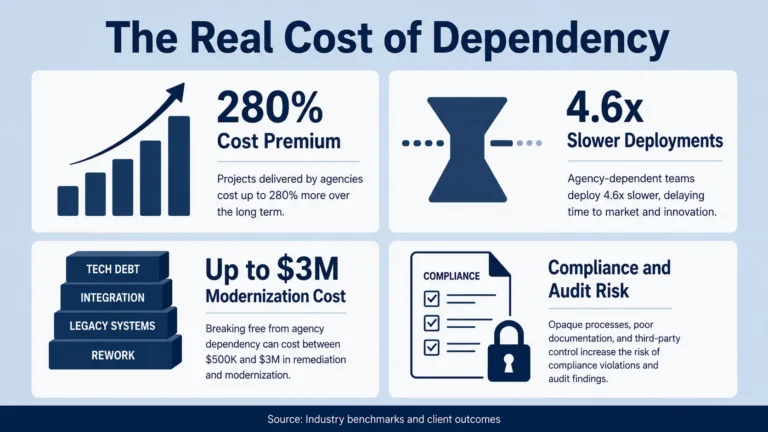
The full cost of agency dependency extends well beyond the monthly retainer fee. Organizations that have undergone independent audits of their agency-dependent portfolios consistently find that the total cost of dependency is two to four times the visible maintenance of contract value.
Direct Financial Exposure
A mid-market SaaS company documented in a Harvard Business Review case study (2023) found that its reliance on the original agency for post-launch changes resulted in a 280% cost premium compared to the market rate for equivalent work performed by informed internal developers. Over a three-year period, this premium amounted to approximately $1.4 million in avoidable expenditure.
Velocity Degradation
Organizations dependent on agency capacity cannot move at the speed their business requires. Every feature request, bug fix, or infrastructure change must be routed through an external queue, scoped, contracted, and scheduled. Internal stakeholders learn to stop requesting changes because the process is prohibitive. The product stagnates while competitors iterate.
A 2024 State of DevOps report found that organizations with high external dependency scores deployed changes 4.6 times less frequently than their peers with strong internal ownership models.
Compounding Technical Debt
When internal teams lack the ability to make changes, they also lack the ability to manage technical debt. Debt accumulates in systems that no one inside the organization fully understands. By the time leadership recognizes the problem, a platform modernization effort may be the only viable path forward, one that typically costs between $500,000 and $3 million for mid-size enterprise applications, according to IDC’s 2023 Software Modernization Benchmark.
Compliance and Audit Risk
In industries subject to regulatory oversight, including financial services, healthcare, and critical infrastructure, the inability to independently audit, modify, or certify application logic is not merely a technical inconvenience. It is a regulatory liability. Auditors increasingly require organizations to demonstrate that they have meaningful control over the systems they operate. An application that only the building agency can explain will not satisfy that standard.
Challenges in Mobile App Development: Why the Stakes Are Higher
The dependency problem is especially pronounced in mobile contexts. The challenges in mobile app development compound traditional software risks because mobile applications sit at the intersection of rapidly evolving platform requirements, device-specific constraints, and consumer-facing performance expectations that tolerate very little degradation.
When a mobile application is built by an external agency and left without adequate internal ownership, organizations face a set of challenges in developing mobile applications that are difficult to resolve after the fact. Operating system updates from Apple and Google routinely introduce breaking changes. Push notification infrastructure, deep link handling, and app store compliance requirements change on cycles that do not align with agency retainer schedules. If the internal team cannot navigate these changes independently, even a well-built mobile application begins to degrade within 12 to 18 months of handover.
A 2023 report from App Annie found that enterprise mobile applications with no dedicated internal maintainer experienced a 34% higher crash rate and a 22% lower user retention rate compared to applications supported by an engaged internal team. These are not abstract metrics. They translate directly to customer experience deterioration and lost revenue.
The challenges in mobile app development are therefore not only technical. They are organizational. An agency can deliver a technically sound mobile application and still leave the client in a position where that application becomes unmaintainable within a single product cycle.
Recognizing the Dependency Trap Before It Closes
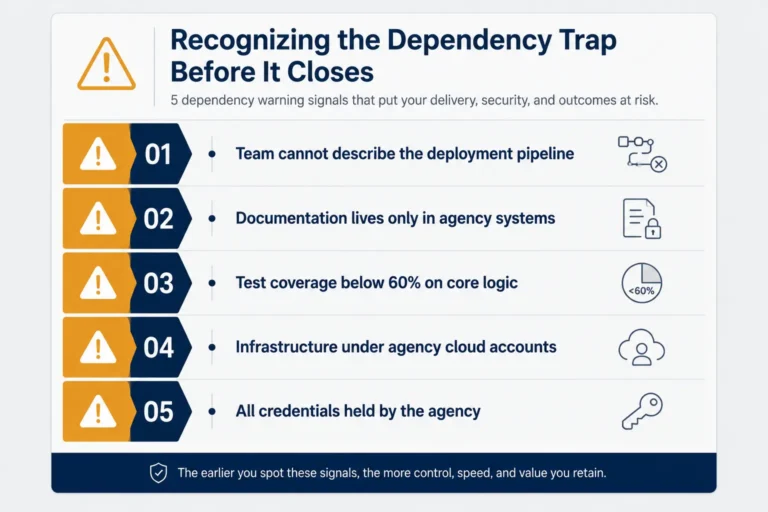
There are clear warning signals that an engagement is moving toward problematic dependency. Leadership teams should treat the following as structured risk indicators.
Warning Signal 1: No internal developer can describe the deployment pipeline in detail.
If your team cannot independently execute a production deployment without agency involvement, you do not control your own release process.
Warning Signal 2: Documentation exists only in the agency’s internal systems.
Architecture decision records, runbooks, environment configurations, and API contracts that live in the agency’s Confluence or Notion workspace are effectively inaccessible to your organization after the engagement ends.
Warning Signal 3: Test coverage is below 60% on core business logic.
Low test coverage means that any developer, internal or external, who attempts to modify the system is operating without a safety net. The agency retains its advantage because they remember where the risk is. Your team does not.
Warning Signal 4: Infrastructure is managed under the agency’s cloud accounts.
Applications deployed to cloud environments owned or controlled by the agency create hard dependencies on that relationship for even the most basic operational tasks. A 2023 Cloud Security Alliance report found that 31% of enterprise organizations had experienced at least one incident where cloud resource access was disrupted by an agency relationship change.
Warning Signal 5: All third-party service credentials are held by the agency.
API keys, OAuth credentials, and vendor accounts that exist only in the agency’s password manager represent a systemic continuity risk that organizations rarely recognize until the relationship ends abruptly.
The Governance Framework for Resolving App Development Challenges at the Source
Organizations that successfully address these app development challenges do not simply hope for good outcomes. They engineer them through deliberate governance structures applied before, during, and after the engagement.
Before the Engagement: Contract for Maintainability
Every procurement document for external software development should include explicit, measurable requirements in the following areas:
- Documentation standards: Architecture decision records, API contracts, environment setup guides, and operational runbooks must be delivered as first-class deliverables, not afterthoughts.
- Code ownership: All source code must be committed to version control repositories owned by the client organization from day one of development.
- Infrastructure sovereignty: All cloud resources must be provisioned under client-owned accounts, with agency access granted through least-privilege IAM roles that can be revoked.
- Test coverage minimums: Core business logic must achieve a minimum of 70% unit test coverage as a condition of milestone acceptance.
- Knowledge transfer obligations: The contract must specify a defined number of internal training hours and structured handover sessions as contractual deliverables.
During the Engagement: Embedded Internal Participation
Dependency most often forms when internal teams are excluded from the development process. Effective governance requires internal developers to be embedded in the agency team throughout the engagement, not merely during review gates. This dual-track model, in which agency developers build and internal developers learn simultaneously, is the most reliable mechanism for resolving application development challenges related to knowledge transfer.
Organizations that follow this model report 47% faster post-handover maintenance velocity compared to those that use a sequential build-then-transfer approach, according to a 2024 Accenture Digital Operating Models study.
After the Engagement: Structured Transition Protocols
The end of an agency engagement is a predictable event, yet most organizations treat it as a crisis rather than a managed transition. A structured transition protocol should include:
- A 90-day parallel operation period during which internal teams own the system with agency support available on a defined SLA
- A formal knowledge audit to identify gaps before the agency relationship fully concludes
- An internal post-mortem on documentation completeness and system comprehensibility
- A runbook verification exercise in which internal developers independently execute all critical operational procedures
A Note on What This Is Not
This analysis is not an argument against engaging agencies. The best agencies bring specialized expertise, proven delivery methodologies, and access to talent that most organizations cannot replicate internally at equivalent speed or cost. The goal is not to avoid agency partnerships. It is to structure them so that the partnership enhances organizational capability rather than replacing it.
The distinction is meaningful. An agency that builds a system your team can maintain has delivered lasting value. An agency that builds a system only they can maintain has delivered a dependency.
Conclusion
The app development challenges explored in this article are not edge cases. They represent a structural pattern that affects a substantial portion of enterprise software portfolios, one that manifests as inflated maintenance costs, degraded product velocity, compliance exposure, and significant modernization liability.
The organizations that avoid this outcome share a common characteristic: they treat maintainability as a non-negotiable procurement requirement, not an aspirational outcome. They embed internal developers in agency engagements, enforce infrastructure sovereignty from day one, and execute structured transitions that leave institutional knowledge inside the organization rather than departing with the agency team. Whether the product in question is a web platform, a mobile application navigating the challenges in mobile app development, or a complex enterprise integration, the governance principles are consistent and transferable.
The cost of implementing these practices is modest. The cost of not implementing them compounds for years.
Thinking Through This for Your Own Context? If any of these patterns look familiar in your current setup, it may be worth a focused conversation. We work with technology teams to assess dependency exposure and identify practical steps forward. No pitch. Just a straightforward discussion about where you stand. Schedule a 30-Minute Advisory Session