
 iOS App Development
 Android App Development
 React Native
 Flutter
 Web Development
 Custom Software
 Front End Development
 Blockchain Development
 Virtual Reality
 Cloud Computing
 IoT Development
 Augmented Reality
 Write us a message
Enterprise organizations are spending more on software than at any point in history. Global IT spending is projected at $5.43 trillion in 2025 [Gartner via Cargoson, 2025], and enterprise software alone reached $317 billion the same year. Yet despite this unprecedented capital commitment, a structural failure persists. No vendor, no systems integrator, and no implementation roadmap can resolve it: the absence of executive-level outcome ownership.
This is not a technology problem. It is a leadership problem.
When an enterprise application is deployed without a clearly designated C-suite owner accountable for its business outcomes, the initiative enters what can be accurately described as the Product Ownership Gap: a zone of diffuse accountability, competing priorities, and incremental disengagement that renders significant technology investments inert.
The consequences are measurable. The average large enterprise lost $104 million in 2024 due to underutilized technology, disjointed strategy, and low adoption [WalkMe/SAP, 2025]. Globally, failed digital transformation programs waste an estimated $2.3 trillion annually [Gartner, 2024]. These are not the casualties of poor software choices. They are the casualties of poor ownership structures.
The Scale of the Problem: What the Data Reveals
The evidence is not situational or sector-specific. It represents a systemic, cross-industry pattern that has persisted for over two decades:
- 70% of digital transformation initiatives fail to meet their stated objectives [Gartner/McKinsey, 2025]
- 88% of business transformations fail to achieve their original ambitions [Bain and Company, 2024]
- 55% to 75% of ERP implementations fail to meet their defined objectives [Gartner, via Rand Group]
- 48% of IT investments across surveyed enterprises failed to deliver ROI [WalkMe/SAP, 2025]
- On average, only 26% of employees actively use their organization’s ERP software [RubinBrown/DocuClipper, 2025]
- 42% of companies abandoned most of their AI initiatives in 2025, up from 17% in 2024 [S&P Global Market Intelligence, 2025]
These numbers do not describe edge cases. They describe the baseline. The single most consistent thread running through post-mortem analyses of failed enterprise technology programs is not vendor selection, technical architecture, or budget adequacy. It is the absence of a named, empowered executive who owns the outcome from initiation through sustained adoption.
The Anatomy of the Ownership Gap
Understanding the Product Ownership Gap requires moving beyond the simplistic framing of “lack of executive sponsorship.” Sponsorship, in the traditional sense of a senior leader approving the budget and appearing at the launch event, is not the same as ownership.
Ownership implies sustained, measurable accountability for the business outcome an application is intended to deliver. It means a C-suite leader whose performance evaluation, strategic mandate, and organizational credibility are tied to whether the platform delivers value, not merely whether it goes live on schedule.
The gap emerges across four distinct failure modes that are remarkably consistent across industries and organization sizes.
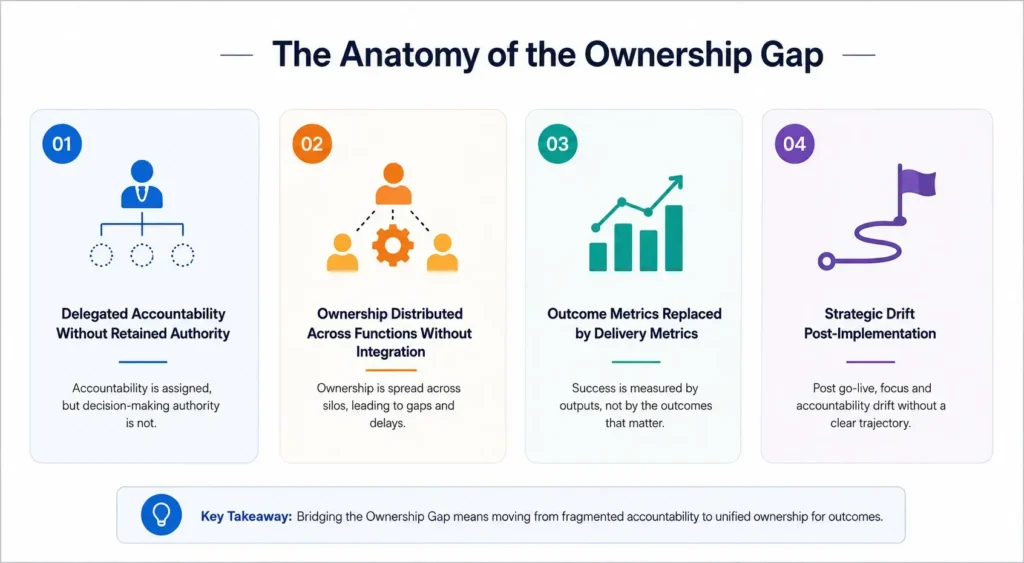
Failure Mode 1: Delegated Accountability Without Retained Authority
In the most common pattern, a senior executive authorizes a technology investment and then transfers all accountability to a project steering committee, an IT function, or a third-party implementation partner. Authority follows accountability downward, and the C-suite leader remains nominally associated with the initiative without bearing any consequence for its outcome.
The result is predictable:
- Decision escalations are delayed because the only person with organizational authority to resolve cross-functional conflicts has disengaged
- Trade-off decisions on scope, customization, and change management investment are made at levels too far from strategic intent
- Business units resist adoption because they see no signal from leadership that the platform matters to anyone above their own management chain
- The initiative is measured by delivery milestones rather than business outcomes, creating an incentive structure that celebrates go-live regardless of value delivered
This is not a failure of the people involved. It is a failure of the accountability architecture. When a C-suite executive does not retain direct, personal ownership of the outcome, the governance vacuum is filled by competing interests rather than unified purpose.
Failure Mode 2: Ownership Distributed Across Functions Without Integration
A second, equally destructive pattern is the diffusion of ownership across multiple C-suite roles. A CIO owns the technology infrastructure. A COO owns the operational process. A CFO owns the business case. A CHRO owns the change management program. No single executive owns the integrated outcome.
Consider the implication: when adoption rates stagnate, and on average only 26% of employees actively use enterprise ERP platforms [RubinBrown, 2025], who is accountable? When the business case projected 18 months to value realization and month 24 shows minimal measurable impact, whose responsibility is it to course-correct?
In a distributed ownership model, the answer is effectively no one. Each function has delivered against its own mandate. But the integrated outcome, meaning meaningful, sustained adoption that delivers the business value the application was purchased to create, has no single owner. KPMG’s 2025 Enterprise Risk and Resiliency Survey found that while 72% of organizations have senior leadership accountable for enterprise resiliency in principle, that accountability is spread across CROs, CIOs, COOs, and CTOs with overlapping mandates and unclear precedence [KPMG, 2025]. The same structural ambiguity applies directly to enterprise application ownership.
Failure Mode 3: Outcome Metrics Replaced by Delivery Metrics
The third failure mode is metric substitution: the gradual replacement of outcome metrics with delivery metrics as the primary measure of program success. This is perhaps the most insidious pattern because it creates the appearance of success in the precise moment that value erosion is accelerating.
Delivery metrics such as go-live date, budget adherence, feature completeness, and UAT sign-off are legitimate operational measures. But they are not business outcome measures. An application can go live on time, within budget, with all specified features fully functional, and still deliver negligible business value if adoption is low, workflows are not redesigned, or the platform is not embedded into decision-making processes.
McKinsey’s 2025 State of AI research found that organizations capturing more value from technology investments are not those deploying the most sophisticated tools. They are those that redesign end-to-end workflows and place senior leaders in critical accountability roles [McKinsey, 2025]. The metric alignment follows the ownership structure.
Failure Mode 4: Strategic Drift Post-Implementation
The fourth failure mode occurs after go-live, during the sustained adoption phase that determines whether an enterprise application delivers its projected value. Implementation programs have a defined endpoint with budgets, timelines, and organizational structures built around delivery. But value realization from enterprise applications is not a delivery event. It is an ongoing operational commitment that requires sustained leadership attention and the organizational authority to resolve friction points that emerge as new platforms interact with established workflows and cultural norms.
When no C-suite leader owns the post-go-live outcome, strategic drift becomes the default trajectory:
- Usage rates decline as the immediate pressure of implementation subsides
- Feature adoption plateaus well below the threshold required for business case realization
- Workarounds proliferate as teams find paths of least resistance around platform requirements
- Competing technology investments draw leadership attention and organizational resources away from sustained adoption
Post-implementation drift is a primary driver of the $104 million in annual losses the average enterprise absorbs from underutilized technology [WalkMe/SAP, 2025].
Closing the Gap: What Executive Ownership Actually Requires
The Product Ownership Gap is a structural problem that requires a structural solution. What is required is a fundamental reorientation of how enterprise application accountability is assigned, measured, and enforced at the C-suite level.
Assign a Named Outcome Owner, Not a Sponsor
The most consequential step is the formal designation of a single C-suite leader as the named outcome owner of every material enterprise application investment. The outcome owner’s performance evaluation must include explicit, measurable criteria tied to the business outcomes the application is intended to deliver, whether that is adoption rates, process efficiency, revenue impact, or cost reduction.
This accountability mechanism changes the behavioral dynamics of the entire program:
- Decision escalations are resolved at the speed required because the outcome owner has both the authority and the personal stake to act
- Cross-functional conflicts are adjudicated by a leader whose accountability transcends any single function
- Post-go-live adoption receives sustained leadership attention because it directly affects the outcome owner’s measured performance
Redefine Success Metrics Before the Program Begins
The second structural requirement is the definition and formal commitment to outcome metrics, not delivery metrics, before program authorization. Effective outcome metrics for enterprise application programs include:
- Adoption depth: Percentage of target users actively using the platform for defined core workflows within 90, 180, and 365 days post-go-live
- Process cycle time reduction: Measurable improvement in the operational processes the application is intended to optimize
- Business case realization rate: Percentage of projected financial benefits achieved at defined review intervals
The outcome owner must formally commit to these metrics at program initiation, transforming the ownership designation from a governance formality into a meaningful performance obligation.
Establish a Sustained Post-Go-Live Ownership Mandate
The third requirement is the explicit extension of the outcome owner’s mandate through the post-go-live adoption phase, with defined review intervals and escalation authorities. The outcome owner’s mandate should include:
- Quarterly business value reviews against defined outcome metrics, not operational status updates
- Authority to mandate workflow redesign, additional training investment, or process changes required to drive adoption
- Formal accountability for adoption rates at the 12-month and 24-month post-go-live intervals
McKinsey’s research consistently shows that organizations placing senior leaders in critical post-implementation roles are significantly more likely to realize the value projected in their original business cases [McKinsey, 2025].
The Competitive Consequence of Inaction
The Product Ownership Gap is not a governance issue with primarily internal consequences. It represents a compounding competitive disadvantage for organizations that tolerate diffuse accountability for enterprise application outcomes.
An enterprise losing $104 million annually to underutilized technology [WalkMe/SAP, 2025] is simultaneously funding a competitor’s operational advantage. Organizations that close the Product Ownership Gap build governance capability that compounds over time, making each subsequent technology investment more likely to deliver value. Those that perpetuate diffuse accountability structures are systematically degrading their capacity to derive value from technology, at precisely the moment competitive differentiation increasingly depends on it.
Conclusion
The Product Ownership Gap is the defining governance failure of enterprise technology investment at scale. It is not caused by inadequate software, insufficient budgets, or poor implementation execution, though these factors contribute to poor outcomes. It is caused by the systematic avoidance of clear, named, consequence-bearing C-suite accountability for business outcomes.
The data is unambiguous. Seventy percent of digital transformations fail to meet their objectives [Gartner/McKinsey, 2025]. Eighty-eight percent of business transformations fall short of their original ambitions [Bain, 2024]. The average large enterprise loses $104 million annually to underutilized technology [WalkMe/SAP, 2025]. These are not vendor problems or technology problems. They are leadership and governance problems.
For C-suite leaders, the imperative is clear:
- Designate a named outcome owner for every material enterprise application investment, not a sponsor but an owner with personal performance accountability for business outcomes
- Define outcome metrics before authorization and commit the named owner to those metrics as a formal performance obligation
- Extend accountability explicitly through the post-go-live adoption phase, where the majority of value is either realized or forfeited
- Reframe the internal narrative around enterprise application success from delivery achievement to outcome realization
The Product Ownership Gap exists because it has been allowed to exist. Closing it is a leadership decision, and it begins with a single act of organizational accountability: naming the executive who will be responsible if this does not work, and empowering them to ensure that it does.
Is your enterprise app underperforming because no one in the C-suite truly owns the outcome? The gap is costing you more than you realize. Schedule a consultation with our experts today and let’s build a clear ownership model that drives accountability, alignment, and real business results.