
 iOS App Development
 Android App Development
 React Native
 Flutter
 Web Development
 Custom Software
 Front End Development
 Blockchain Development
 Virtual Reality
 Cloud Computing
 IoT Development
 Augmented Reality
 Write us a message
In most enterprises, the mobile app budget does not fail because the number is too small. It fails because nobody can say with confidence who owns it. Funding flows from IT one quarter, gets reallocated to a product line the next, and quietly stalls when a reorganization moves the sponsor to a new role. The result is predictable: shipping slows, technical debt compounds, and leadership loses visibility into where the money actually went.
Budget ownership is not an accounting formality. It determines who sets priorities, who is accountable for outcomes, and how quickly your organization can respond to market shifts. This article examines the three dominant models for owning the mobile app budget, the practical trade-offs of each, and a framework for deciding which one fits your operating environment.
For senior technology and product leaders, this is increasingly a board-level concern rather than an operational detail. Mobile experiences now influence customer acquisition, retention, employee productivity, and brand perception, which means the way the underlying investment is governed has consequences that extend well beyond the engineering organization. Ownership of the mobile app budget is therefore inseparable from your wider enterprise mobile application development strategy. Getting the model right early avoids costly restructuring later, when the portfolio is larger, the stakes are higher, and the political cost of change has grown.
Why Mobile App Budget Ownership Determines App Outcomes
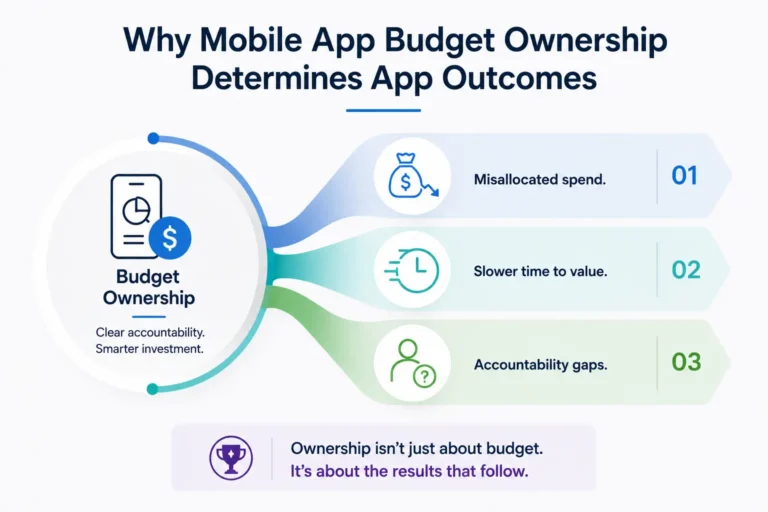
Mobile is no longer a side channel. It is frequently the primary interface between an enterprise and its customers, employees, and partners. That shift makes app budget planning a strategic exercise rather than a routine line item, because when ownership is ambiguous, the consequences show up directly in delivery metrics and financial performance.
- Misallocated spend. Gartner has consistently estimated that organizations waste a significant share of their technology budgets on shadow IT and duplicated tooling. Fragmented mobile ownership is a common contributor, with parallel teams licensing overlapping platforms and analytics tools.
- Slower time to value. When approval for a feature requires negotiation across IT, a product line, and finance, release cycles extend. Industry research consistently links clear product funding lines with shorter lead times.
- Accountability gaps. If no single owner is answerable for return on the mobile investment, post-launch performance rarely gets measured against the business case that justified the spend.
The central question is therefore not how much to spend, but where decision rights and accountability for that spend should sit.
The Three Models for Owning the Mobile App Budget
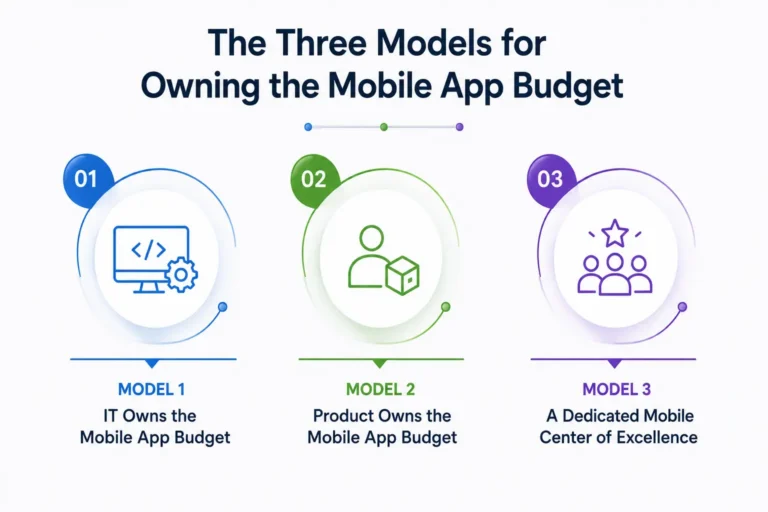
Once leadership accepts that ownership must be deliberate, the practical question becomes which structure to adopt. In practice, enterprises converge on three dominant models, each defined by where decision rights and accountability for the mobile investment ultimately sit. The distinction is not cosmetic. The model you choose shapes how quickly features ship, how tightly security is enforced, how efficiently spend is consolidated, and whether anyone can be held answerable for the return on the investment.
- IT ownership, where the budget is held by central technology under the CIO and optimized for governance, security, and standardization.
- Product ownership, where funding sits with a product organization and is optimized for customer value, revenue, and speed of iteration.
- A dedicated Center of Excellence, where a cross-functional unit holds a shared, governed budget and balances enterprise standards with business unit autonomy.
None of these is inherently superior. Each carries a distinct set of trade-offs across governance, speed, cost, and accountability, and each tends to suit a particular stage of organizational maturity. The sections that follow examine each model in turn, including how it operates in practice, where it performs well, where it breaks down, and the type of organization it suits best.
Model 1: IT Owns the Mobile App Budget
Under this model, the mobile app budget sits within central IT, typically reporting to the CIO or a technology leadership function. IT controls architecture, vendor relationships, security, infrastructure, and the funding that supports them. Mobile becomes one line within IT budget planning, governed by the same standards and approval processes that apply to other enterprise systems. Because it folds neatly into established enterprise software budgeting cycles, this is often the default starting point for organizations where mobile began as an extension of existing digital infrastructure rather than as a standalone commercial product.
Where IT Ownership Works Well
- Strong governance and standardization. Security, compliance, identity management, and platform consistency are enforced from one place, which matters heavily in regulated sectors such as healthcare and financial services where a single misconfiguration can carry regulatory and reputational cost.
- Infrastructure efficiency. Shared services, DevOps tooling, cloud commitments, and vendor contracts are consolidated, reducing duplication across business units and improving negotiating leverage with suppliers.
- Risk and compliance alignment. For organizations with HIPAA, SOC 2, GDPR, or similar obligations, centralized control simplifies audit, data governance, and accountability when regulators come asking.
Where IT Ownership Struggles
- Distance from the customer. IT priorities often emphasize stability and risk reduction over rapid feature experimentation, which can slow the responsiveness that customer-facing apps depend on.
- Backlog competition. The mobile roadmap competes with infrastructure projects, security initiatives, and core enterprise systems for the same pool of funding and engineering capacity, and mobile does not always win that contest.
- Feature lag. Business stakeholders may experience long queues for changes that, from a revenue standpoint, are urgent, creating friction between commercial and technology functions.
Best fit: Regulated enterprises, internal-facing or employee apps, and organizations where governance and security outweigh speed of feature delivery.
Model 2: Product Owns the Mobile App Budget
Here, budget authority sits with a product organization, often under a Chief Product Officer or a business unit leader who is accountable for commercial results. Funding follows outcomes such as engagement, conversion, and retention rather than infrastructure milestones. The mobile app is treated as a product with a profit and loss view rather than a technology asset to be maintained, which fundamentally changes how investment decisions get made and measured.
Where Product Ownership Works Well
- Customer and revenue alignment. Spend is tied directly to user value and commercial metrics, which sharpens prioritization and makes it easier to defend or grow the budget with evidence.
- Faster iteration. Product teams can fund and ship experiments quickly without routing every decision through a central technology queue, which is decisive in competitive consumer and digital markets.
- Clear accountability for outcomes. A product owner can be held to measurable results, which strengthens the business case discipline around mobile investment and discourages funding that cannot be justified.
Where Product Ownership Struggles
- Governance drift. Without strong guardrails, individual product teams may diverge on security practices, data handling, and platform choices, creating risk that only becomes visible after an incident.
- Duplicated tooling. Multiple product lines independently licensing analytics, testing, and engagement platforms is a frequent and avoidable source of waste at scale.
- Technical debt risk. Speed-focused teams can underinvest in shared architecture and platform health, creating long-term remediation cost that surfaces well after the features that caused it have shipped.
Best fit: Customer-facing apps tied to revenue, digital-first businesses, and organizations competing on experience and release velocity.
Model 3: A Dedicated Mobile Center of Excellence
A Center of Excellence (CoE) is a cross-functional unit that owns mobile strategy, standards, and a shared budget while embedding closely with business units. It is designed to capture the governance strength of IT and the outcome focus of product within a single accountable structure. Rather than choosing between control and speed, the CoE aims to provide both, acting as an enabling function that sets the rules of the road and then helps teams move quickly within them.
How the CoE Model Functions
- It sets enterprise-wide standards for security, architecture, design systems, and analytics, so every team starts from a common, governed foundation rather than reinventing one.
- It maintains a central, governed budget while allocating funding to business unit initiatives against a shared prioritization framework, keeping investment visible and intentional.
- It pools scarce mobile talent and reusable platform components, reducing the cost and risk of every team hiring its own specialists or building the same capability twice.
Where the CoE Model Works Well
- Balanced governance and speed. Shared guardrails prevent fragmentation while business units retain a fast path to funding and delivery.
- Reuse and efficiency. Common components, design systems, and platforms reduce duplicated spend across the portfolio and shorten the time to launch each new app.
- Strategic visibility. Leadership gets one consolidated view of mobile investment and return, which is difficult to achieve in the other two models and invaluable for portfolio-level decisions.
Where the CoE Model Struggles
- Setup cost and maturity. A CoE requires dedicated leadership, defined operating processes, and executive sponsorship, which takes time to establish.
- Risk of becoming a bottleneck. If governance overtakes enablement, the CoE can slow the very teams it is meant to accelerate.
Best fit: Large enterprises running multiple apps across several business units, where both consistency and speed are non-negotiable and mobile is a strategic priority.
Comparing the Three Mobile App Budget Models
The table below summarizes how each model performs against the dimensions that matter most when deciding where the mobile app budget should sit.
Dimension | IT Owns | Product Owns | Center of Excellence |
Governance and security | Strong | Variable | Strong |
Speed to market | Lower | High | Balanced |
Customer and revenue alignment | Lower | High | High |
Cost efficiency at scale | Moderate | Low | High |
Accountability for outcomes | Diffuse | Clear | Clear |
Setup complexity | Low | Low | High |
Read across the rows and a pattern emerges. IT ownership trades speed for control, product ownership trades governance and cost discipline for speed and revenue alignment, and the Center of Excellence attempts to hold both, at the price of higher setup complexity. No single column wins on every dimension, which is precisely why the decision has to be made against your own context rather than a generic best practice.
A Practical Framework for App Budget Planning and Choosing Your Model
Rather than adopting a model by default, decision-makers should evaluate ownership against four questions. The answers usually point clearly toward one structure.
- How regulated is your environment? Heavy compliance obligations favor IT or a CoE over distributed product ownership.
- How directly does the app drive revenue? Strong revenue linkage favors product ownership or a CoE that allocates to business outcomes.
- How many apps and business units are involved? A broad portfolio across multiple units is the classic case for a Center of Excellence.
- How mature is your mobile operating model? Early-stage organizations often start with IT or product ownership and graduate to a CoE as the portfolio grows.
A useful pattern many enterprises follow is staged evolution. Mobile begins under IT for control, shifts toward product ownership as commercial stakes rise, and consolidates into a Center of Excellence once the portfolio is large enough that fragmentation becomes the dominant cost. The transitions matter as much as the destinations. Moving from one model to the next should be triggered by a clear business signal, such as a new revenue-bearing app, a compliance event, or evidence of duplicated spend, rather than by a reorganization or a change in leadership preference. Treating the model as a living decision, reviewed on a defined cadence, keeps the funding structure aligned with the business as it grows.
The Bottom Line
There is no universally correct owner for the mobile app budget. The right answer depends on your regulatory exposure, the commercial role mobile plays, the size of your app portfolio, and the maturity of your operating model. What is universal is the cost of leaving the question unanswered. Ambiguous ownership produces waste, delay, and accountability gaps regardless of how much you invest.
The most resilient enterprises treat budget ownership as a deliberate design decision, not an organizational accident. They define who holds decision rights, who is accountable for outcomes, and how funding is governed, and they revisit that structure as the business evolves.
Whichever model you choose, the qualities that separate successful mobile portfolios from struggling ones are consistent: a single accountable owner, funding tied to measurable outcomes, governance that enables rather than obstructs, and a willingness to evolve the structure as the portfolio matures. Clarity on ownership is what turns a mobile budget from a recurring source of friction into a durable engine of value.
Where Does Your Mobile Budget Belong?
If your organization is weighing how to structure ownership of its mobile investment, it can help to work through the trade-offs with a team that has implemented all three models across regulated and customer-facing environments. Our advisors can review your current funding structure, app portfolio, and governance needs, then help you map a model that balances control, speed, and cost. Reach out for a no-pressure consultation to explore which approach best fits where your enterprise is headed.