
 iOS App Development
 Android App Development
 React Native
 Flutter
 Web Development
 Custom Software
 Front End Development
 Blockchain Development
 Virtual Reality
 Cloud Computing
 IoT Development
 Augmented Reality
 Write us a message
Knowing how to shortlist managed IT providers comes down to a disciplined sequence. Define what 24/7 must cover, screen a long list against hard requirements, score the survivors on weighted criteria, verify their claims with evidence, then test the final two or three in a live session. Many enterprises aim for a final shortlist of three providers, small enough to evaluate properly and large enough to keep pricing competitive.
The stakes justify the effort:
- 25% of large Canadian businesses were affected by a cyber security incident in 2025 (Statistics Canada).
- The average data breach in Canada cost CA$6.98 million in 2025, up 10.4% in a year (IBM Canada).
- 1 in 5 organizations said their most recent major outage cost more than US$1 million (Uptime Institute).
A provider chosen on price or a polished pitch will sit inside that risk for the next three to five years. This guide sets out how to shortlist managed IT providers so the decision holds up in front of your board, auditors and insurers.
Why Does Shortlisting Matter More for 24/7 Support?
Round-the-clock support is where provider capability varies most. Daytime help desks look similar on paper. What happens at 3 a.m. on a Sunday does not.
- Some providers run a staffed overnight desk. Others route after-hours calls to an on-call engineer with a pager.
- Security monitoring may be included, sold as an add-on, or subcontracted to a third party.
- Third-party involvement in data breaches doubled to 30% in one year (Verizon DBIR, 2025), so your provider’s own controls become part of your risk profile.
Demand for outsourced operations is also rising. 67% of executives now use managed or operate services, up from 45% two years earlier (Deloitte Global Outsourcing Survey, 2024). More buyers means more providers using the same 24/7 language, which makes a structured managed IT provider shortlist essential.
How to Shortlist Managed IT Providers: A Five-Stage Process
The process below moves from requirements to a final decision in roughly six to ten weeks for most enterprise programs.
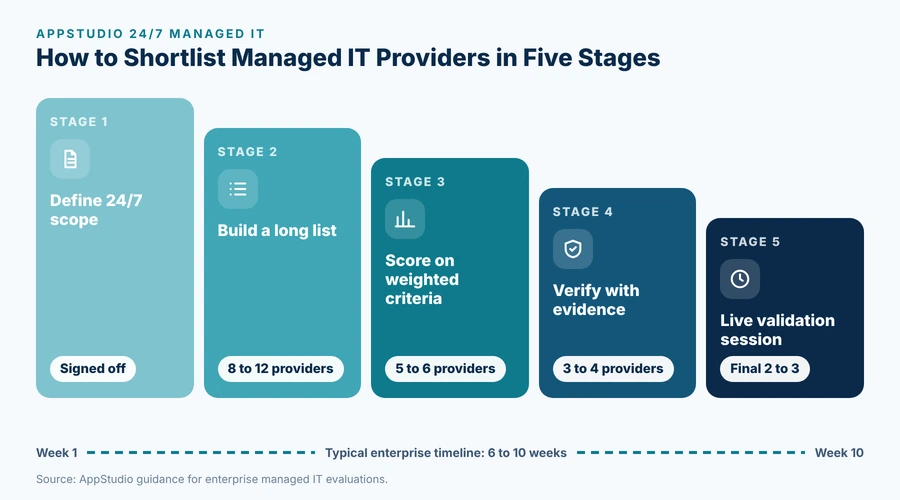
Stage 1: Define What 24/7 Must Cover
The first step in how to shortlist managed IT providers happens before you contact anyone: write down what round-the-clock support means for your organization. This document becomes the baseline every bidder is measured against.
- Which systems need overnight cover: end-user support, infrastructure, cloud, security, or all four
- Target response and resolution times by priority level
- Data residency requirements, including whether data must stay in Canada
- Regulatory frameworks that apply, such as PIPEDA, Quebec’s Law 25, PCI DSS or sector rules
- Number of users, sites and time zones
Get sign-off from the CIO, CISO, CFO and procurement lead at this stage. Requirements that change mid-evaluation are a frequent reason shortlists have to restart.
Stage 2: Build a Long List of 8 to 12 Providers
Cast a wide net, then cut quickly. Sources worth using include peer referrals, analyst reports, review platforms and providers already working in your sector.
At this stage, screen against pass or fail requirements only:
- A staffed 24/7 service desk, not on-call cover
- Experience supporting organizations of your size
- Ability to meet your data residency rules
- Relevant certifications, such as ISO 27001 or SOC 2
Any provider that fails one of these drops off. That usually leaves five or six. Keeping this screen strict is how to shortlist managed IT providers without wasting weeks on bidders who could never meet your baseline.
Stage 3: Score Providers on Weighted Evaluation Criteria
This is where the managed IT provider shortlist takes shape. Send a short, structured request for information and score each written response the same way, using managed IT provider evaluation criteria agreed in Stage
- Limit the request to 20 to 30 questions so providers answer in detail
- Ask for written answers, not sales decks
- Have at least two reviewers score each response independently, then compare
The weighted model in the next section shows how to turn those answers into a ranking.
Stage 4: Verify Claims With Evidence
Proposals describe intentions. Evidence shows performance. Ask every remaining provider for proof before anyone reaches the final round, and call at least two references per provider.
- Compare what references describe with what the proposal promised
- Ask references how the provider handled their worst overnight incident
- Check whether the delivery lead named in the proposal actually runs those accounts
This is the stage most often skipped by teams learning how to shortlist managed IT providers under time pressure, and the one that catches the most gaps.
Stage 5: Run a Live Validation Session
Invite the final two or three providers to a working session with your IT and security leads. Walk through a realistic overnight incident and watch how each team responds.
- Use a scenario from your own environment, such as a ransomware alert at 2 a.m. or a failed overnight backup
- Ask the people who would actually work your account to attend, not only the sales team
- Time each step: detection, triage, escalation and the first update to your executives
This step separates providers who can describe 24/7 support from those who already run it.
What Managed IT Provider Evaluation Criteria Should You Use?
Consistent managed IT provider evaluation criteria let you compare very different proposals side by side. Score each area from 1 to 5, multiply by the weight, and total the result.
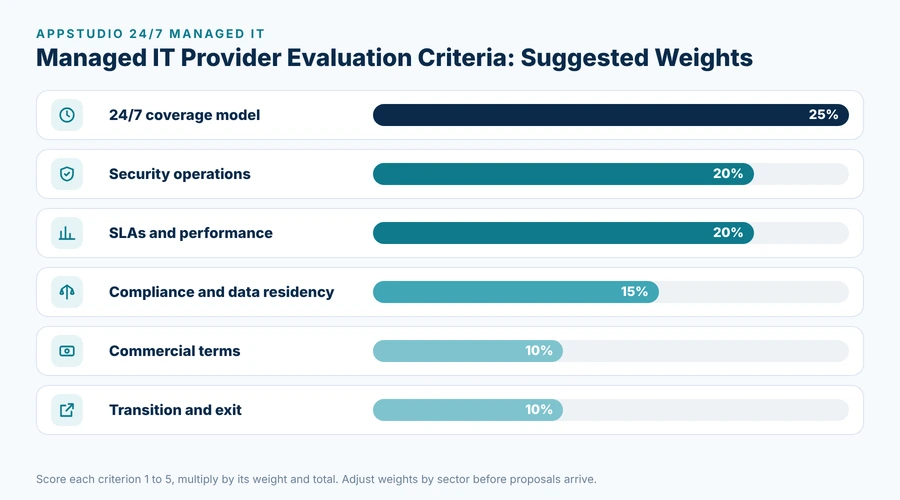
Criterion | What a strong provider shows | Weight |
24/7 coverage model | Staffed overnight desk, named shift structure, weekend cover | 25% |
Security operations | 24/7 monitoring, detection and containment included | 20% |
SLAs and performance | Written targets by priority, service credits, published results | 20% |
Compliance and data residency | Canadian data options, mapped controls, audit evidence | 15% |
Commercial terms | Clear inclusions, predictable pricing, capped increases | 10% |
Transition and exit | Documented onboarding plan and exit support | 10% |
Adjust the weights to your sector. A bank or hospital may move compliance to 25%. A distributed retailer may give coverage more weight. The point is to agree the weights before proposals arrive, so scoring isn’t shaped by whichever pitch was most persuasive.
The global cybersecurity workforce gap reached 4.76 million people in 2024 (ISC2). That shortage is why security operations deserve a heavy weighting: few enterprises can staff a round-the-clock security team internally, so the provider’s capability becomes yours.
What Evidence Should You Request Before Finalizing the Shortlist?
Ask for documents, not descriptions. A provider confident in its 24/7 managed IT support will share these without hesitation.
- SLA performance reports: the last 6 to 12 months of actual response and resolution times, anonymized
- Shift rosters: how many people staff the desk overnight and on weekends
- Certifications: current ISO 27001 certificate and SOC 2 Type II report, with scope clearly stated
- Incident runbooks: a sample escalation procedure for a priority 1 security event
- References: two or three clients of similar size, ideally in your sector
- Subcontractor list: any third parties involved in delivering support or monitoring
For a full list of what to ask during this stage, see our guide on questions to ask a managed IT provider before signing.
How to Choose a Managed IT Provider From Your Final Three
Once scoring and verification are complete, the final decision is less about features and more about fit. Many guides on how to choose a managed IT provider stop at features, but the final three will usually be close on capability. When deciding how to choose a managed IT provider from a strong final three, weigh these factors:
- Live session performance: which team diagnosed the scenario fastest and communicated most clearly
- Account leadership: who your named delivery lead will be, and whether you met them
- Total cost over three years: including onboarding, security tooling and annual price increases
- Cultural fit: how each team handled challenging questions from your security lead
On cost, compare like for like. Some providers bundle security and help desk into one per-user fee. Others price each service separately. Our guide to managed IT services cost per user in Canada sets out current price ranges and the extras to check for.
Illustrative scenario: a Canadian insurer with 1,200 users starts with 10 providers. Pass or fail screening removes four that rely on on-call overnight cover and one that can’t keep data in Canada. Weighted scoring narrows the remaining five to three. In the live session, one provider contains a simulated ransomware alert in under 20 minutes, while the others take longer to escalate. The insurer signs with the fastest team, with the SLA written to match what it saw.
Red Flags That Should Remove a Provider From Your Shortlist
Some warning signs justify removal regardless of score:
- After-hours support described as “available” rather than staffed
- No published or historical SLA performance data
- Security monitoring fully subcontracted, with no visibility of the subcontractor
- Certificates that cover only part of the business, or have lapsed
- Exit terms that are missing, vague or carry heavy penalties
- Reluctance to provide reference clients
Any one of these suggests the provider’s support may not hold up when you need it most. Part of knowing how to shortlist managed IT providers is accepting that a high score doesn’t outweigh one of these gaps.
Who Should Be Involved in Shortlisting Managed IT Providers?
A shortlist built by IT alone often misses commercial or regulatory risk. When enterprises ask us how to shortlist managed IT providers, our first answer is to bring every risk owner in from Stage 1. The strongest evaluations involve:
- CIO or CTO: owns technical requirements and coverage scope
- CISO: assesses security operations, incident response and certifications
- CFO or finance lead: reviews total cost, pricing models and contract terms
- Procurement: manages the process, scoring consistency and vendor communication
- Legal and compliance: reviews data residency, liability and regulatory alignment
Organizations with heavy audit requirements often add specialists from their governance, risk and compliance function at Stage 4.
How AppStudio Supports Enterprises Through the Shortlisting Process
AppStudio built its managed IT services to meet the evidence enterprises ask for at every stage.
- Real people support users, systems and urgent incidents at any hour, weekends included, with endpoint, firewall and SIEM operations watched 24/7
- Its help desk states a typical baseline of under 10 minutes to first response on critical issues and under 30 minutes on standard requests, agreed before go-live
- Security operations run through its managed cybersecurity services rather than a separate vendor
- AppStudio reports ISO 27001 and ISO 9001 certification, with programs mapped to HIPAA, PCI DSS, ISO 27001 and SOC 2
- After-hours and overflow cover is available through its IT help desk services for teams that want to keep some support in-house
Sector teams also support managed IT for healthcare organizations and financial institutions, where overnight response and audit evidence carry extra weight.
Frequently Asked Questions
How Many Providers Should Be on a Managed IT Shortlist?
Three is a practical number for enterprises working out how to shortlist managed IT providers. It’s enough to keep pricing competitive and few enough to evaluate each provider properly, including a live validation session.
How Long Does It Take to Shortlist Managed IT Providers?
Most enterprise evaluations take roughly six to ten weeks from requirements to final decision. That timeline covers every stage of how to shortlist managed IT providers, from scope to live session. Regulated organizations may need longer for security and compliance review.
What Is the Most Important Criterion for 24/7 Managed IT Support?
The coverage model. Confirm that the overnight desk is staffed by people working a shift, not engineers on call, then check that security monitoring runs on the same schedule.
Should We Run a Formal RFP to Shortlist Managed IT Providers?
A short request for information works well for screening. A full RFP is usually reserved for the final three, where detailed pricing and contract terms matter most.
What Certifications Should a Managed IT Provider Have?
ISO 27001 and SOC 2 Type II are the most widely requested. Check the scope of each certificate to confirm it covers the services you’re buying.
Conclusion: Build a Shortlist That Holds Up
Learning how to shortlist managed IT providers well protects your organization for years, not months, because the provider you select will run your 24/7 managed IT support through several budget cycles. Define 24/7 scope first, screen hard, score on agreed weights, demand evidence and test the final teams live. That sequence turns a sales-led process into a decision your board and auditors can trust.
If you’re still deciding whether to outsource at all, our guide on when to outsource IT helpdesk covers that first. If you’re ready to evaluate providers, AppStudio’s team will walk your IT and security leaders through our coverage model, SLA history and certifications.
Book a 24/7 managed IT consultation with AppStudio to see how we score against your shortlist criteria.