
 iOS App Development
 Android App Development
 React Native
 Flutter
 Web Development
 Custom Software
 Front End Development
 Blockchain Development
 Virtual Reality
 Cloud Computing
 IoT Development
 Augmented Reality
 Write us a message
If you have asked a vendor for a quote and received a range between “$50,000 and $500,000,” you are not alone. Enterprise app development cost varies this dramatically because no two organizations build the same thing at the same scale, with the same security requirements, or on the same timeline.
This guide cuts through the ambiguity. Whether you are a CTO evaluating vendors, a business owner making your first mobile app investment, or a product head building the board case, you will find concrete pricing ranges, the real cost drivers shaping 2026 budgets, and the ROI logic that makes this investment defensible.
The 2026 Pricing Landscape: What Businesses Are Actually Paying
Industry data compiled from thousands of projects puts the average mobile app development cost for a custom enterprise solution between $100,000 and $500,000 in 2025-2026, depending on complexity, integration depth, and development approach.
Here is how that breaks down across tiers:
App Complexity | Typical Features | Estimated Cost Range |
Basic Internal Tool | Single function, minimal integrations, basic auth | $25,000 – $75,000 |
Mid-Complexity | Multi-role access, API integrations, dashboards | $75,000 – $200,000 |
High-Complexity Enterprise | ERP/CRM integration, AI features, compliance, scalability | $200,000 – $500,000+ |
Mission-Critical / Regulated | Healthcare, fintech, multi-region, full security stack | $400,000 – $1,000,000+ |
The global mobile application development services market is projected to reach $81.2 billion by 2032. Businesses that have already deployed enterprise mobility tools are moving faster, working with more accurate data, and widening the gap on competitors who are still planning.
The 7 Real Drivers Behind Enterprise App Development Cost
1. App Complexity and Feature Scope
Complexity is the single largest cost variable. A straightforward employee directory and a field operations platform with offline sync, GPS tracking, and real-time analytics are both enterprise apps, yet they carry entirely different app development budget requirements.
Features that consistently push mobile app cost upward include multi-role permissions, real-time data sync, offline functionality, push notifications, workflow automation, and custom reporting. Each one adds development hours, testing cycles, and infrastructure requirements.
2. Development Approach: Custom, Low-Code, or Hybrid?
Custom development delivers the highest performance and deepest integration capability. It is the most expensive path upfront, typically requiring $150,000 or more for a fully featured solution.
Low-code and no-code platforms have matured considerably. Roughly 40% of large enterprises now prioritize low-code platforms to accelerate time-to-market. These platforms can reduce initial mobile app development cost by 40-60% for apps with standard workflows, though they introduce vendor lock-in risks and long-term customization ceilings.
Cross-platform frameworks such as Flutter and React Native now account for over 74% of enterprise app builds. According to the Stack Overflow Developer Survey 2025, cross-platform frameworks deliver near-native performance for 90% of business use cases, cutting development time significantly versus building separate iOS and Android codebases.
Approach | Cost Reduction vs. Full Custom | Trade-offs |
Native (iOS + Android) | Baseline | Highest performance, highest cost |
Cross-platform (Flutter / React Native) | 30-50% lower | Minor UX constraints in edge cases |
Low-code / No-code | 40-60% lower | Limited customization, vendor lock-in |
Hybrid | 20-35% lower | Moderate flexibility |
3. AI and Intelligent Feature Integration
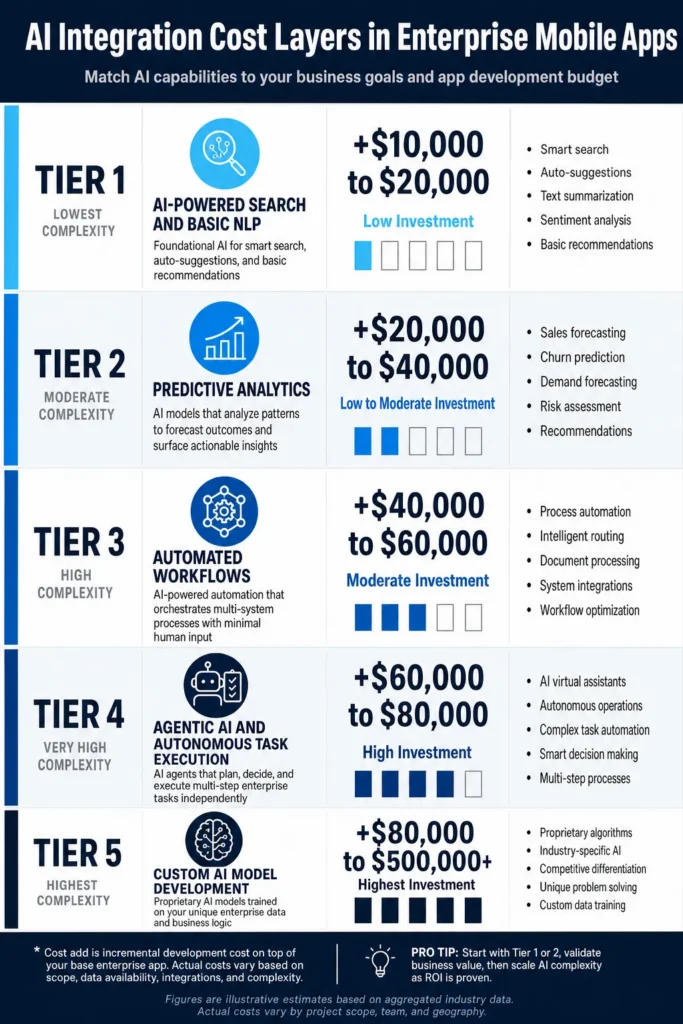
This is the cost driver that has shifted most in the past 12 months. Gartner predicts 40% of enterprise applications will be integrated with task-specific AI agents by end of 2026, up from less than 5% in 2025. That is an eightfold increase in a single year, and it directly shapes mobile app investment decisions today.
AI features now routinely requested include predictive analytics, natural language search, automated reporting, anomaly detection, and AI-assisted workflows. Each adds $20,000 to $80,000 per capability depending on whether you are integrating an existing API or building custom models. Businesses that defer AI integration today risk an expensive rebuild within 18 to 24 months.
4. Security, Compliance, and Regulatory Architecture
Security is non-negotiable, and its costs are frequently underestimated. The average time to identify a data breach is 207 days, and 76% of enterprise mobile breaches involve compromised credentials. Global information security spending is projected to reach $244.2 billion in 2026, up 13.3% year-over-year.
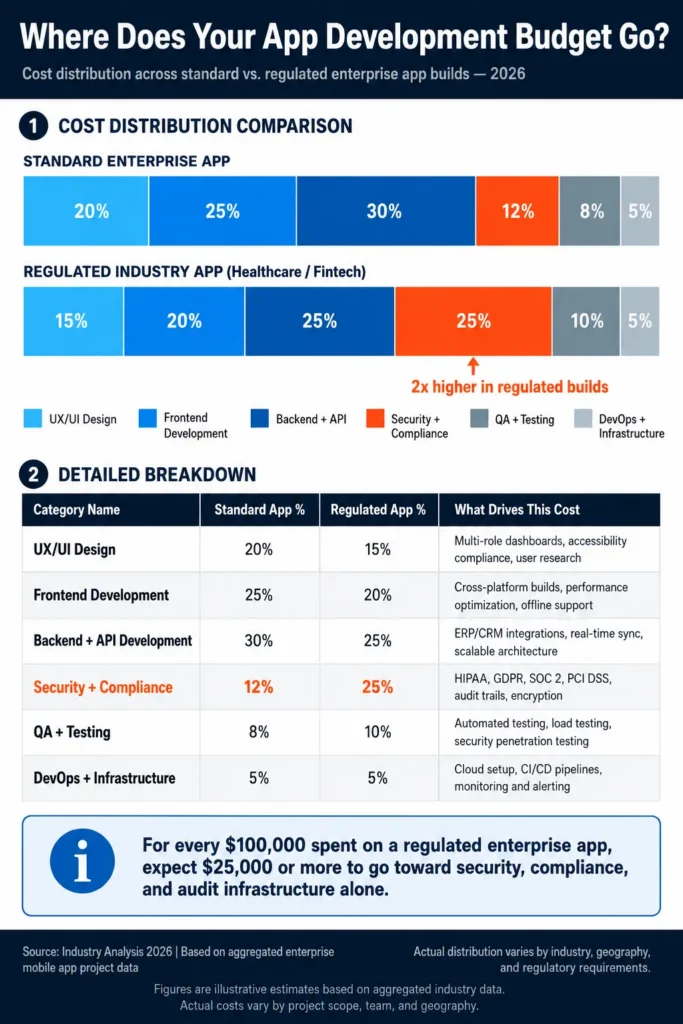
For enterprise builds, the security and compliance layer typically adds 15-25% to total enterprise app development cost. Compliance frameworks that directly affect architecture decisions and mobile app cost include GDPR, HIPAA, SOC 2 Type II, PCI DSS, and the EU AI Act for apps using automated decision-making.
Organizations operating across multiple jurisdictions face compounding costs, as each framework demands specific audit trails, data residency controls, and access governance.
5. Backend Complexity and System Integrations
Enterprise apps rarely operate in isolation. Most connect to existing ERP systems, CRM platforms, HR software, payment gateways, or analytics engines. Every integration point adds development effort, API licensing, and testing complexity.
A basic build with one or two integrations might add $15,000 to $30,000 in backend work. A platform connecting to five or more enterprise systems with real-time sync and bi-directional data flow can add $80,000 to $150,000 in backend development alone, making integration depth one of the most impactful variables in any app cost estimate.
6. Team Location and Hiring Model
Where your development team is located creates one of the most significant variables in app development pricing. Current 2026 market rates by region:
Region | Blended Hourly Rate |
United States / Canada | $100 – $200/hour |
Western Europe | $80 – $150/hour |
Eastern Europe | $40 – $80/hour |
India and South Asia | $25 – $60/hour |
Latin America | $40 – $75/hour |
Global hourly rates softened approximately 9-16% across many regions in 2025 as AI tooling compressed delivery time. However, total project app development budget figures have not dropped proportionally because teams are now building more feature-rich apps with deeper integrations and stricter compliance requirements than they were 24 months ago.
7. Ongoing Maintenance and Total Cost of Ownership
Build cost is only the beginning. Annual maintenance for an enterprise mobile app typically runs 15-25% of the initial development investment. First-year maintenance frequently reaches 50% of build cost due to bug resolution, OS compatibility updates, and feature iterations driven by user feedback.
A complete mobile app investment calculation must include annual update cycles, cloud infrastructure ($1,000 to $10,000 per month at scale), third-party API licensing, security monitoring, and ongoing user support. A $200,000 build will typically cost an additional $30,000 to $50,000 per year to maintain and evolve.
MVP-First vs. Full-Scope: How Strategy Changes Your App Development Budget
An MVP-first approach, where you launch the core workflow and expand in phases, can reduce the initial app development budget by 40-60%. This works well for organizations deploying a new mobile-first tool for the first time, or for customer-facing apps where market feedback should shape feature prioritization.
Full-scope delivery makes more sense for mission-critical internal tools, regulated industry applications, and platforms where phased rollouts introduce operational risk. The right decision depends on how well-defined your requirements are, how stable your integration landscape is, and how much organizational change management is involved.
The ROI Case for Mobile App Investment
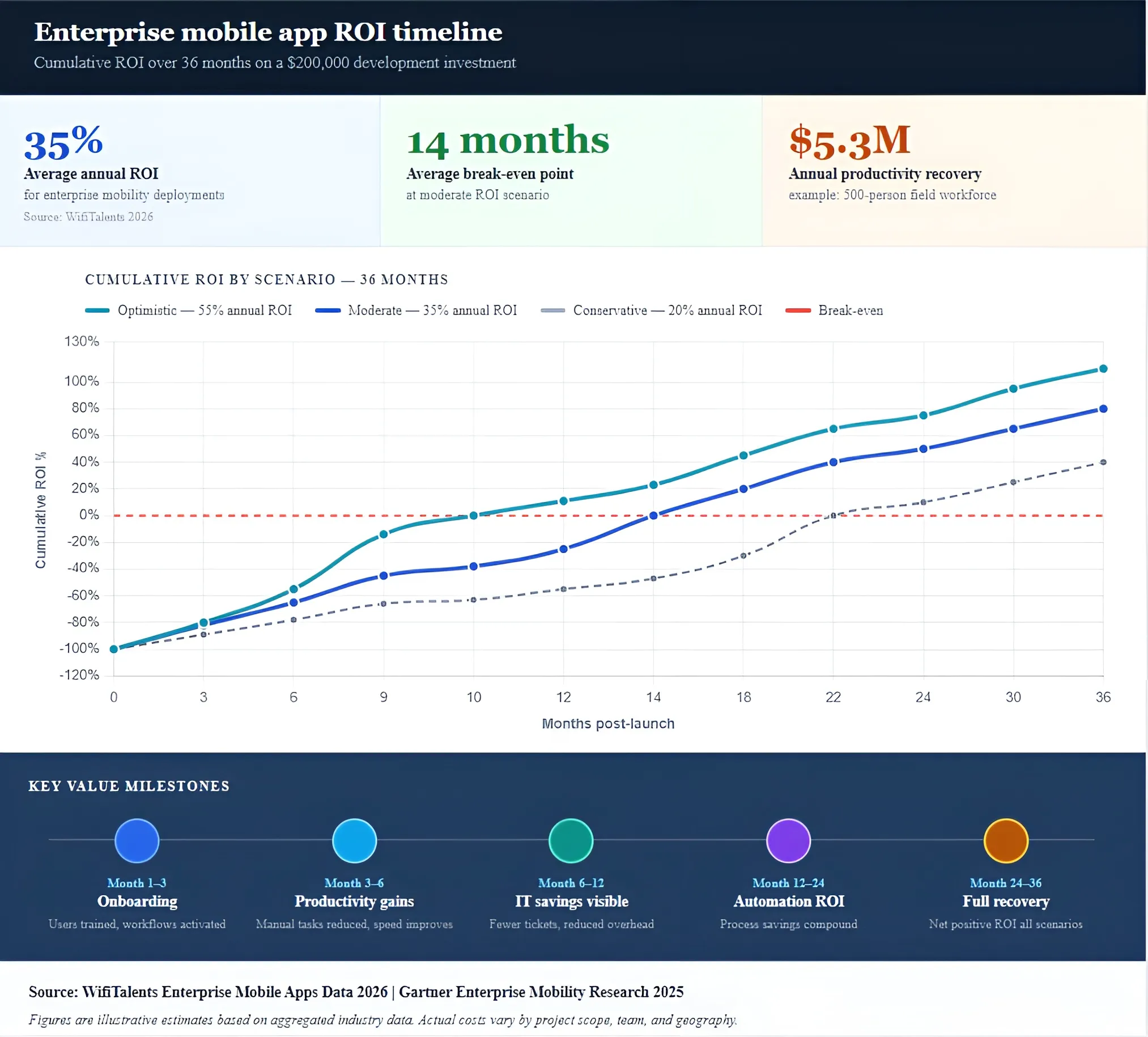
The mobile app investment conversation should not stop at cost. The average ROI for an enterprise mobility deployment is estimated at 35% within the first two years, driven by productivity gains, reduced manual processes, faster decision-making, and improved user experience.
Consider the math: a 500-person field workforce saving 45 minutes per day through a better mobile workflow tool, at an average fully-loaded hourly cost of $35, recovers approximately $5.3 million annually. A $300,000 enterprise mobile app development cost pays back in weeks, not years.
Organizations that have made this mobile app investment report 46% faster internal communication speeds, measurable reduction in data entry errors, and higher customer satisfaction scores tied directly to mobile-first experience improvements.
What Most App Cost Estimates Miss
Vendor quotes frequently undercount four categories that consistently cause budget overruns:
Discovery and architecture planning is often excluded from initial quotes but adds $15,000 to $40,000 for a complex build. Skipping it raises both risk and long-term rework costs.
Change management and training is a real business cost. Deploying a new enterprise app without structured adoption support leads to low utilization and weak ROI regardless of how well the app is built.
App Store and enterprise distribution setup, particularly for iOS, requires provisioning, MDM configuration for internal tools, and ongoing certificate management. This adds time and cost that rarely appears in a first quote.
Post-launch performance optimization is rarely included in fixed-price contracts. Apps serving hundreds or thousands of concurrent users will need tuning once real-world load patterns emerge. Planning for this in your app development budget from the start avoids unwelcome surprises at scale.
A Practical App Development Budget Framework for 2026
Rather than anchoring to a single number, use these bands as your starting app cost estimate reference:
- $25,000 to $75,000: Single-function internal tools, basic workflow apps, minimal integrations
- $75,000 to $200,000: Multi-role enterprise tools with ERP/CRM integration and analytics
- $200,000 to $500,000: AI-enabled platforms with advanced security, compliance, and scale
- $500,000+: Mission-critical, regulated, or multi-region enterprise systems
Your actual number within each band is shaped by development approach, team location, AI feature scope, integration complexity, and compliance obligations. Use a structured app cost estimate process, not a ballpark figure, before committing to any vendor or timeline.
Final Thoughts
Enterprise app development cost in 2026 is not a fixed number. It is a function of scope, standards, and strategic intent. Organizations that treat this as a cost center will get a different outcome than those that treat it as an operational multiplier and competitive differentiator.
The more important question is not how cheaply you can build it, but how much value a well-built platform generates relative to its total mobile app development cost over three to five years.
At AppStudio, we help businesses of all sizes answer that question accurately before a single line of code is written. Our engagements start with a structured discovery process that maps your goals to the right architecture, development approach, and realistic app development pricing, so there are no surprises at go-live and no capability gaps three months after launch.
If you are planning a build in 2026, the best starting point is to book a consultation with an enterprise mobile app specialist before you commit your budget. A single scoping conversation can save months of rework and tens of thousands in avoidable costs.