
 iOS App Development
 Android App Development
 React Native
 Flutter
 Web Development
 Custom Software
 Front End Development
 Blockchain Development
 Virtual Reality
 Cloud Computing
 IoT Development
 Augmented Reality
 Write us a message
Selecting the right software development engagement model is one of the most consequential decisions an enterprise technology leader will make before a project begins. It shapes cost structures, delivery timelines, resource allocation, risk ownership, and the flexibility available to respond to evolving business requirements. Yet this decision is frequently treated as a formality rather than a strategic lever.
For enterprise organizations operating at scale, the stakes are particularly high. A misaligned engagement model for software development does not merely inflate costs or cause delivery delays. It can erode cross-functional trust, introduce compliance exposure, and undermine the long-term maintainability of a platform that hundreds or thousands of internal and external users depend upon.
This article provides a structured, objective framework for evaluating the three primary app development models available to enterprise programs: Fixed Price, Time and Materials, and Dedicated Team. Understanding the structural mechanics, risk profiles, and optimal use cases of each model is essential for procurement leaders, CTOs, and program managers tasked with delivering complex digital solutions.
Why Engagement Model Selection Matters at the Enterprise Level
Enterprise application development is rarely a contained, linear process. Requirements evolve as stakeholders refine their understanding of the problem space. Regulatory constraints shift. Integration dependencies surface late. Legacy architecture introduces constraints that were not anticipated during scoping.
The chosen engagement model governs how cost, scope, and delivery timelines respond to these realities. An app development model that works well for a startup building a minimum viable product may introduce substantial operational friction when applied to an enterprise modernization initiative spanning multiple business units, compliance frameworks, and integration layers.
Procurement teams must move beyond cost-per-hour comparisons and evaluate each model through the lens of strategic fit, organizational readiness, and risk distribution.
The Three Primary Engagement Models for Enterprise App Development
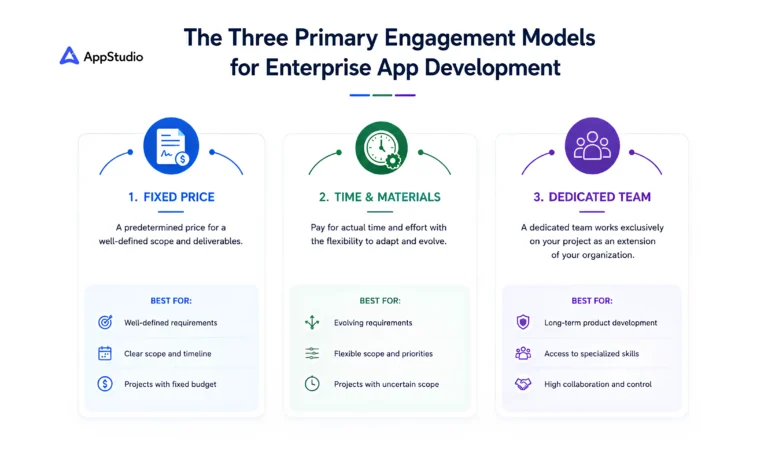
Enterprise software procurement teams are typically presented with three well-established engagement structures, each designed to address a different set of project conditions. Selecting among them requires a clear understanding of how scope, cost accountability, and delivery responsibility are allocated under each arrangement.
The right model is not simply a matter of preference or budget. It is a function of how well-defined your requirements are, how long the program will run, how much flexibility you need during delivery, and how much governance capacity your internal teams can commit. Getting this decision right from the outset prevents costly structural misalignments that are difficult to unwind once a program is underway.
The three software development engagement models are Fixed Price, Time and Materials, and Dedicated Team. Each carries distinct commercial mechanics, risk profiles, and governance requirements, which are examined in detail below.
Fixed Price Engagement Model
How It Works
Under a Fixed Price arrangement, the client and vendor agree to a defined scope of work, a set delivery timeline, and a predetermined budget before development begins. The vendor assumes responsibility for delivering the agreed scope within that budget, regardless of the actual effort required.
When It Works Well
Fixed Price engagements are most effective when project requirements are clearly understood, stable, and unlikely to change materially during the course of delivery. Suitable scenarios include:
- Development of a discrete, well-scoped module with clearly defined inputs and outputs
- Regulatory compliance tooling where requirements are codified and non-negotiable
- Version upgrades or platform migrations with known technical parameters
- Proof-of-concept builds with tightly bounded functionality
Risk and Cost Dynamics
From the client’s perspective, Fixed Price offers budget certainty and reduces the administrative overhead of ongoing time tracking and approval cycles. However, this apparent simplicity carries embedded risks that enterprise teams must account for.
Vendors bidding on Fixed Price contracts typically build contingency into their estimates to protect against scope uncertainty. This risk premium can inflate the total contract value relative to actual effort delivered. More critically, when requirements evolve during delivery, which is the rule rather than the exception in enterprise environments, change requests become a friction point. Scope negotiations can stall progress, incentivize minimal viable compliance rather than quality delivery, and damage the vendor relationship.
Bottom Line for Enterprise
Fixed Price is appropriate for well-defined, bounded workstreams where both parties have high confidence in the specification. It is poorly suited to complex, multi-phase enterprise programs where scope clarity will emerge iteratively.
Time and Materials Engagement Model
How It Works
Under a Time and Materials (T&M) arrangement, the client pays for the actual time and resources consumed during development, at agreed rates per resource type. Scope can be adjusted throughout the engagement, and billing reflects the work actually performed.
When It Works Well
T&M is the predominant model for enterprise engagements that involve significant complexity, evolving requirements, or iterative discovery. It is well-suited to:
- Agile or scrum-based delivery programs where sprint scope is determined incrementally
- Digital transformation initiatives where business requirements are being refined in parallel with development
- Long-duration platform builds involving architecture decisions that require progressive elaboration
- Engagements where time-to-market is prioritized and scope flexibility is a business necessity
Risk and Cost Dynamics
When evaluating fixed price vs time and materials, the primary distinction lies in how each model handles uncertainty. Fixed Price embeds that uncertainty into the contract value upfront, while T&M surfaces it through ongoing governance. The primary risk in T&M engagements is budget exposure. Without robust governance structures, costs can escalate beyond initial projections. This model demands active client-side program management, including regular sprint reviews, velocity tracking, backlog governance, and clear escalation protocols for scope decisions.
For enterprises with mature PMO functions and experienced product ownership, these governance requirements are manageable and the benefits of flexibility far outweigh the administrative overhead. The key is ensuring that commercial terms include appropriate rate card transparency, not-to-exceed thresholds for planning cycles, and clear change management procedures.
T&M also promotes a more collaborative vendor relationship. Because the client and vendor share the uncertainty of a dynamic scope, there is a natural incentive alignment around quality and honest communication, rather than the adversarial dynamic that can develop under Fixed Price when actual effort diverges from estimated effort.
Bottom Line for Enterprise
Time and Materials is the preferred model for complex enterprise programs with evolving requirements, provided the organization has the internal capability to manage scope and budget governance effectively.
Dedicated Team Engagement Model
How It Works
The dedicated team engagement model operates differently from both Fixed Price and T&M. Rather than contracting for a defined scope or paying for consumed hours, the client engages a team of skilled professionals, including developers, architects, QA engineers, and often a delivery lead, who work exclusively on the client’s program for an extended period. The team operates as a functional extension of the client’s internal organization, embedded within its processes, tools, and culture.
When It Works Well
The dedicated team engagement model is optimal for enterprise organizations with significant, ongoing development needs that extend beyond a single project. It is particularly well-suited to:
- Long-term product development programs requiring deep domain knowledge accumulation
- Organizations with sustained digital product roadmaps spanning multiple years
- Cases where knowledge retention and institutional memory are critical to delivery quality
- Teams requiring specialized skill sets that are difficult to source and retain in-house
- Organizations seeking to accelerate capacity without the overhead and risk of permanent headcount expansion
Risk and Cost Dynamics
From a financial perspective, the dedicated team engagement model typically operates on a monthly retainer structure, providing cost predictability while maintaining delivery flexibility. Over time, the embedded team’s familiarity with the client’s architecture, processes, and domain creates compounding efficiency gains that reduce per-unit delivery cost.
The principal risk in this model is onboarding latency and the time required to achieve full productivity. Initial ramp-up periods require structured knowledge transfer and close collaboration between client stakeholders and the incoming team. Organizations that invest in this onboarding phase systematically achieve significantly stronger long-term outcomes.
A secondary consideration is vendor dependency. Enterprises must ensure that contractual terms address knowledge documentation requirements, transition planning, and intellectual property ownership to maintain strategic optionality.
Bottom Line for Enterprise
The dedicated team engagement model delivers maximum value for organizations with continuous product development needs, where accumulated domain expertise, team cohesion, and process integration translate directly into delivery quality and velocity over time.
Comparative Framework: Choosing the Right App Development Model
The following dimensions provide a structured basis for evaluating engagement model fit across your enterprise program:
Scope Definition. If requirements are fully specified and stable, Fixed Price is viable. If requirements will evolve, T&M or the dedicated team engagement model is more appropriate.
Project Duration. Short-duration, discrete workstreams favor Fixed Price or T&M. Long-duration programs with ongoing development needs favor a Dedicated Team structure.
Internal Governance Capacity. Organizations with mature PMO functions and strong product ownership can manage T&M and Dedicated Team engagements effectively. Organizations with limited governance capacity may benefit from the structural clarity of Fixed Price on bounded workstreams.
Risk Tolerance. In any fixed price vs time and materials evaluation, Fixed Price transfers delivery risk to the vendor at the cost of flexibility, while T&M and Dedicated Team distribute risk more equitably but require active client-side management.
Strategic Importance. For mission-critical platforms where quality, long-term maintainability, and continuous improvement are priorities, the dedicated team engagement model provides structural advantages that neither Fixed Price nor standard T&M arrangements can replicate.
Hybrid Approaches in Enterprise Contexts
Many mature enterprise technology programs do not rely on a single app development model across their entire portfolio. A common and effective approach is to apply Fixed Price to well-defined phase deliverables, such as an architecture assessment or a specific integration module, while engaging a Dedicated Team for ongoing platform development and feature delivery.
This hybrid approach allows organizations to manage cost certainty on discrete, bounded workstreams while maintaining the flexibility and continuity required for complex, evolving programs. Understanding the full spectrum of software development engagement models, and how they can be combined, gives enterprise leaders a meaningful strategic advantage when structuring large-scale programs.
Making the Right Decision for Your Enterprise Program
There is no universally correct engagement model for software development at the enterprise level. The optimal choice is a function of project scope clarity, organizational governance maturity, program duration, risk tolerance, and strategic intent.
What is clear, however, is that the decision deserves the same level of rigor and deliberation as technology stack selection or vendor evaluation. An app development model that is misaligned with the actual characteristics of a program introduces structural friction that no amount of talent or effort can fully overcome.
Enterprise technology leaders who invest the time to evaluate their chosen engagement model for software development honestly, and who build governance structures appropriate to the model they select, consistently achieve better outcomes: on cost, on quality, and on long-term platform sustainability.
If your organization is planning a significant enterprise application initiative and is navigating engagement model selection, a structured advisory conversation with an experienced delivery partner can provide the clarity and confidence needed to make the right decision from the outset.