
 iOS App Development
 Android App Development
 React Native
 Flutter
 Web Development
 Custom Software
 Front End Development
 Blockchain Development
 Virtual Reality
 Cloud Computing
 IoT Development
 Augmented Reality
 Write us a message
The conversation in the boardroom has shifted. For the past decade, low-code platforms were quietly classified by many CIOs as a containment problem, a category of tools to be monitored, restricted, and tolerated where business pressure made restriction impossible. That framing is now actively destroying enterprise value. The CIOs who continue to treat low-code as shadow IT to be policed are losing ground, every quarter, to peers who have re-architected it into a governed delivery platform that sits at the center of their application strategy.
This is not a forecast. It is the present state of enterprise IT, documented across analyst data, breach economics, and the operating choices of large enterprises that have already moved.
The Market Has Already Decided: Low-Code Is the New Default
The first thing every C-suite leader needs to internalize is that low-code is no longer an emerging category. It is the dominant model for new enterprise application development, and the data leaves little room for debate.
- The global low-code development platform market was valued at USD 37.39 billion in 2025 and is projected to reach USD 48.91 billion in 2026, on track to USD 376.92 billion by 2034 at a 29.10% CAGR. (Fortune Business Insights, 2025)
- Gartner forecasts that 75% of new enterprise applications will be built on low-code platforms by 2026, up from less than 25% in 2020. (Gartner, via Kissflow)
- Gartner further projects that by 2029, 80% of mission-critical applications will rely on low-code, moving these platforms from the periphery to the operational core of the enterprise. (Gartner, via Kissflow)
- Forrester research confirms that 87% of enterprise developers already use low-code platforms for at least some of their development work. (Forrester, via App Builder)
- By 2026, 80% of low-code users will come from outside the IT department, up from 60% in 2021. (Gartner, via Kissflow)
The strategic implication is that the question is no longer whether the enterprise will adopt low-code. It already has, with or without the CIO’s sponsorship. The only remaining question is whether the platform will be governed by IT or grown in the dark by individual departments.
The Real Cost of Treating Low-Code as a Shadow IT Problem
When low-code is framed as a risk to be suppressed rather than a capability to be channeled, the consequence is not the absence of low-code. It is the absence of oversight while adoption continues anyway. The financial impact of this stance is now quantifiable.
- The IBM Cost of a Data Breach Report 2025 identified shadow IT as one of the top three factors driving breach costs upward. Organizations with high levels of shadow IT experienced data breach costs USD 670,000 higher than organizations with low levels of shadow IT. (IBM, 2025)
- The average enterprise is estimated to host approximately 1,200 unofficial applications, creating an attack surface that security teams cannot see, let alone defend. (Kiteworks research, 2025)
- The global average cost of a data breach reached USD 4.44 million in 2025, while the U.S. average hit a record USD 10.22 million. (IBM, 2025)
- Studies indicate that 30% to 40% of IT spending in large enterprises flows through shadow IT channels, meaning a meaningful share of the technology budget is already being committed outside IT’s strategic plan. (Weweb, citing industry studies)
- 63% of breached organizations either do not have a governance policy for AI-enabled tools or are still developing one, and among those with policies, only 34% perform regular audits to detect unsanctioned tools. (IBM, 2025)
The pattern is consistent across these data points. The cost of treating low-code as a category to be excluded is not lower risk. It is higher risk that the CIO can no longer see, and that will surface only when something fails.
The Delivery Crisis That Low-Code Was Built to Solve
Even setting aside the shadow IT economics, the CIO who refuses to operationalize low-code is fighting a delivery problem that traditional development cannot solve. The supply-demand imbalance in software engineering is structural, not cyclical.
- 72% of IT leaders report that project backlogs are now preventing them from working on strategic initiatives. (Quixy)
- The United States alone is projected to face a 1.2 million developer shortage by 2026, and 82% of organizations report difficulty hiring engineers. (CMARIX)
- The global tech talent gap is forecast to reach 85.2 million unfilled roles by 2030. (Forrester, via Spidya)
- Traditional IT delivery cycles routinely require 3 to 12 months simply to start a project once it enters the backlog. (WeWeb)
- Forrester finds that low-code platforms enable cloud-native applications to be built more than 10 times faster and with 70% fewer resources than traditional development. (Forrester, via Quixy)
- IDC reports that low-code platforms accelerate the software development lifecycle by 62% for new applications and 72% for adding new features. (IDC, via ToolJet)
For the CIO, this is a delivery math problem. The enterprise needs more applications than the IT organization can ever staff for. Low-code is the only proven mechanism to expand delivery capacity without expanding headcount at an equivalent rate.
The CIO Who Treats Low-Code as a Delivery Platform: What Changes
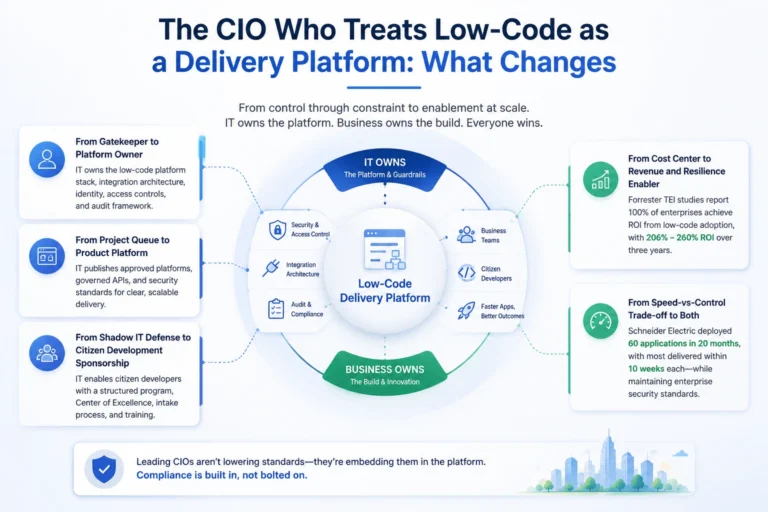
There is a clear pattern in how the leading CIOs have repositioned low-code. It is not about loosening control. It is about reasserting control through a different operating model, one in which IT owns the platform and the guardrails, while business units own the build.
The shift involves several specific changes to how the IT function operates.
- From gatekeeper to platform owner. IT no longer attempts to build every application. It owns the sanctioned low-code platform stack, the integration architecture, the identity and access controls, and the audit framework. Business teams build within these boundaries.
- From project queue to product platform. Instead of an opaque backlog, IT publishes the approved platforms, the data sources available through governed APIs, and the security standards each application must meet before promotion to production.
- From shadow IT defense to citizen development sponsorship. Rather than auditing for unauthorized tools, IT formally enables a citizen developer program with a defined Center of Excellence, intake process, and training curriculum.
- From cost center to revenue and resilience enabler. Forrester’s Total Economic Impact studies report 100% of enterprises achieve ROI from low-code adoption, with documented ROI between 206% and 260% over three years. (Forrester, via Planet Crust)
- From speed-vs-control trade-off to both. Schneider Electric deployed 60 applications in 20 months on its low-code platform, with most delivered within 10 weeks each, while maintaining enterprise security standards. (AIMultiple, via Adalo)
The CIOs making this shift are not relaxing standards. They are codifying them inside the platform so that compliance is built in, rather than enforced after the fact.
The Financial Case the CFO Will Understand
Because this is ultimately a board-level decision, the case must hold up in financial terms. The data on this is unusually consistent across vendor-independent sources.
- Forrester’s Total Economic Impact analysis of Microsoft Power Platform documented 224% ROI over three years with USD 81.7 million net present value. (Forrester Consulting)
- Ricoh’s deployment of OutSystems delivered 253% ROI with full payback in 7 months. (Forrester TEI, via CMARIX)
- Enterprises using low-code report avoiding the hiring of two additional developers on average, generating approximately USD 4.4 million in business value over three years. (Quixy, citing industry research)
- Organizations using AI and automation extensively in security operations save an average of USD 1.9 million per breach, and the same governance and observability layers that secure low-code platforms contribute directly to this saving. (IBM, 2025)
- 78% of Fortune 500 firms now deploy low-code into mission-critical systems, indicating that the platform category has cleared enterprise procurement and risk thresholds. (Roots Analysis)
The financial argument is no longer speculative. It is built on multi-year, audited customer studies across the largest enterprise platforms in the market.
What the Losing CIO Looks Like in Two Years
It is worth being explicit about the trajectory of the CIO who chooses the shadow IT framing. The pattern is predictable.
- The enterprise will continue to adopt low-code tools at the departmental level, regardless of IT policy, because the business pressure to deliver is greater than the cost of non-compliance.
- The CIO will be unable to inventory the resulting applications, meaning the 1,200-application shadow surface documented in industry research will exist inside the organization, unmanaged. (Kiteworks)
- When a breach occurs, 97% probability suggests it will involve a system that lacked proper access controls, based on IBM’s 2025 finding regarding AI-related breaches in environments without governance. (IBM, 2025)
- The IT backlog will continue to grow because the only outlet IT has approved, traditional development, cannot scale to demand.
- Business unit confidence in IT will erode, accelerating the migration of build authority away from the CIO’s office and toward business technologists who report elsewhere.
- The CIO’s strategic seat at the executive table will narrow, because the function will be perceived as a constraint on delivery rather than a source of it.
This is not a hypothetical degradation. It is the documented pattern across enterprises that have studied their own shadow IT exposure.
What the Winning CIO Does in the Next Four Quarters
For the CIO who chooses the delivery platform framing, the operating moves are specific and sequenced.
- Quarter one: inventory and platform consolidation. Conduct a full discovery of low-code and citizen development tools already in use across the enterprise. Gartner indicates that 75% of large enterprises are already using four or more low-code tools, so consolidation, not introduction, is typically the first task. (Gartner, via Alpha Software)
- Quarter two: governance framework and Center of Excellence. Establish a dual-sponsored CoE (typically COO and CIO co-sponsorship), a written governance charter, and an intake framework that classifies applications by risk and complexity before they are built.
- Quarter three: integration architecture and security baseline. Stand up the governed API layer, identity and access controls, and audit logging that every approved low-code application must inherit by default. The goal is to make compliant building the easiest path.
- Quarter four: scaled enablement. Launch the formal citizen developer enablement program. Industry data shows that within the first year of a citizen development initiative, approximately 79% of organizations successfully build and launch at least one production application. (Index.dev)
- Ongoing: outcome measurement. Report on backlog reduction, application delivery velocity, business unit satisfaction, and avoided shadow IT cost as core IT performance metrics, alongside traditional uptime and security indicators.
The sequence matters. Governance and integration architecture before scaled enablement is the difference between a delivery platform and a sanctioned form of shadow IT.
The Strategic Conclusion for the C-Suite
The decision in front of the CIO is not whether low-code will be present in the enterprise. That decision has been made by the market, the business units, and the developer shortage. The decision is whether the CIO will own the platform on which it runs.
- The CIO who treats low-code as a shadow IT risk will spend the next several years auditing, restricting, and absorbing the cost of breaches and backlog they could not control.
- The CIO who treats low-code as a delivery platform will spend the same years expanding their delivery capacity, reducing their backlog, hardening their security posture through unified governance, and proving an ROI the CFO can defend.
Both CIOs will be working hard. Only one of them will be building strategic advantage. The data, from Gartner, Forrester, IBM, IDC, and the published economics of the largest enterprises in the market, has made it increasingly difficult to argue that the first path leads anywhere except to a smaller seat at the executive table.
The enterprises that will define the next decade of digital operations are the ones whose CIOs have already made this choice. The window to follow them, with the strategic advantage still intact, is narrowing each quarter.
Ready to turn your low-code footprint from a shadow IT risk into a governed delivery platform? Schedule a consultation with our team. We will assess your current maturity, identify your highest-priority governance gaps, and build a four-quarter roadmap that delivers measurable ROI before your next budget cycle.