
 iOS App Development
 Android App Development
 React Native
 Flutter
 Web Development
 Custom Software
 Front End Development
 Blockchain Development
 Virtual Reality
 Cloud Computing
 IoT Development
 Augmented Reality
 Write us a message
Introduction: The Contract Obsession That Quietly Kills Enterprise Projects
Before a single architecture decision is made, before a development team is evaluated, and often before the scope has been clearly defined, most enterprise organizations send a contract to legal.
The instinct is understandable. When your organization is preparing to build enterprise applications at scale, spending potentially millions of dollars and committing engineering resources for 12 to 24 months, you want protection. You want terms. You want recourse if something goes wrong.
But here is the uncomfortable truth that experienced technology leaders already know: the enterprise app development contract is rarely the thing that saves a failing project, and it is never the thing that makes a successful one.
This is not an argument against having a proper app development agreement in place. Contracts matter. Intellectual property clauses, liability limits, and data handling terms are all legitimate business concerns. But when organizations treat the application development contract as the primary governance mechanism for a complex build, they are addressing the symptoms of project risk while ignoring the root causes entirely.
This article explains what those root causes actually are, and where enterprise technology leaders should be concentrating their energy before, during, and throughout a major application build.
What an App Development Contract Can and Cannot Do
An app development agreement is a legal instrument. It defines scope, outlines payment milestones, allocates intellectual property, and establishes liability frameworks. In a well-structured engagement, it also includes provisions for change management, dispute resolution, and source code ownership.
What a well-drafted application development contract cannot do is any of the following:
- Guarantee that the requirements you documented in month one actually reflect what your business needs in month six
- Ensure that the development team assigned to your project has the contextual knowledge to build for your specific regulatory environment, user base, or integration landscape
- Compensate for ambiguous acceptance criteria when a vendor delivers software that technically meets the contract but fails to meet expectations
- Recover the six months of organizational momentum you lose when a vendor relationship breaks down and you have to restart procurement
The gap between what enterprises expect from their app development contract and what it realistically delivers is where most enterprise software failures quietly begin. Legal protection is not a substitute for operational alignment.
The Three Decisions That Actually Determine Enterprise App Build Outcomes
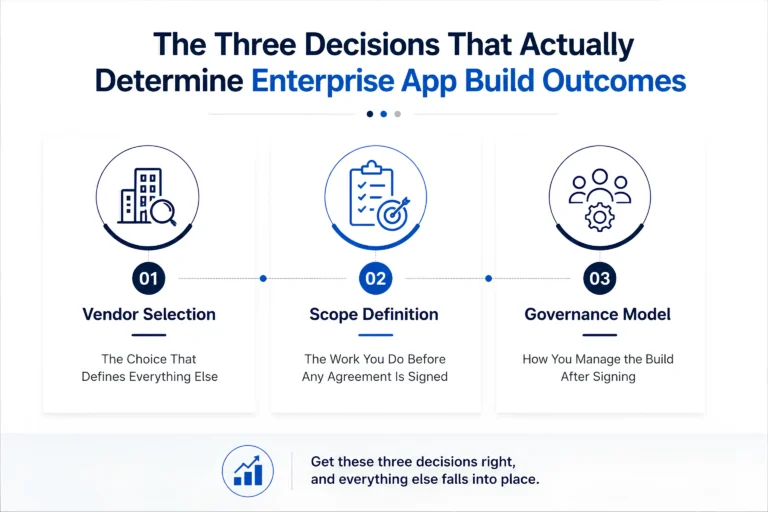
1. Vendor Selection: The Choice That Defines Everything Else
Before you negotiate a single clause in your enterprise app development agreement, you will have already made the most consequential decision of the entire engagement: who you are building with.
Enterprise application development is not a commodity service. The difference between a development partner who understands distributed system architecture, legacy system integration, and enterprise security requirements, and one who simply has competitive day rates, is the difference between a project that delivers business value and one that delivers a codebase you will spend years maintaining or replacing.
The criteria that matter in vendor selection go far beyond portfolio reviews:
Technical depth in your specific domain. A firm that builds consumer-facing mobile applications and a firm that builds compliance-grade financial systems require fundamentally different capabilities. Generic software development experience does not transfer equally across industries. Evaluate whether the vendor has built systems that face the same regulatory, performance, and integration constraints your build will face.
Discovery and requirements methodology. How a vendor handles ambiguity during pre-sales tells you almost everything about how they will handle it during delivery. Ask them to walk through their requirements gathering process. Ask how they handle scope changes. Ask what their escalation path looks like when requirements contradict each other. The answers reveal whether you are looking at a delivery partner or a body shop.
Team stability and assignment practices. Many development firms win engagements with senior architects and deliver them with junior teams. Contractual language about staffing does exist, but behavioral signals during the sales process are more reliable. Ask specifically who will be assigned to your account, what their engagement history looks like, and what happens to your project if a key person leaves.
Reference validation, not reference collection. Do not accept a list of reference clients. Call them. Ask specifically about how the vendor handled scope changes, what the quality of communication was during difficult phases, and whether they would re-engage the same team for their next build.
No app development contract can compensate for a vendor selection process that produces a poor match.
2. Scope Definition: The Work You Do Before Any Agreement Is Signed
The second decision that determines enterprise app build outcomes is the quality of your scope definition work. This is where most organizations underinvest, and where most project failures trace their origins.
When enterprises begin to build enterprise applications without a rigorous discovery process, they create a foundational problem that no contract can solve. A poorly defined scope means that every milestone in your application development contract is measuring delivery against criteria that were never precise enough to be meaningful. Vendors can deliver on contract while failing to deliver on expectation, and the friction that follows consumes time, budget, and organizational trust.
Effective scope definition for enterprise application builds typically includes:
A clear separation between functional and non-functional requirements. What the application does is only part of the requirement. How fast it must respond, how many concurrent users it must support, what uptime standards it must meet, and which compliance frameworks it must satisfy are equally critical. Non-functional requirements are consistently the source of post-delivery disputes because they were not specified before the engagement began.
Integration mapping and dependency documentation. Enterprise applications do not exist in isolation. They connect to ERP systems, identity management platforms, data warehouses, third-party APIs, and legacy infrastructure. Each integration point carries risk. Mapping every dependency before the engagement begins surfaces assumptions that would otherwise become blockers during delivery.
A defined change management process. Scope will change. Requirements will evolve. Business priorities will shift. Organizations that treat scope change as a failure are organizations that either freeze development into irrelevance or spend the entire engagement in disputes about what was originally agreed. A mature change management process acknowledges that change is normal, defines how it is evaluated, and establishes how it affects timeline and cost. This is a process question, not a contract question.
3. Governance Model: How You Manage the Build After Signing
The third decision is the governance model you put in place for the duration of the engagement. This is the area where enterprise organizations most frequently underinvest, particularly in the early months when the project appears to be tracking well.
An enterprise app development agreement defines the formal boundaries of the engagement. It does not define how decisions get made when those boundaries are unclear, how escalations are handled when delivery velocity slips, or how strategic changes to the product roadmap are incorporated without derailing active development cycles.
Governance structures that actually work in enterprise application builds share several characteristics:
Defined decision authority at each level. Developers, architects, product owners, and executive sponsors should all have clarity about what decisions they are authorized to make and which decisions require escalation. When this is ambiguous, minor decisions stall in approval queues and major decisions get made informally without proper documentation.
Structured cadences with substantive agendas. Weekly status calls that recap completed tickets are not governance. Governance is a structured review of delivery metrics against milestones, risk identification, dependency status, and decision documentation. If your standing meetings are not producing written decisions and action owners, they are social coordination, not project oversight.
Independent technical oversight. For enterprise builds above a certain complexity threshold, having an internal technical lead or an independent architect who is not part of the delivery team review design decisions and delivery artifacts is one of the most underutilized risk management tools available. It is far less expensive than discovering architectural debt after go-live.
Milestone definitions that reflect business value, not activity. Contract milestones tied to lines of code delivered, sprints completed, or modules deployed measure activity, not outcomes. Milestones tied to functional capabilities that work end-to-end in a production-equivalent environment give you genuinely useful signals about whether the build is on track.
What Belongs in the Contract vs. What Belongs in Governance
To be clear about the role of the enterprise app development contract: there are elements that absolutely should be in a formal agreement, and enterprises should not treat these as secondary.
Intellectual property ownership. Source code, architecture documentation, and all work product should vest with the client at completion. This should be explicit, not assumed.
Data handling and security obligations. For enterprise applications handling regulated data, the application development contract should specify compliance obligations, security standards, and breach notification requirements with specificity, not generality.
Escalation and dispute resolution pathways. A well-structured app development agreement will define what happens when delivery milestones are missed, when requirements disputes arise, and when either party needs to exit the engagement. These provisions are operational, not just legal.
Payment tied to demonstrable delivery. Milestone payments should be tied to working software in testable environments, not to documentation deliverables or sprint completions. This creates shared accountability.
What does not belong exclusively in the contract is the management of ongoing delivery risk. Contracts are signed once. Projects run for months. The governance operating model you build around the engagement is what manages the delivery between the signature and the go-live.
The Signs Your Organization Is Over-Indexed on the Contract
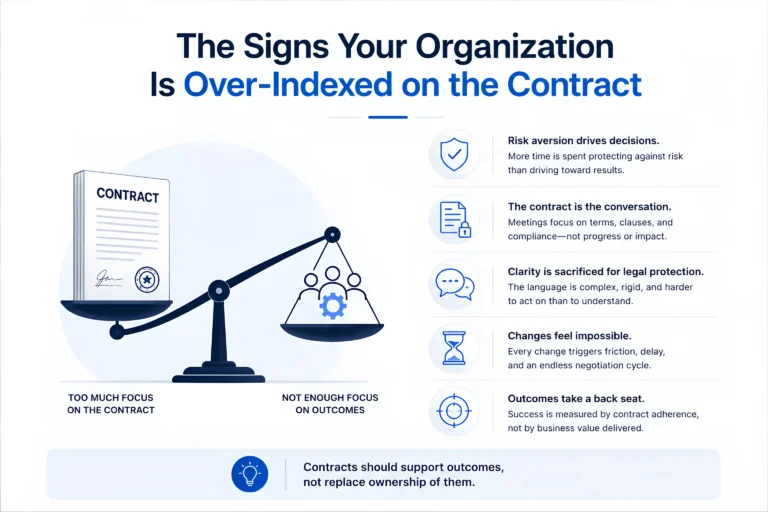
There are patterns that signal an enterprise organization is treating the app development agreement as a primary risk management tool rather than one component of a broader delivery structure:
Legal cycle time exceeds discovery cycle time. If your legal team is spending more calendar time on contract negotiation than your technical team is spending on requirements definition and vendor technical evaluation, your risk allocation is inverted.
Procurement drives vendor selection criteria. When the dominant selection criteria are price, insurance coverage, and contractual flexibility rather than technical capability, domain experience, and delivery methodology, the procurement function is optimizing for contract risk rather than delivery outcomes.
There is no internal product owner assigned to the build. An application development contract assigns responsibilities to the vendor. It cannot assign accountability to your organization. If there is no internal owner with the authority and availability to make daily product decisions, the vendor will make those decisions for you, and the contract will not save you from the consequences.
Acceptance criteria are left to be defined later. Any enterprise app development agreement that defers acceptance criteria to post-signing documentation is setting up a milestone dispute. What constitutes successful delivery should be defined before the contract is executed.
Building for Outcomes, Not for Coverage
The organizations that consistently build successful enterprise applications share a common orientation: they treat the contract as the floor, not the ceiling, of their project governance.
They negotiate a sound app development agreement. They protect their intellectual property. They define their liability terms. And then they move their attention to the things that actually determine whether the build delivers business value: vendor capability, scope quality, integration strategy, team structure, and ongoing governance.
When a build succeeds, it succeeds because the right team built the right thing with a functioning operating model around them. When a build fails, it fails because one or more of those elements was missing, and no application development contract has ever closed that gap.
The decision to sign is, in fact, the least important decision you will make. The decisions you make before, and the way you manage what comes after, are what matter.
Conclusion: Rebalance Where You Invest Your Due Diligence
Enterprise application builds are among the most complex, high-stakes initiatives an organization can undertake. They deserve rigorous due diligence, strong internal ownership, and a disciplined approach to vendor evaluation and ongoing governance.
What they do not need is for that rigor to be concentrated almost entirely in the legal review of an app development agreement while the operational fundamentals of the engagement receive comparatively little attention.
Revisit where your organization spends its pre-engagement energy. If the contract is getting more scrutiny than the vendor’s technical methodology, the scope definition process, and the governance model you will operate within for the next 12 to 24 months, the allocation is wrong.
Correct it before you sign anything.
Work With a Team That Understands What Enterprise Builds Actually Require
If your organization is preparing to build enterprise applications and you want to ensure that the foundations are set correctly from day one, we can help.
Our team works with enterprise technology leaders to structure engagements that are built for delivery outcomes, not just contractual coverage. From vendor evaluation frameworks and scope definition workshops to ongoing technical governance and independent architecture review, we bring the operational depth that complex enterprise application development requires.
Schedule a Free Consultation to discuss your enterprise app build with a senior member of our team. No sales cycle. No generic pitch. A direct conversation about where your project stands and what it needs to succeed.