
 iOS App Development
 Android App Development
 React Native
 Flutter
 Web Development
 Custom Software
 Front End Development
 Blockchain Development
 Virtual Reality
 Cloud Computing
 IoT Development
 Augmented Reality
 Write us a message
Every few years, the same question lands on a leadership team’s desk: should we keep maintaining the system that runs the business, or rebuild it from scratch? It feels like an architecture debate, but it is really a money question. Enterprise app modernization is, at its core, a technical-debt math problem. You rebuild when the cost of carrying the debt outweighs the cost of replacing the system, and not a moment sooner. Get that calculation wrong in either direction and you either bleed budget into a system that cannot keep up, or you torch capital on a greenfield development effort that recreates problems you already solved.
The stakes have risen sharply. 2025 was the most expensive year in the history of enterprise technology, with roughly $4 trillion poured into cloud, AI infrastructure, modernization programs, and software. Gartner put worldwide IT spending at about $5.43 trillion for the year, with enterprise software growing around 14 percent. Yet a large share of that money never reaches new capability. Two-thirds of global IT budgets still go to keeping existing systems running. This guide lays out how senior leaders can make the rebuild-or-maintain call with discipline rather than instinct.
What Enterprise App Modernization Actually Means
A spectrum, not a single act
Enterprise app modernization is the practice of updating, re-architecting, or replacing software so it meets current business needs, security expectations, and technology standards. It is a spectrum, not a single act. At one end sits light-touch work: upgrading frameworks, containerizing a monolith, or moving workloads to the cloud. At the other end sits a full software rewrite, where the application is rebuilt from the ground up. The application modernization services market reflects how central this has become, valued at roughly $22.7 billion in 2025 and projected to more than double by the early 2030s.
Why it is a discipline, not a one-time project
The mistake many organizations make is treating modernization as a one-time project rather than an operating discipline. Modernization without a sustained operating model simply relocates technical debt instead of removing it. The goal is not a heroic rebuild every decade; it is a system you can keep current at a manageable cost.
Technical Debt: The Number That Drives the Decision
What technical debt is costing enterprises now
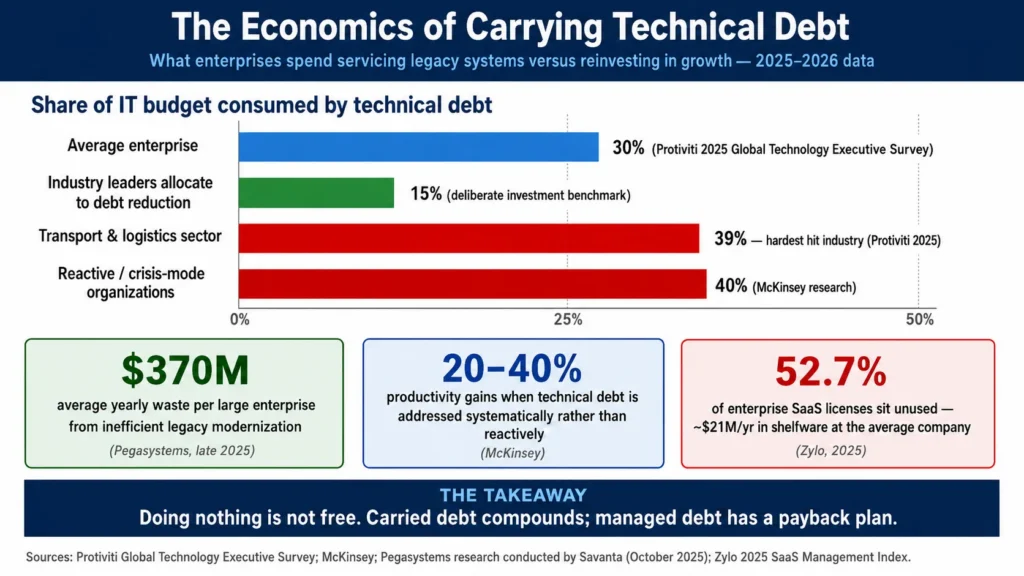
Technical debt is the accumulated cost of shortcuts, aging frameworks, and workarounds. Like financial debt, it carries interest, and that interest is now consuming an alarming share of budgets. The Protiviti 2025 Global Technology Executive Survey found organizations spend an average of 30 percent of their IT budgets servicing technical debt. McKinsey research estimates technical debt represents 20 to 40 percent of an organization’s entire technology estate value. In reactive, crisis-driven organizations, that figure climbs toward 40 percent of the IT budget, and in transport and logistics it reaches 39 percent.
The payoff for managing debt deliberately
The cost of carrying it is concrete. Pegasystems research from late 2025 found the average global enterprise wastes more than $370 million a year on inefficient legacy modernization. The encouraging counterpoint: firms that address technical debt systematically, rather than in panic, report 20 to 40 percent productivity gains, and leading companies deliberately allocate around 15 percent of their budget to debt reduction as a standing line item.
How to read your own technical debt number
If maintenance is comfortably under a third of your IT spend and the system still serves the business, the math favors maintaining and modernizing incrementally. As that share creeps toward 40 percent, money is being diverted from new products before a single line of new code is written, and the case for a more aggressive intervention strengthens.
Build vs Buy Software: Framing the Crossroads
The one test that settles most cases
Before deciding how to rebuild, decide whether you should build at all. The build vs buy software question turns on one test: is this capability standard for your industry, or is it the way you win? Standard functions such as HR, accounting, and basic CRM are almost always cheaper to buy. The capabilities that differentiate you are the ones worth owning. As one widely used framing puts it, you cook your signature dishes but you do not manufacture the stove.
The hidden costs on both sides
The economics here are easy to underestimate. With buying, the license is rarely the real cost. Hidden integration, configuration, data migration, and training can add 150 to 200 percent on top of the initial fee over time, and Zylo’s 2025 research found that 52.7 percent of SaaS licenses sit unused, with the average company wasting roughly $21 million a year on shelfware. With building, custom enterprise applications commonly run from $100,000 to $500,000 or more, plus the ongoing cost of an engineering team. Deloitte’s 2025 findings show organizations with proprietary core technology see about twice the revenue growth, but only when they build the right things.
Where the market is heading
The market is shifting toward custom. Retool’s 2026 build vs buy report, surveying more than 800 professionals, found 35 percent of enterprises have already replaced a SaaS tool with custom-built software, and 78 percent expect to build more internal tools in 2026, a shift accelerated by AI-assisted development. Buying still wins on speed for commodity needs, where off-the-shelf tools can deploy 40 to 60 percent faster than custom alternatives.
Greenfield Development and the Software Rewrite Trap
When a rebuild is the right call
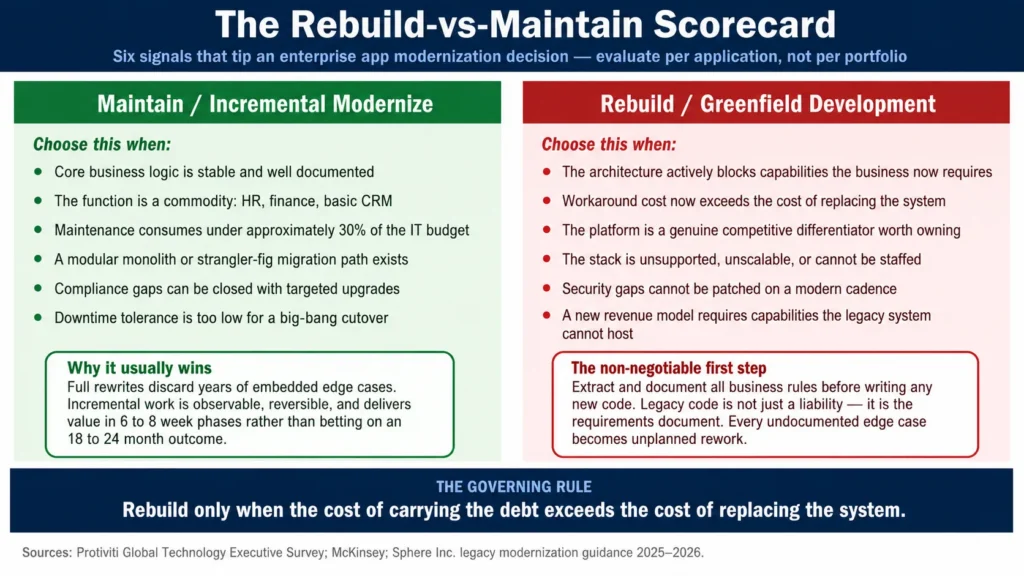
When the decision lands on rebuild, you are choosing greenfield development: starting fresh on a modern stack. It is the right call when the existing architecture actively prevents what the business needs, when workaround costs exceed rebuilding costs, or when the platform is a genuine competitive differentiator that the old stack cannot host. It is also the highest-risk path in the entire modernization spectrum, and it fails more often than leaders expect.
Why full rewrites fail
Full rewrites fail because they discard the business logic quietly embedded in old code: the edge cases, integrations, and rules accumulated over years. Teams rediscover these the hard way, through production incidents, budget overruns, and cancelled projects. The cautionary tale that circulates among architects is concrete: one insurer spent 18 months and $3.4 million rewriting a claims application, only to discover 47 undocumented business rules buried in a single user-interface event handler. The old code, in effect, was the requirements document.
The discipline that de-risks a rewrite
The discipline that separates successful greenfield development from expensive failure is simple to state and hard to do: extract and document the existing business rules before writing new code. A software rewrite that skips this step is not a fresh start, it is a slow-motion rediscovery of everything the legacy system already knew.
A Practical Framework for the Decision
Five questions to ask per application
Senior teams can cut through the noise with a short sequence of questions, applied per application rather than to the whole estate at once. The portfolio almost never deserves a single answer.
- Differentiator test: Is this the way you win, or a commodity? Commodity goes to buy; differentiators justify a build.
- Debt test: What share of spend does this system consume in maintenance, and is that share rising toward the 40 percent danger zone?
- Blocker test: Does the current architecture merely cost more, or does it actively prevent capabilities the business now requires?
- Knowledge test: Are the embedded business rules documented and extractable, or do they live only in the running code and a few people’s heads?
- Reversibility test: Can you modernize incrementally and observably, or are you forced into a single high-risk cutover?
Reading the answers
When the answers point to commodity, manageable debt, and recoverable risk, maintain and modernize in place. When they point to a true differentiator blocked by its own architecture, with extractable knowledge and an appetite for the risk, a rebuild becomes defensible. Most enterprises land somewhere in between, which is why incremental, reversible approaches like the strangler-fig pattern have become the default for so much modern work.
The Cost of Doing Nothing
It is tempting to treat delay as the safe, free option. It is neither. Companies running legacy systems are roughly 40 percent more likely to experience compliance failures, a risk that compounds as data and security regulations tighten. Unsupported software adds direct cost too: when Windows 10 support ended in October 2025, organizations choosing to delay faced extended security update fees rising from around $61 per device in the first year toward $244 per device by the third. Every dollar spent buying time funds no new capability. Inaction is a decision, and it carries its own bill.
Making the Call With Confidence
Enterprise app modernization rewards leaders who treat it as a financial discipline rather than a technical reflex. Measure what your technical debt actually costs, separate the commodity capabilities you should buy from the differentiators worth building, and reserve greenfield development for the cases where the architecture genuinely blocks the business and the embedded knowledge can be carried forward. Done this way, modernization stops being a periodic crisis and becomes a managed, intentional investment with a clear payback plan.
Your next step
If your team is weighing a rebuild against another year of maintenance, the most valuable first step is an honest assessment of where your debt sits and what each path would truly cost over five years. AppStudio runs structured modernization assessments that put real numbers behind the rebuild-or-maintain decision before any code is written. Book a modernization assessment to see which path the math supports for your systems.