
 iOS App Development
 Android App Development
 React Native
 Flutter
 Web Development
 Custom Software
 Front End Development
 Blockchain Development
 Virtual Reality
 Cloud Computing
 IoT Development
 Augmented Reality
 Write us a message
The conference room falls quiet when an enterprise application is performing its core function without error. Dashboards are green. Tickets are low. Leadership moves on to other priorities.
This is precisely where the risk begins.
Across the world’s largest organisations, the most consequential failures do not originate in systems that are obviously broken. They originate in systems that appear to be functioning accumulating technical debt, widening security exposures, and quietly drifting out of alignment with business strategy. By the time the dysfunction becomes visible, the cost of correction has multiplied many times over.
This article examines why the “working well enough” phase of an enterprise app’s lifecycle is, counterintuitively, its most dangerous and what executive leadership must do to prevent complacency from becoming catastrophe.
The Complacency Trap: When Stability Becomes a Liability
Enterprise organisations are built for operational continuity. When a system runs without incident, it signals success. When it requires no immediate intervention, it drops from the executive agenda. This institutional reflex rewarding stability and deprioritising what is not visibly broken is one of the most consequential governance traps in large-scale enterprise application management.
Research validates this directly:
- A survey of 500+ U.S. IT professionals identified complacency the belief that a current system “works well enough” as the single most pervasive barrier to enterprise application modernisation [Saritasa, 2025].
- 69% of IT leaders report that technical debt in their enterprise applications fundamentally limits their ability to innovate [OutSystems].
- 61% of technology leaders acknowledge that legacy application debt negatively affects organisational performance yet modernisation projects are still routinely deferred [OutSystems].
The mechanism is well understood. When a system runs without visible failure, there is no urgency. Without urgency, internal advocacy for modernisation loses traction. Without advocacy, budget allocation stalls. The cycle perpetuates until the system fails in a manner that is both abrupt and expensive.
The critical insight for C-suite leaders: The optimal window for enterprise application modernisation is not during failure. It is during the period of apparent stability when the organisation has the operational headroom and financial capacity to act strategically rather than reactively.
What "Working Well Enough" Is Actually Costing the Organisation
The costs associated with an enterprise application that is functioning but not modernised are rarely captured on a single line of a P&L statement. They are distributed across the enterprise embedded in maintenance overhead, opportunity cost, workforce productivity, and risk exposure.
The aggregate figures are substantial:
- The average global enterprise wastes more than $370 million per year due to its inability to efficiently modernise outdated legacy systems and applications [Pegasystems / Savanta, 2025].
- Technical debt now accounts for 40% of IT balance sheets, with CIOs estimating it represents 20–40% of their entire technology estate value [McKinsey].
- Gartner projects that 50% of enterprise applications will still contain avoidable technical debt by 2025 debt that was, by definition, preventable [Gartner].
- The global stock of accumulated technical debt across enterprise software now equates to 61 billion workdays of developer remediation effort [CAST Software, 2025].
These are not abstract engineering metrics. They represent capital consumed by inertia rather than channelled toward competitive advantage. For a large enterprise, the differential between proactive modernisation and deferred action can represent hundreds of millions of dollars in total cost of ownership over a three to five-year horizon.
The Hidden Architecture of Risk in a "Stable" Enterprise App
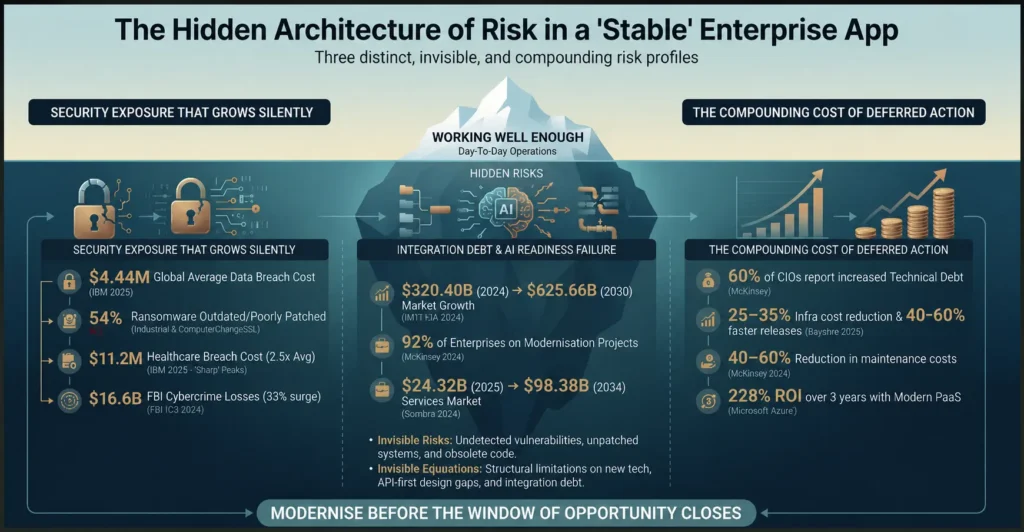
An enterprise application that is working well enough typically presents three distinct and compounding risk profiles all of which are invisible in day-to-day operations.
Security Exposure That Grows Silently
A legacy enterprise application does not announce when it becomes a security liability. Vulnerabilities accumulate as frameworks age, patches are deferred, and integration points multiply. The consequences when this exposure is exploited are severe:
- The global average cost of a data breach now stands at $4.44 million per incident [IBM Cost of a Data Breach Report, 2025].
- 54% of ransomware incidents in 2026 are traced back to outdated or poorly patched systems [Indusface / CompareCheapSSL].
- Healthcare organisations which frequently operate legacy clinical enterprise applications face breach costs of $11.2 million per incident, 2.5 times the global average and the highest of any sector for 15 consecutive years [IBM, 2025].
- $16.6 billion in total cybercrime losses were reported to the FBI in 2024 alone a 33% surge year-over-year [FBI IC3].
The relationship between application age and security risk is not linear. An enterprise application running on an outdated framework is not marginally more vulnerable it is categorically more vulnerable, because the threat landscape has evolved while the application’s defences have not.
Integration Debt and AI Readiness Failure
Modern enterprise strategy is increasingly predicated on the deployment of artificial intelligence, real-time analytics, and automation. These capabilities are not simply add-ons. They require a foundational architecture API-first design, cloud-native infrastructure, real-time data pipelines that legacy enterprise applications structurally cannot provide.
- The global enterprise application market is projected to grow from $320.40 billion in 2024 to $625.66 billion by 2030, at an 11.8% CAGR [market data, 2026].
- 92% of enterprises are currently working on modernisation projects, reflecting how widespread the recognition of this capability gap has become [Kissflow, 2026].
- The global application modernisation services market is projected to grow from $24.32 billion in 2025 to $98.38 billion by 2034, driven by demand for scalable, AI-compatible enterprise infrastructure [Sombra, 2025].
An enterprise app that is “working well enough” today may be the single greatest barrier to competitive positioning in the next 18 to 36 months. Organisations that delay modernisation are not simply behind in a technology upgrade cycle they are structurally incapable of deploying the capabilities their competitors are actively scaling.
The Compounding Cost of Deferred Action
Enterprise application debt follows a compounding logic directly analogous to financial debt. Each quarter of deferred modernisation increases both the volume of remediation required and the cost of executing it.
- 60% of CIOs report that technical debt in their enterprise applications has increased materially over the past three years [McKinsey].
- Organisations that modernised enterprise platforms between 2022 and 2025 report 25–35% reductions in infrastructure costs, 40–60% faster release cycles, and 50% reductions in security breach risk [Bayone, 2025].
- Modernisation reduces application maintenance costs by 40–60% in validated post-implementation assessments [Kissflow, 2026].
- Microsoft Azure research documents a 228% ROI over three years for organisations that migrated legacy enterprise applications to modern PaaS infrastructure, alongside a 50% increase in application development speed [Microsoft Azure].
The financial case is not for modernisation at some future point. It is for modernisation before the window of cost-effective action closes.
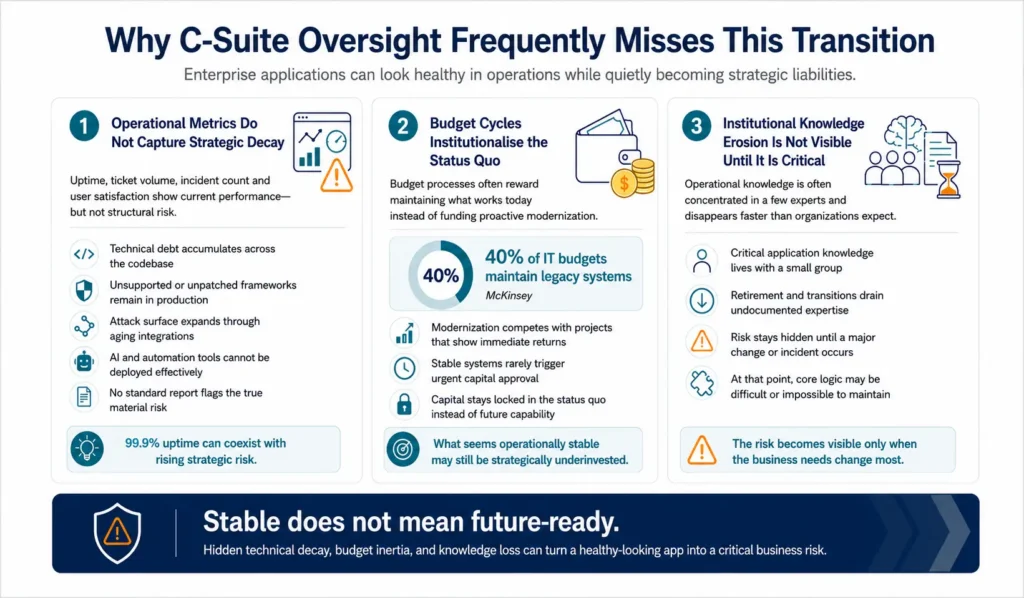
Why C-Suite Oversight Frequently Misses This Transition
Understanding why enterprise applications silently cross from healthy to hazardous requires examining how executive visibility is structured in large organisations.
Operational Metrics Do Not Capture Strategic Decay
Standard operational dashboards uptime, incident count, ticket volume, user satisfaction measure current performance. They do not measure the rate at which an application’s architecture is drifting from enterprise requirements, the accumulation of security exposure, or the widening gap between its capabilities and competitive benchmarks.
An enterprise application with 99.9% uptime and minimal ticket volume can simultaneously be:
- Accumulating severe technical debt across its codebase
- Running on an unsupported or unpatched framework
- Presenting an expanding and unmapped attack surface
- Incapable of integrating with the AI and automation tools the business requires
None of these conditions appear in standard operational reporting. None generate alerts. None trigger a review. Yet all represent material risk.
Budget Cycles Institutionalise the Status Quo
Annual budget processes in large enterprises are structurally oriented toward maintaining what exists rather than proactively investing in what will be required. When an enterprise application is operationally stable, there is no triggering event to generate a capital investment proposal. Modernisation competes against projects with more immediate and measurable returns and, in the absence of a visible crisis, it frequently loses.
The result is what McKinsey describes as the “technical debt trap”: organisations spending 40% of their IT budgets maintaining legacy systems [McKinsey] capital that is locked into sustaining the status quo rather than building competitive capability.
Institutional Knowledge Erosion Is Not Visible Until It Is Critical
Enterprise applications that have been operational for a decade or more accumulate an invisible dependency: the expertise of the engineers and architects who built them. As this cohort retires or transitions, institutional knowledge is lost at a rate that is rarely tracked. The risk does not surface until a critical modification is required at which point the organisation may discover that the application’s core logic is undocumented and effectively unmaintainable.
The Strategic Framework: How Executive Leadership Should Respond
1. Reframe "Stability" as a Trigger for Assessment, Not a Justification for Inaction
The executive instinct to de-prioritise stable systems must be actively counter-programmed. A stable enterprise application should trigger a structured review, not a continuation of the status quo. The questions C-suite leaders should be asking are not “Is it working?” but:
- What is the current technical debt profile of this application, and at what rate is it compounding?
- What security vulnerabilities exist in the current architecture, and what is our exposure if they are exploited?
- What AI, automation, or integration capabilities does this application’s architecture preclude?
- What is the projected total cost of ownership over the next five years if no action is taken?
2. Mandate Lifecycle Reviews as a Governance Obligation
Enterprise application governance should include mandatory lifecycle assessments at defined intervals not solely in response to incidents or significant upgrade requests. These assessments should produce structured outputs across four dimensions:
- Security posture – Framework currency, vulnerability exposure, and patch status
- Technical debt inventory – Codebase quality, documentation coverage, and dependency health
- Strategic alignment – Capability gap versus current and anticipated business requirements
- Modernisation economics – Total cost of inaction versus projected cost and return of modernisation investment
3. Recognise That the Optimal Modernisation Window Is Now
The research consensus is consistent: the best time to modernise a legacy enterprise application is while it is still functioning. Waiting for failure transforms a planned strategic investment into a crisis-driven expenditure with compressed timelines, elevated costs, and severely constrained options.
- 79% of modernisation projects that fail do so after spending over $1.5 million, frequently due to architectural constraints that were present but unaddressed for years [PwC / vFunction].
- Analysts project that 75% of organisations will face systemic failures by 2027 if technical debt continues to accumulate at current rates [industry analysis, 2025].
The organisations that will lead their sectors in 2030 are not those that responded to enterprise application failures most effectively. They are those that governed their application portfolios with sufficient foresight to modernise before failure became the forcing function.
What Proactive Enterprise Application Development and Modernisation Delivers
When enterprise application development and modernisation is executed as a planned strategic initiative rather than a crisis response, the return profile is materially different:
- 25–35% reduction in infrastructure costs in post-modernisation assessments [Bayone, 2025]
- 40–60% faster release cycles, enabling faster response to market opportunities [Bayone, 2025]
- 50% reduction in security breach risk following planned modernisation [Bayone, 2025]
- 228% ROI over three years in documented enterprise cloud migration cases [Microsoft Azure]
- 40% reduction in IT support costs within one year, documented in large-scale financial services modernisation programmes [industry case data]
Beyond the financial returns, proactive enterprise application services and modernisation delivers a strategic asset that reactive remediation cannot: optionality. An enterprise with a modern application architecture can adopt new capabilities, enter new markets, and respond to competitive threats with a speed and flexibility that a legacy-constrained organisation structurally cannot match.
Conclusion
The enterprise application that runs quietly in the background processing transactions, supporting workflows, generating no alerts is not a solved problem. It is an unsupervised risk.
The organisations that will avoid the next generation of enterprise technology failures are not those that monitor their applications most closely for signs of breakdown. They are those that have institutionalised the discipline to govern their enterprise application portfolios proactively treating the absence of visible failure not as a reason for complacency, but as the optimal conditions in which to act.
The most dangerous moment in an enterprise application’s life is not when it fails. It is when it works well enough that no one asks what comes next.
If your enterprise application has not been assessed in the past year, the risk is already compounding. Schedule a consultation with our team. We will evaluate your application portfolio, identify critical gaps, and deliver a prioritised modernisation roadmap aligned to your business objectives.