
 iOS App Development
 Android App Development
 React Native
 Flutter
 Web Development
 Custom Software
 Front End Development
 Blockchain Development
 Virtual Reality
 Cloud Computing
 IoT Development
 Augmented Reality
 Write us a message
The real graveyard of enterprise technology investment is not the failed launch. It is the slow, silent erosion that begins the day after go-live.
Across boardrooms and technology steering committees, the conversation around enterprise apps has long been dominated by development milestones: delivery timelines, budget approvals, vendor selections, and launch readiness reviews. Yet the data tells a fundamentally different story. The most significant and sustained risk to enterprise application value does not occur during build. It accumulates during the years that follow.
For business and technology leaders responsible for large-scale investment decisions, understanding this dynamic is not a matter of technical curiosity. It is a strategic imperative.
The Hidden Economics of Enterprise Apps Ownership
When organisations commission an enterprise apps, whether a custom-built enterprise web application, a heavily configured ERP platform, or a proprietary workflow system, the capital allocation conversation almost exclusively centres on development cost. That framing is structurally incomplete.
Consider what the data shows:
- IEEE research indicates that 60% of total software cost occurs during the maintenance phase, with only 40% going to initial development [IEEE / Savi, 2026].
- Gartner estimates that organisations spend 55 to 80% of their IT budgets on maintenance rather than new initiatives [Gartner, via Idealink, 2025].
- According to the O’Reilly 60/60 rule, 60% of a software product’s lifecycle expenses are consumed by maintenance, of which 60% is directed at enhancements rather than defect resolution alone [O’Reilly, via Vention Teams].
The practical implication: a $2 million enterprise application development investment typically carries a lifetime maintenance cost of $4 to $6 million. Organisations that budget only for the build have, in effect, only budgeted for the minority share of total cost of ownership.
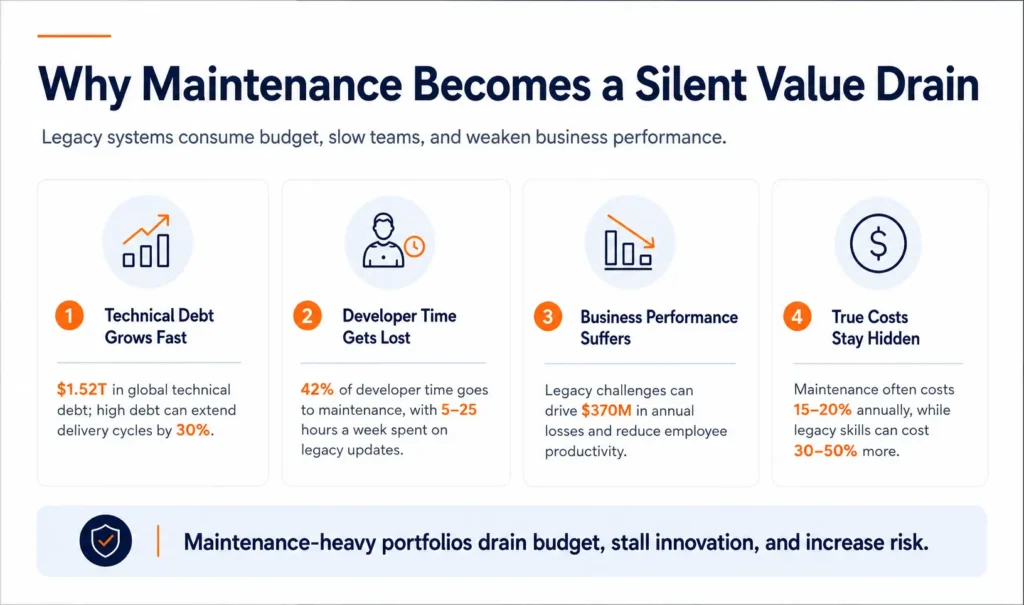
Why Maintenance Becomes a Silent Value Drain
1. Technical Debt Compounds Faster Than Most Leaders Realise
Technical debt is not a theoretical concern confined to engineering teams. It is a direct tax on organisational agility and, ultimately, on revenue.
- IT organisations globally carry an estimated $1.52 trillion in technical debt, according to research cited in the Wall Street Journal [Unqork / WSJ].
- Gartner projected that by 2025, companies would spend 40% of their IT budgets on maintaining technical debt [Gartner, via RecordPoint].
- More than 3 in 5 IT leaders report that their organisation’s data infrastructure is experiencing a moderate to severe negative impact from technical debt, including outdated code [SnapLogic / CIO Dive, 2024].
- Companies with high technical debt report 30% longer product development cycles compared to organisations that have modernised their infrastructure [Forrester, via TechBullion].
The consequence is a compounding drag. Each year of deferred modernization does not simply carry forward the same maintenance cost. It increases it. Integration complexity grows, security exposure widens, and the talent required to service ageing systems becomes scarcer and more expensive.
2. The Developer Productivity Penalty Is Measurable
One of the most overlooked dimensions of maintenance burden is its direct impact on the productivity of technology teams and therefore on the organisation’s capacity to deliver new capability.
- Stripe’s Developer Coefficient report found that 42% of professional time goes toward managing technical debt and maintenance rather than product development [Stripe Developer Coefficient, via Function-4, 2026].
- More than three-quarters of IT decision-makers report that their teams spend 5 to 25 hours per week updating and patching legacy systems [SnapLogic / CIO Dive, 2024].
- McKinsey research shows that organisations actively managing technical debt free up engineers to spend up to 50% more time on work that directly supports business goals [McKinsey, via Function-4].
For organisations operating enterprise application solutions at scale, spanning CRM, ERP, supply chain, and customer-facing platforms, this productivity drain is multiplied across every system in the portfolio. Engineering resources that could accelerate competitive differentiation are instead absorbed by the maintenance burden of yesterday’s applications.
3. Legacy Enterprise Apps Erode Business Performance, Not Just IT Metrics
The erosion caused by poorly maintained enterprise apps extends well beyond IT dashboards. It reaches into workforce productivity, customer experience, and commercial performance.
- Enterprises report $370 million in annual losses attributable to legacy system challenges, with legacy transformation projects alone accounting for nearly $134 million of that figure each year [Pegasystems / Savanta, via IT Pro].
- A Forrester study found that 46% of employees cite outdated technology as a key obstacle to productivity [Forrester, via TechBullion].
- 40% of employees report frustration and resentment with corporate technology, while 65% face significant friction with the tools provided at work [MeltingSpot, 2026].
- In a 2019 IBM study, 53% of IT managers identified lost revenue as the costliest aspect of system downtime, with 47% citing lost productivity and 41% citing reputational damage [IBM, via Coast App].
These are not IT-layer concerns. They are operational and financial outcomes with direct bearing on business performance and competitive positioning.
4. Enterprises Underestimate What Maintenance Actually Costs
The accounting challenge compounds the strategic one. Most organisations do not have a clear, aggregated view of what their enterprise apps are truly costing to maintain, because those costs are distributed across multiple budget lines that are rarely consolidated.
- Gartner and Forrester peg annual IT software maintenance at 15 to 20% of the initial build cost [Gartner / Forrester, via Savi, 2026], yet many enterprise portfolios significantly exceed this benchmark due to accrued technical debt.
- Legacy specialists command 30 to 50% above modern-stack salaries due to a shrinking talent pool with no new pipeline of practitioners [LegacyLeap, 2026].
- When asked why enterprises do not address technical debt, senior IT leaders cited the cost of re-architecting applications (68%), user disruption (43%), and lack of in-house skills (36%) [Sync-Sys / CIO survey].
The result is a situation where the true cost of ownership remains invisible until it becomes a crisis.
The Four Stages Where Enterprise Apps Begin to Fail
Understanding the failure pattern is the first step toward interrupting it. Across enterprise application solutions, the degradation typically follows a recognisable trajectory:
Stage 1: Post-Launch Neglect (Months 6 to 18) The application is live. Governance attention shifts to the next initiative. Maintenance is treated as a housekeeping function rather than a strategic discipline. Minor issues accumulate unaddressed.
Stage 2: Feature Freeze (Years 1 to 3) The cost and complexity of modifying the application increases as undocumented dependencies multiply. The enterprise web application becomes progressively harder to adapt to evolving business requirements. Workarounds proliferate.
Stage 3: Integration Decay (Years 3 to 5) The surrounding technology ecosystem evolves, covering cloud platforms, APIs, security protocols, and regulatory requirements, while the application does not. Compatibility gaps emerge. Data flows become unreliable. Manual intervention becomes routine.
Stage 4: Strategic Obsolescence (Year 5 and Beyond) The application can no longer be meaningfully enhanced without a rebuild. It becomes a drag on every initiative that touches it. The organisation faces a choice between an expensive modernisation programme and the continued cost of operating a system that is actively impeding progress.
What Effective Enterprise Application Governance Looks Like
Organisations that sustain value from their enterprise application investments share several disciplines that distinguish them from those that do not:
Lifecycle Budgeting from Day One
- Allocate maintenance funding as a fixed percentage of the build cost, typically 15 to 20% annually, at the point of initial investment approval, not retrospectively.
- Treat total cost of ownership over a five to seven-year horizon as the primary financial metric for technology investment decisions.
Proactive Technical Debt Management
- Establish a quarterly technical debt review as a board-level reporting item, not an IT-internal discussion.
- Quantify technical debt in business terms: developer hours consumed, deployment delays, integration failures, and security exposure, not lines of code.
Architecture for Changeability
- Require that enterprise application solutions are designed with modular, API-first architectures that reduce the cost of future change.
- Avoid architectural patterns that create deep coupling between systems, which are the primary driver of integration decay over time.
Talent and Knowledge Continuity
- Recognise that knowledge concentration risk, where critical business logic is understood by only one or two individuals approaching retirement, is a category of enterprise risk that belongs on the risk register alongside financial and operational exposures.
- Invest in documentation and knowledge transfer as continuous practices, not one-time project activities.
Governance-Linked Modernisation Cadence
- Establish a structured review cycle, annually at minimum, to assess which applications in the portfolio are approaching Stage 3 or Stage 4 on the failure trajectory.
- Build a funded modernisation roadmap that prevents the accumulation of urgent, unplanned remediation programmes.
The Strategic Case for Rethinking Enterprise Application Investment
The organisations that will extract sustained competitive advantage from their technology investments in the next decade are not necessarily those with the largest development budgets. They are those that govern the full lifecycle of their enterprise apps with the same rigour they apply to capital assets in any other category.
The evidence is clear:
- Only 39% of software projects currently meet their defined success criteria [Zipdo, 2023], and many that launch successfully deteriorate before they are ever replaced.
- 31.1% of software projects are cancelled before completion, and 52.7% exceed their original budgets by 189% [Zipdo, 2023], yet the conversation rarely extends to what happens to the projects that do complete.
- Enterprises relying on ad-hoc fixes face 15% more downtime than those operating under structured maintenance and support programmes [API Pilot, 2024].
- A manufacturing firm that deferred $63,500 in IT modernisation subsequently incurred a ransomware recovery cost of $4.2 million [Function-4, 2026], a ratio that illustrates, in concrete terms, the cost of treating maintenance as discretionary.
The framing that needs to change at the leadership level is this: an enterprise application is not a capital expenditure that delivers value upon delivery. It is an operational asset that requires continuous stewardship to hold its value and depreciates faster than most organisations account for.
Conclusion: The Investment That Begins at Go-Live
Development captures attention because it has a narrative: a project, a timeline, a launch. Maintenance does not. It is unglamorous, diffuse, and easy to defer. But it is precisely in that deferral that most enterprise apps begin to die.
For organisations investing in enterprise application solutions, whether greenfield builds, platform implementations, or enterprise web application modernisation programmes, the strategic question is not only “Can we deliver this?” It is: “Have we structured our investment, governance, and operating model to sustain this over its useful life?”
The organisations that ask the second question before the first are the ones whose technology investments continue to compound in value. The rest are funding the graveyard.
Enterprises spend up to 80% of IT budgets on maintenance yet most enterprise apps still lose value quietly, year after year. The difference between an application that compounds in value and one that drains your portfolio is not the build. It is what happens after. Schedule a consultation with our experts today and let us assess where your enterprise application stands before the next stage of decay sets in.