
 iOS App Development
 Android App Development
 React Native
 Flutter
 Web Development
 Custom Software
 Front End Development
 Blockchain Development
 Virtual Reality
 Cloud Computing
 IoT Development
 Augmented Reality
 Write us a message
Most enterprise software projects are celebrated the moment they go live. The go-live date is circled on the calendar, championed in board decks, and announced in internal newsletters. Then, quietly, something breaks. Not the system. The digital adoption.
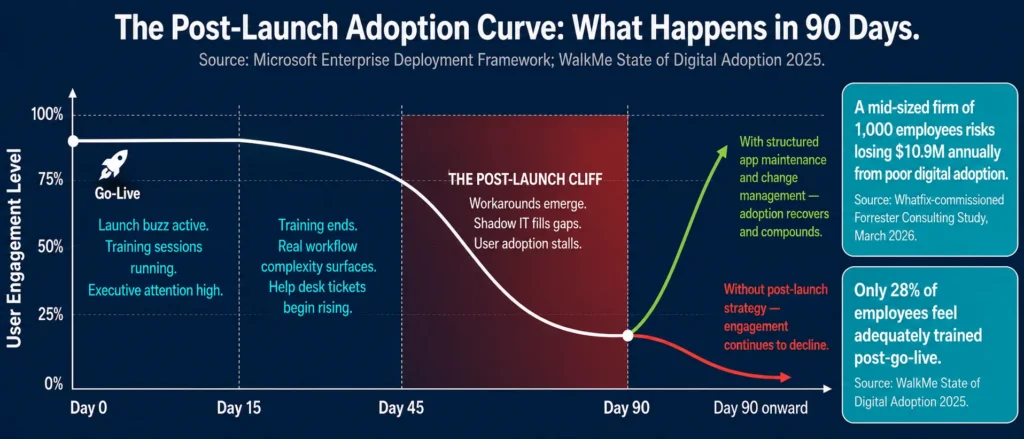
Within 90 days of launch, engagement metrics fall. Support tickets spike. Workarounds replace workflows. Teams revert to spreadsheets. And the business case that justified months of enterprise software development starts to unravel.
This is the post-launch cliff, and it is far more common than most organizations admit.
The Numbers Behind the Problem
The data tells a consistent story. Digital transformation failure rates range from 70% to 95%, averaging around 87.5% across large-scale enterprise initiatives, according to research compiled by Cargoson (2025). Separately, Gartner’s 2026 CIO and Technology Executive Survey of more than 3,100 CIOs found that only 48% of digital initiatives enterprise-wide meet or exceed their business outcome targets.
The financial toll is direct and measurable. A Whatfix-commissioned Forrester Consulting study published in March 2026, based on a global survey of 335 senior decision-makers across North America, Europe, APAC, and India, found that a mid-sized organization of approximately 1,000 employees could lose an estimated $10.9 million annually due to poor digital adoption. WalkMe’s State of Digital Adoption 2025 report, drawing on data from 1.5 million users across 2,400 enterprise applications, independently found that enterprises lost over $104 million in 2024 due to underutilized enterprise software and poor productivity practices.
Despite 8% annual growth in U.S. enterprise technology spending since 2022, labor productivity grew only 2%, according to Cargoson’s enterprise software market analysis (2025). The gap between investment and outcome is not a budget problem. It is a digital adoption problem.
Why the 90-Day Window Is Critical
The first 90 days after go-live represent the most vulnerable period in an enterprise application’s lifecycle. This is when behavior is still malleable, when users are forming habits, and when organizations have the highest leverage to intervene.
Miss this window, and the patterns that emerge become deeply embedded. Employees develop workarounds. Shadow IT fills the gaps. Institutional knowledge does not transfer into the platform. By the time leadership notices declining user adoption metrics, the culture around the tool has already calcified.
Microsoft’s own enterprise software deployment frameworks recognize this reality. Their recommended ROI measurement approach explicitly includes a 90-day activation tracking phase as a distinct milestone between deployment and outcome measurement. This is not arbitrary. It reflects a hard-earned understanding of where enterprise software either compounds its value or begins to erode it.
The Five Root Causes of Digital Adoption Failure
Understanding why digital adoption fails requires looking beyond the technology itself. In most enterprise environments, the platform is not the problem.
1. Training That Ends at Go-Live
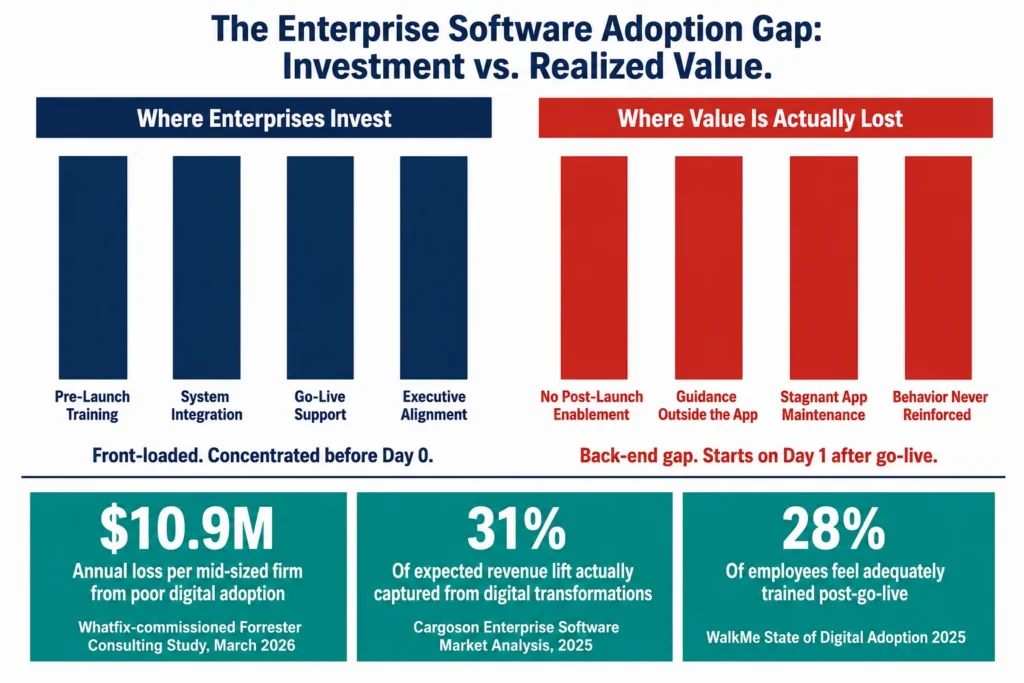
Organizations invest heavily in pre-launch training. Once the enterprise software goes live, that support largely disappears. According to Apty’s 2026 enterprise software adoption framework, employees are trained during implementation, but real workflows surface weeks or months later. By then, much of the procedural knowledge has faded.
This creates a gap between knowledge and execution that quietly destroys user adoption at scale. When users encounter friction and cannot find in-context help, they either abandon the workflow or build a workaround that bypasses the platform entirely.
2. Enablement Content Lives Outside the Application
Most enterprise training relies on portals, PDFs, and video libraries that sit outside the platform itself. In high-velocity work environments, users rarely leave their workflow to search for guidance. They rely on memory, colleagues, or informal shortcuts.
The result is inconsistent process adherence across departments and roles. Digital adoption fails not because users are resistant, but because the support infrastructure is disconnected from the moment of need.
3. One-Size-Fits-All Rollout Design
Enterprise software is used differently by frontline staff, managers, compliance teams, regional offices, and executive users. When a single training path is designed for a broad audience, role-specific friction goes unaddressed.
MuleSoft’s 2025 Connectivity Benchmark Report found that only 28% of enterprise applications are properly connected, and 95% of IT leaders report that integration issues impede adoption. When the application does not match how a specific role actually works, user adoption breaks down along those fault lines.
4. App Maintenance Treated as an IT Function, Not a Business Function
Post-launch app maintenance is frequently handed back to IT and removed from the business roadmap. Quarterly security patches get prioritized. User experience improvements do not.
Enterprise mobile best practices, including guidance from DEVtrust (2025), recommend monthly security and bug fix cycles alongside quarterly feature releases to sustain stability and user engagement. When that app maintenance cadence is absent, performance degrades, user trust erodes, and the business case for the enterprise software weakens over time.
5. Change Management Stops Before Behavior Actually Changes
Change management in most enterprise software rollouts is front-loaded. Stakeholder communication, training plans, and readiness assessments happen before launch. Post-launch behavioral reinforcement rarely follows with the same rigor.
The WalkMe State of Digital Adoption 2025 report found that while 79% of executives feel confident about meeting software transformation goals, only 28% of employees feel adequately trained for the tools they are expected to use. That perception gap is not a communications failure. It is a change management failure that continues long after the go-live announcement.
The Cost of Underestimating User Adoption
Enterprises that invest in even a single digital adoption best practice can improve their digital transformation ROI from 22% to 64%, according to WalkMe’s 2025 research. That is a meaningful multiplier on the investment already made. Organizations that follow three or more digital adoption best practices can achieve up to 85% ROI on transformation efforts.
Yet average digital adoption investment rose from $2.8 million in 2023 to $5.1 million in 2025, per the same report. Organizations are spending more on enterprise software, but without a post-launch strategy that connects that spending to sustained behavioral change, the investment does not compound.
According to Cargoson’s 2025 enterprise software market analysis, organizations capture only 31% of expected revenue lift and 25% of expected cost savings from digital transformations. The remaining value is not lost to bad technology. It is lost to poor user adoption strategy in the weeks and months after go-live.
What Sustained Digital Adoption Actually Requires
Reversing the post-launch cliff is not a training problem or a technology problem in isolation. It requires a structured, sustained approach across three dimensions.
Continuous In-App Guidance
Guidance embedded at the point of action outperforms post-hoc documentation every time. When users encounter a new workflow, a complex approval chain, or a compliance step, the support needs to surface within the enterprise software itself, not in a separate portal. Role-specific walkthroughs, contextual tooltips, and in-app alerts tied to actual workflows reduce friction and strengthen digital adoption without pulling users out of their tasks.
Proactive App Maintenance as a Retention Strategy
Effective app maintenance in enterprise contexts means more than uptime and security patches. It means treating the application as a live product with a release cadence tied to user feedback, analytics, and evolving business processes. When users see that their pain points result in visible improvements, engagement recovers. When the enterprise software stagnates, so does user adoption.
Change Management That Extends Beyond Go-Live
Post-launch change management should include usage analytics reviews, role-based digital adoption benchmarks, champion networks within business units, and executive visibility into adoption metrics. The 90-day window is not an end date. It is a diagnostic checkpoint.
A Framework for Avoiding the Cliff
The table below outlines a phased post-launch approach that enterprise teams can use as a planning baseline for sustained digital adoption across the full application lifecycle.
Phase | Timeline | Key Actions |
Pre-Launch | 60 days before go-live | Role-based training design, adoption KPI definition, champion identification |
Launch Window | Days 0 to 30 | In-app guidance active, help desk integration, usage tracking baseline set |
Critical Zone | Days 30 to 90 | Weekly adoption reviews, feedback loops, re-engagement for low-adoption roles |
Stabilization | Days 90 to 180 | Feature release cadence begins, ROI measurement, change management phase two |
Continuous | 180 days onward | App maintenance roadmap, usage analytics, annual adoption benchmarking |
The Organizational Implication
Digital adoption failure is a leadership problem, not a user problem. When CTOs, CIOs, product heads, and business owners treat the go-live date as the finish line, the post-launch cliff becomes an organizational inevitability.
The enterprises that sustain digital adoption invest in post-launch infrastructure with the same seriousness they apply to pre-launch readiness. They treat their enterprise software as a product, not a project. They measure user adoption rates with the same discipline they apply to deployment milestones. And they recognize that app maintenance is not overhead; it is the mechanism through which the original business case remains intact.
According to WalkMe’s 2025 report, 73% of large organizations now have six or more people formally responsible for driving software adoption. That is a meaningful structural shift. It signals that the most digitally mature enterprises have stopped treating digital adoption as an afterthought and started treating it as a core function.
Closing
The 90-day post-launch window does not have to become a cliff. With the right strategy, it can become the period in which digital adoption gains its strongest foothold, where usage deepens, where workflows normalize, and where the investment in enterprise software begins to generate the returns it was always capable of delivering.
The question for every CTO, CIO, product leader, and enterprise decision-maker is simple: when your next application goes live, what happens on Day 31?
If the answer is unclear, that is where the conversation needs to start. Our team works with enterprises to design and execute post-launch digital adoption strategies that protect software ROI and sustain user adoption long after go-live. Schedule a consultation today and let us help you build a post-launch plan that works.