
 iOS App Development
 Android App Development
 React Native
 Flutter
 Web Development
 Custom Software
 Front End Development
 Blockchain Development
 Virtual Reality
 Cloud Computing
 IoT Development
 Augmented Reality
 Write us a message
Most enterprise app development RFPs are designed to attract vendors. The best ones are designed to eliminate the wrong ones.
That distinction sounds minor. The financial consequences of missing it are not. Only 30 percent of large-scale technology programs are delivered on time, within budget, and within planned scope, according to Boston Consulting Group’s 2024 Build for the Future study surveying more than 1,000 C-suite executives across 20 sectors (BCG, 2024). The 70 percent that miss do not fail primarily because of bad technology choices. They fail because of vendor selection decisions made on the basis of capability claims rather than verified delivery discipline. And the RFP process is where that selection decision is either set up for success or quietly predetermined for failure.
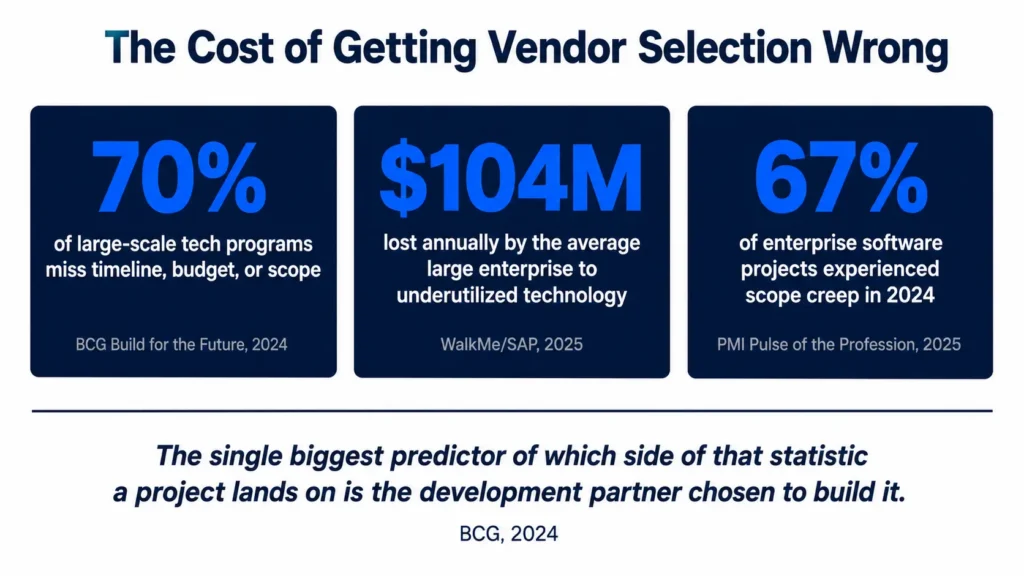
The average large enterprise lost $104 million in 2024 due to underutilized technology, disjointed strategy, and low adoption (WalkMe/SAP, 2025). 67 percent of enterprise software projects experienced scope creep in 2024 alone, with scope creep driving 20 to 30 percent budget overruns across outsourced development projects (PMI Pulse of the Profession 2025, Gitnux 2026). 42 percent of outsourcing clients cite communication problems as their top challenge, with 27 percent experiencing significant rework rates from quality issues (Gitnux, 2026). Most of these outcomes were not caused by poor execution after vendor selection. They were caused by poor vendor selection, which was caused by an RFP that asked the wrong questions, weighted the wrong criteria, and produced proposals that were too generic to differentiate between who could actually deliver and who was skilled at saying they could.
This piece is a structural guide for CTOs who want to build an enterprise app development RFP that produces useful, differentiated responses, not a stack of polished proposals that all look the same and tell you nothing about who to actually trust with a multi-million dollar program.
Why Most Enterprise App Development RFPs Fail Before a Vendor Responds
The failure modes of enterprise app development RFPs are well documented and remarkably consistent. Understanding them is the prerequisite for building a document that avoids them.
Failure Mode 1: The RFP is a requirements list, not a problem brief.
The most common structural error in enterprise app development RFPs is treating the document as a specification to be responded to rather than a strategic brief to be solved. An RFP that presents a list of functional requirements and asks vendors to confirm they can deliver them produces confirmations. Every vendor can confirm they can deliver almost anything at the proposal stage. What the confirmation does not reveal is whether the vendor understands your business context, has delivered comparable complexity before, and has the architectural judgment to navigate the decisions your requirements have not yet anticipated.
Most RFP responses fail because teams treat the document as a questionnaire rather than a strategic brief. Success requires understanding the client’s operational context (Arphie AI, February 2026). The inverse is equally true: an RFP that reads like a questionnaire produces questionnaire responses. An RFP that reads like a strategic brief produces strategic thinking.
Failure Mode 2: Vague objectives that invite fabricated alignment.
Without measurable objectives, vendors are left without direction (Mobisoft Infotech, November 2025). When an RFP states that the goal is to “improve operational efficiency” or “modernize the customer experience,” every vendor can claim alignment. The vagueness that feels like flexibility in the RFP author produces undifferentiated responses that are impossible to evaluate meaningfully.
Failure Mode 3: Weighting cost too heavily.
Organizations that weight cost above 30 percent in their RFP evaluation criteria experienced 40 percent more project failures, 35 percent more change orders, and 28 percent longer project timelines than those weighting cost at 15 to 25 percent (Deloitte 2025 CPO Survey, cited by RequestForProposalTemplate.com, March 2026). The cheapest proposal is almost never the lowest-risk one in enterprise software development. An RFP scoring model that over-weights cost is a selection model that systematically selects for risk.
Failure Mode 4: Incomplete requirements that predetermine scope creep.
Inadequate requirement analysis is a leading cause of scope creep, which drove budget overruns in 35 percent of outsourced development projects (Gitnux, 2026, citing multiple sources). Projects with user involvement in requirements gathering have 40 percent higher success rates than those driven purely by executive mandates (PMI Pulse of the Profession 2025). The RFP that presents requirements defined exclusively by leadership without operational input is setting up scope disputes that will begin arriving the moment the project reaches working users.
Failure Mode 5: No discovery phase before the RFP is written.
The structural decisions made before contracts are signed predetermine failure in enterprise software programs (HST Solutions, May 2026). An RFP written without a prior discovery phase to validate requirements, map the existing environment, and define success in measurable business outcomes is an RFP that asks vendors to price and propose against an incomplete picture. The gap between what the RFP describes and the reality the winning vendor encounters upon engagement is where budget overruns and timeline slippage are born.
The Architecture of an Effective Enterprise App Development RFP
An effective enterprise app development RFP is not longer than an ineffective one. It is more precisely structured. Every section serves a specific purpose in differentiating vendors on the dimensions that actually predict delivery success.
Section 1: Business Context and Strategic Objectives
This is the section most RFPs underwrite and most vendors wish was longer. Before any technical requirements appear, the RFP should communicate with enough depth that a sophisticated vendor can genuinely assess whether they are a fit and propose approaches that the RFP author had not anticipated.
What belongs in the business context section:
- The specific business problem this application is being built to solve, described in operational terms rather than technology terms
- The measurable outcomes that define success: not “improved efficiency” but “reduce order processing time from 4.2 hours to 45 minutes” or “eliminate the manual reconciliation step that currently requires 3 FTE and produces a 2 percent error rate”
- The organizational context: who will use this application, in what workflows, in what volume, under what operational conditions
- The constraints that are non-negotiable: regulatory requirements, compliance frameworks, existing systems that must be integrated, performance thresholds that cannot be compromised
- The growth trajectory: how the application’s user base, transaction volume, and feature scope is expected to evolve over 18 to 36 months
- What has been tried before: prior attempts to solve this problem, why they did not succeed, and what that history implies about the constraints a new solution must navigate
The depth of business context in an RFP is directly correlated with the quality of proposals received. A vendor who reads your business context section and immediately understands your problem is a vendor worth talking to. A vendor who reads it and responds with a generic capability statement is a vendor who has not engaged with your problem, regardless of how impressive their portfolio looks.
Section 2: Technical Environment and Integration Requirements
Enterprise applications do not exist in isolation. They integrate with existing systems, inherit existing data structures, and operate within existing security and compliance frameworks. The RFP must communicate the technical environment with enough specificity that vendors can genuinely scope the integration work rather than estimating it generically.
What the technical environment section must include:
- Current system landscape: every system the new application must integrate with, the integration method required (API, database, file transfer, event stream), and the quality and documentation status of each system’s integration capability
- Data architecture: the data sources the application will consume, the volume and velocity of that data, and any known data quality issues that the application must accommodate or address
- Infrastructure constraints: cloud platform preferences or mandates, on-premises requirements, geographic data residency requirements, and existing DevOps toolchain that the vendor must integrate with
- Security and compliance requirements: applicable frameworks (SOC 2, HIPAA, PCI-DSS, GDPR, CMMC, and others), existing security tooling the application must accommodate, and audit requirements that impose specific logging, access control, or documentation obligations
- Performance requirements: defined and measurable, not aspirational. Specific response time thresholds, concurrent user volumes, transaction throughput requirements, and availability targets with defined recovery time and recovery point objectives
The specificity of this section is what separates proposals that can be compared on a meaningful basis from proposals that are priced to a level of ambiguity that guarantees future change orders. A vendor who receives a vague technical environment description will price for what they know and charge for what they discover. A vendor who receives a precise technical environment description has no basis for scope expansion claims that were not addressed in the original proposal.
Section 3: Scope Definition With Explicit Out-of-Scope Boundaries
This is the section most frequently written poorly and most frequently exploited by vendors who under-price in-scope work and generate margin on out-of-scope change orders.
An enterprise app development RFP should define scope in two directions simultaneously: what is in scope with enough specificity to be priced accurately, and what is explicitly out of scope to prevent scope expansion claims that the vendor will otherwise argue were implied.
What scope definition requires:
- Functional scope described as user stories or use case descriptions, not feature lists. “The application must enable a warehouse manager to create, assign, and track pick tasks across a facility with up to 500 concurrent pickers” is a scopeable requirement. “Inventory management functionality” is not.
- Integration scope defined per system with the specific data objects, transaction volumes, and latency requirements for each integration point
- Data migration scope explicitly addressed: what historical data will be migrated, in what volume, from what source systems, and to what quality standard before the migration is considered complete
- Testing scope: who is responsible for each testing phase, what acceptance criteria govern each phase, and what constitutes a passed acceptance test versus a failed one
- Out-of-scope boundaries: explicitly name what is not included, including infrastructure provisioning if that is the client’s responsibility, third-party licensing if the vendor is expected to budget for it separately, or ongoing operational support if that is addressed through a separate engagement
The explicit out-of-scope boundary is the most underused mechanism in enterprise app development RFPs. Every ambiguity in the scope definition is a future dispute. Every future dispute is a change order. Every change order is budget overrun and schedule delay. Writing the out-of-scope list with the same rigor as the in-scope list is not defensive procurement. It is the single most effective mechanism for producing proposals that reflect the actual cost of delivery.
Section 4: Proposal Response Requirements That Force Differentiation
This is where most RFPs produce their least useful output: by asking vendors to answer generic questions that any skilled proposal writer can address without any specific knowledge of your problem.
The proposal response requirements section should be designed to make it impossible to respond well without genuinely engaging with your specific context. Questions that can be answered with reusable content from a proposal library should be replaced with questions that require specific, contextual thinking.
Generic questions that produce undifferentiated responses:
- “Describe your development methodology”
- “Provide examples of similar projects you have delivered”
- “Describe your approach to quality assurance”
- “Provide your proposed project timeline”
Specific questions that force genuine engagement:
- “Based on the technical environment described in Section 2, identify the three integration points you consider highest risk and describe your specific approach to each”
- “Describe a project you have delivered that involved comparable integration complexity and volume. What were the three most significant technical decisions made during that project and what alternatives were considered?”
- “Our stated success metric is reducing order processing time from 4.2 hours to 45 minutes. What architectural decisions in your proposed approach are most directly responsible for achieving that outcome, and what is your contingency if those decisions prove insufficient?”
- “What information in this RFP is insufficient for you to provide a reliable fixed-price estimate? What assumptions are you making in your pricing, and what events would trigger a change order request?”
- “Which aspect of this scope would you recommend we descope from the initial delivery and why?”
The last two questions are particularly revealing. A vendor who cannot articulate the assumptions embedded in their pricing is a vendor who will generate change orders when those assumptions prove incorrect. A vendor who can identify descoping opportunities is a vendor who understands your problem well enough to prioritize it strategically, which is a capability you need throughout delivery, not just at proposal stage.
Section 5: Team Composition and Key Personnel Requirements
The proposal you receive will be written and presented by the vendor’s best people. The project will be delivered by whoever is available when the contract starts. This gap between proposal team and delivery team is one of the most common sources of delivery disappointment in enterprise app development.
The RFP should explicitly require commitment to specific key personnel and create contractual mechanisms that make substituting those personnel without client approval a material contract event.
What team composition requirements should specify:
- Named key personnel for each critical role: technical lead, solution architect, project manager, and any specialist roles that the project complexity requires
- CVs and verifiable reference contacts for each named individual, not role descriptions that could describe anyone
- Percentage of time commitment for each named individual, with explicit prohibition of partial allocation schemes where your project shares a senior resource with three others
- Substitution provisions: the client’s right to approve any substitution of named key personnel, with reasonable timeline to evaluate and approve alternatives before work continues
- Subcontracting disclosure: whether any scope components are proposed to be delivered by subcontractors, the identity of those subcontractors, and the same CV and reference requirements applied to key subcontractor personnel as to the prime vendor’s team
Projects with user involvement in requirements gathering have 40 percent higher success rates (PMI Pulse of the Profession 2025). The same principle applies to team quality: the people who wrote the proposal are typically the people who know how to win your business. The RFP’s job is to make sure they are also the people who deliver it.
Section 6: Pricing Structure Requirements That Expose Total Cost
The pricing section of an enterprise app development RFP is where the most consequential information asymmetry lives. Vendors understand the full cost profile of software development engagements. Most procurement processes do not, and that asymmetry is where margin is generated on change orders, ongoing support fees, and license costs that were not visible in the headline proposal number.
Hidden fees lift total outsourced development costs by 15 to 25 percent above the initial proposal figure (Gitnux, 2026). The RFP should require pricing transparency at a level that makes those costs visible before selection rather than after contract execution.
What the pricing section should require:
- Itemized cost breakdown by phase and workstream: not a total project fee but a breakdown that shows the cost of each functional area, each integration point, and each project phase separately
- Hourly rate card for all role types proposed: this is the rate that change orders will be priced at, and knowing it before contract execution is the only mechanism for evaluating whether change order pricing is reasonable
- Change order trigger definition: the vendor’s explicit definition of what constitutes an in-scope versus out-of-scope request, so that scope dispute resolution has a reference point before it is needed
- Total cost of ownership over three years: initial development cost, estimated annual maintenance, licensing fees, infrastructure costs, and the expected cost of the first major enhancement cycle
- Payment milestone structure tied to specific, measurable deliverables rather than calendar dates: a payment milestone triggered by “completion of development phase” is an invitation for dispute. A payment milestone triggered by “all 47 acceptance test cases passing at greater than 98 percent success rate” is a governance mechanism
The payment milestone structure tied to measurable deliverables is the most powerful financial governance tool available to a CTO in an enterprise app development procurement. It converts the vendor’s financial incentives from “get paid at the calendar milestone” to “get the client to acceptance criteria,” which is the alignment you need throughout delivery.
The Evaluation Framework: How to Score Responses Without Losing Objectivity
An RFP is only as good as the evaluation process that follows it. The most well-structured RFP in the world produces poor vendor selection outcomes if the evaluation process defaults to subjective preferences, relationship bias, or price-dominated scoring.
The 5-point weighted scoring model is used by 72 percent of Fortune 500 procurement departments and is validated as the most reliable mechanism for objective vendor selection in knowledge-work procurements (Deloitte 2025 CPO Survey). The weight distribution for enterprise app development RFPs should reflect the empirical relationship between evaluation criteria and delivery outcomes.
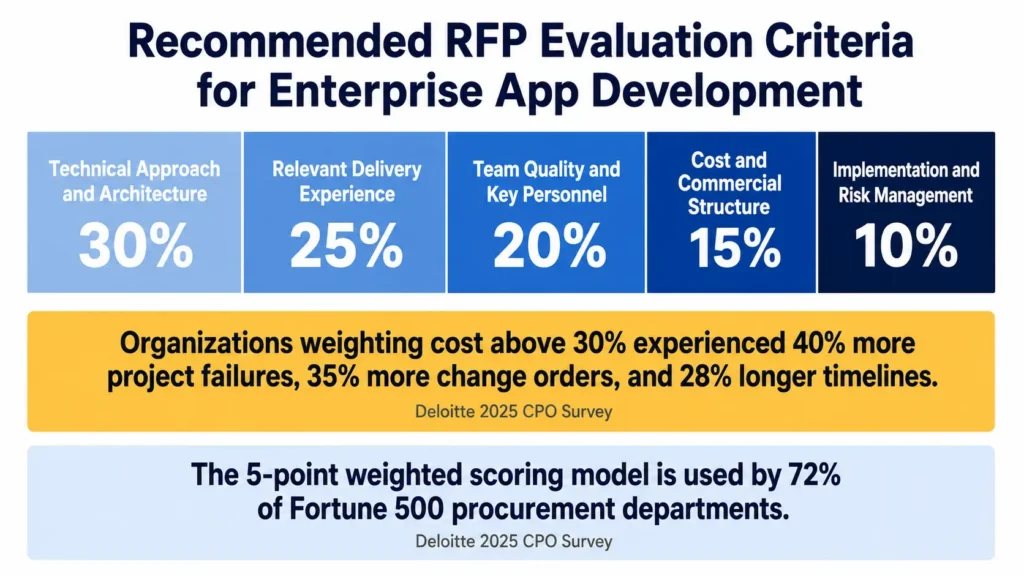
Recommended Weighted Scoring Model for Enterprise App Development RFPs:
Evaluation Criterion | Recommended Weight | Rationale |
Technical approach and architecture | 30% | Directly determines whether the proposed solution can actually deliver the stated outcomes |
Relevant delivery experience | 25% | BCG 2024: vendor delivery discipline is the single biggest predictor of program success |
Team quality and key personnel | 20% | The people delivering the project determine its outcome more than the methodology |
Cost and commercial structure | 15% | Deloitte 2025: weighting cost above 30% increases project failure rate by 40% |
Implementation approach and risk management | 10% | Reveals whether the vendor has a credible plan for the highest-risk elements of the scope |
Sources: Deloitte 2025 CPO Survey, BCG 2024 Build for the Future, RequestForProposalTemplate.com scoring framework.
Critical scoring guidance:
Organizations that weighted cost above 30 percent experienced 40 percent more project failures, 35 percent more change orders, and 28 percent longer timelines than those weighting cost at 15 to 25 percent (Deloitte 2025 CPO Survey). The scoring model above deliberately caps cost at 15 percent for this reason. A vendor who is 20 percent more expensive but scores materially higher on technical approach, delivery experience, and team quality represents lower total project cost, because the risk-adjusted cost of a 30 percent more expensive engagement is substantially lower than the fully loaded cost of a project failure.
The reference check as a scoring input, not a formality:
One of the most revealing software procurement practices involves conducting rigorous, multi-level reference interviews rather than treating reference checks as a formality (Modernization Intel, January 2026). The reference check for enterprise app development should go beyond the vendor-provided contact list to independently verify delivery claims, and the questions should be specifically designed to surface how the vendor handled the inevitable problems that every complex project generates.
Reference check questions that actually reveal delivery quality:
- What were the three most significant problems encountered during the project and how did the vendor respond to each?
- Were there change orders? What triggered them? Do you believe they were legitimate or were they requirements that should have been identified during scoping?
- Were the key personnel named in the proposal actually the ones who delivered the work?
- If you were doing this project again with full hindsight, what would you do differently in the vendor selection and contracting process?
- Would you hire this vendor again for a project of comparable complexity? If yes, what conditions would you put in the contract that you did not have the first time?
The last question is the most important one in any reference check. The conditions an experienced client would add to a second contract with the same vendor tell you more about the vendor’s delivery patterns than any capability statement in the proposal.
The Pre-RFP Work That Determines Whether the RFP Is Worth Writing
The most commonly skipped step in enterprise app development procurement is the discovery work that should precede the RFP. An RFP written without adequate pre-work produces responses that price against an incomplete picture, which produces proposals that cannot be meaningfully compared and contracts that generate disputes.
What the pre-RFP discovery phase requires:
- Stakeholder alignment on success definition: every stakeholder who will influence vendor selection or project governance should have an explicit, documented agreement on what outcomes the project must deliver before the RFP is written, not after proposals are received
- User research with actual end users: the people who will use the application daily have requirements that executive stakeholders consistently underestimate. Projects with user involvement in requirements gathering have 40 percent higher success rates (PMI Pulse of the Profession 2025). That research belongs in the RFP as context, not in a post-contract discovery phase that vendors bill for
- Technical architecture review of the existing environment: a current-state assessment of the systems the new application must integrate with, including their API documentation quality, their known limitations, and the integration patterns they support
- Regulatory and compliance requirements mapping: a complete inventory of the compliance obligations that govern the new application, with the specific technical implications of each requirement documented before the RFP is issued
- Budget reality testing: before publishing a budget range in the RFP, test that range against informal market conversations to ensure it reflects the actual market cost of the scope being defined. An RFP that describes enterprise-scale complexity while signaling a startup-scale budget produces proposals that either price dishonestly at the stated budget or decline to respond entirely
The quality of proposals you receive is a direct reflection of the quality of the RFP you issue. And the quality of the RFP you issue is a direct reflection of the discovery work you completed before writing it.
The Structural Red Flags That Reveal a Weak Proposal
Once responses are received, the evaluation process benefits from a list of structural red flags that distinguish proposals that are telling you what you want to hear from proposals that are demonstrating genuine engagement with your problem.
Red flags in vendor proposals that signal delivery risk:
Red Flag | What It Signals |
Generic capability statements not tied to your specific requirements | Vendor has not engaged with your problem |
Pricing with no itemized breakdown | Change orders will be the margin mechanism |
Timeline with no dependency logic | Timeline was not built for your scope |
Key personnel described by role rather than named individuals | The people in the proposal are not the people who will deliver |
No risk section or a risk section with generic risks | Vendor has not done the work to understand your specific risk profile |
Scope that exactly matches your RFP without any questions or challenges | Vendor is agreeing to everything and will negotiate via change order |
References from projects with fundamentally different complexity profiles | Claimed experience is not comparable |
Assumption-free fixed pricing on a complex scope | Assumptions are hidden and will surface as change orders |
No questions submitted during the RFP process | Vendor either does not understand the problem or does not intend to win |
The last red flag is particularly revealing. A sophisticated vendor who reads a complex enterprise app development RFP and has zero clarifying questions is a vendor who either understands your problem so well that everything is clear, which is possible but rare, or a vendor who has not genuinely engaged with the scope and is proposing generically. Most CTOs who have run serious procurement processes report that the vendors who ask the best questions during the RFP process consistently produce the best proposals and the best delivery outcomes. The quality of the questions a vendor asks before submitting tells you more about their capability than the proposal itself.
The Questions That Separate the Best Vendors From the Rest
Beyond the formal evaluation criteria, the following questions belong in every enterprise app development RFP as specific response requirements. The quality and specificity of answers to these questions is the most reliable predictor of delivery quality available before contract execution.
Technical differentiation questions:
- What is the single greatest technical risk in this scope and what is your specific mitigation approach?
- Describe a technical decision you made in a comparable engagement that you would make differently with hindsight and why
- What are the three assumptions in your pricing that, if wrong, would generate change order requests?
Delivery discipline questions:
- How do you handle a situation where the client’s requirements evolve materially after contract execution? Walk us through your process with a specific historical example
- What is your process for managing a project that is running behind schedule at the 40 percent completion mark?
- Describe the governance structure you propose for this engagement: who are the named decision-makers on your side, what is their authority, and how often will they be available for strategic alignment conversations?
Cultural fit questions that reveal partnership quality:
- Describe a client relationship that did not go well and what you learned from it
- What would you need from our organization to maximize the probability of delivery success on this project?
- What aspects of this scope would you recommend we reconsider before contract execution?
The Contract Structure That Protects the Outcomes the RFP Defined
The RFP and the contract are a single procurement instrument, and the CTO who treats them as separate documents loses the governance leverage that a well-structured RFP creates. Every outcome defined in the RFP should have a corresponding contractual mechanism that makes that outcome enforceable.
Critical contractual provisions that preserve RFP intent:
- Key personnel commitment with approval rights for substitution
- Payment milestones tied to specific, measurable acceptance criteria rather than calendar dates or phase completions
- Change order governance with the rate card and change order trigger definition agreed at contract execution
- Quality gates with independent validation rights: the client’s right to have deliverables independently validated before milestone payment is released
- Data ownership provisions that are absolute: all code, documentation, and data created under the contract is the client’s property upon delivery, with no vendor claims to IP or proprietary tooling dependency
- Exit provisions that include complete handover documentation and a transition support obligation at defined rates if the engagement terminates for any reason
Effective governance starts before project kickoff. When engaging a vendor for a complex software program, the contract should stipulate the creation of a joint steering committee comprising the client sponsor, the technical lead, and vendor executives, meeting regularly to review performance and approve significant change requests. This prevents scope creep and ensures executive alignment on progress and obstacles (Modernization Intel, January 2026).
What a Well-Structured Enterprise App Development RFP Actually Produces
The outcome of following this framework is not a stack of identical proposals from which the cheapest is selected. It is a differentiated set of responses from which a small number of genuinely capable vendors emerge, whose proposals reflect a real understanding of your problem, whose pricing is built on visible and challengeable assumptions, and whose key personnel are named, verifiable, and committed.
That differentiation is what makes vendor selection a defensible, high-confidence decision rather than an educated guess. And it is the foundation on which a multi-million dollar enterprise app development program either succeeds or joins the 70 percent that BCG found are not delivered on time, within budget, and within scope.
The RFP is not procurement overhead. It is the first deliverable of the project. Write it like one.
Receiving an RFP that actually describes what you need built is half the battle. Finding a development partner who can answer the hard questions in it is the other half.
If your organization has an enterprise app development RFP on the table and you want a partner who will engage with your problem rather than your checklist, schedule a consultation with our team. We will tell you upfront what we can deliver, where the risks in your scope are, and what the contract should say to protect you. No generic capability statements. No assumptions hidden in the pricing. Just an honest conversation about whether we are the right fit for what you are building.