
 iOS App Development
 Android App Development
 React Native
 Flutter
 Web Development
 Custom Software
 Front End Development
 Blockchain Development
 Virtual Reality
 Cloud Computing
 IoT Development
 Augmented Reality
 Write us a message
Picking an IT partner is a routine procurement decision in most industries. In Canadian financial services, it is a regulatory decision. The moment a bank, insurer, credit union, or wealth manager hands over infrastructure, security monitoring, or end-user support, that provider becomes part of how regulators judge the institution’s own risk management.
That changes the buying criteria. Price, response times, and tooling still matter, but they come after a harder set of questions: Can this provider help you report an incident to your regulator within hours? Will it let your auditors and supervisors inspect its controls? Can you leave without disrupting critical operations? This guide explains how to choose an MSP for financial services in Canada using the lens regulators actually apply, so the decision holds up long after the contract is signed.
How to Choose an MSP for Financial Services in Canada
To choose an MSP for financial services in Canada, start by mapping the services you plan to outsource against your regulatory obligations, then evaluate providers on their ability to meet them. In practice, that means seven steps:
- Classify the arrangement by criticality. Decide whether the services support critical operations, because that drives how much due diligence and contractual protection you need.
- Identify your regulator’s expectations. Federally regulated institutions follow OSFI guidelines, while credit unions and many insurers also answer to provincial regulators.
- Test incident reporting capability. Confirm the provider can notify you fast enough for you to meet your own reporting deadlines.
- Secure audit and access rights. Make sure you, your auditors, and your regulator can assess the provider.
- Map subcontractors and data locations. Know who else touches your data and where it lives.
- Verify resilience and recovery testing. Ask for evidence of tested recovery, not just documented plans.
- Agree on an exit plan before you sign. Define how services, data, and knowledge transfer back to you or to a new provider.
The rest of this guide breaks down each of these steps.
Why Provider Selection Carries More Weight in Financial Services
Financial institutions sit at the top of the breach cost table. According to the IBM Cost of a Data Breach 2025 report for Canada, the average breach in Canada’s financial sector cost CA$9.97 million, the highest of any industry measured and well above the national average of CA$6.98 million.
The threat picture is also shifting toward vendors. The Canadian Centre for Cyber Security’s National Cyber Threat Assessment 2025-2026 reports that finance was among the sectors with the largest increase in Canadian ransomware incidents from 2022 to 2023, at 157%. The same assessment warns that a breach at a single vendor can cascade into incidents across many client organizations, and that an incident at one dominant provider can affect an entire sector.
For a financial institution, that means an IT provider is not just a cost line. It is a concentration point for operational, cyber, and regulatory risk, and selecting one deserves the same rigour as any other material risk decision. Understanding how to choose an MSP for financial services is, at its core, an exercise in third-party risk management.
Start With Your Regulator, Not the Provider’s Pitch
When leaders ask how to choose an MSP for financial services, the most common mistake is evaluating providers before defining the regulatory requirements they need to support. Canadian financial regulation now spells out clear expectations for third parties, and those expectations should become your evaluation criteria.
Requirement | Who it applies to | What it means for your MSP |
OSFI Guideline B-10, Third-Party Risk Management | Federally regulated financial institutions (FRFIs) | Risk-based due diligence, minimum contract provisions, audit rights, and exit planning for high-risk and critical arrangements |
OSFI Guideline B-13, Technology and Cyber Risk Management | FRFIs | Provider assets, incident processes, and recovery testing fall within your technology risk framework |
OSFI Guideline E-21, Operational Risk and Resilience | FRFIs | Third parties must support your ability to withstand and recover from severe disruption |
OSFI Technology and Cyber Security Incident Reporting Advisory | FRFIs | Incidents must be reported to OSFI within 24 hours, so your provider must escalate faster than that |
FSRA IT Risk Management Guidance | Ontario credit unions, insurers, mortgage and pension sectors | You remain accountable for outsourced IT risk, with material incidents generally reported within 72 hours |
Quebec Law 25 | Organizations handling personal information collected in Quebec | A privacy impact assessment is required before personal information is communicated or processed outside Quebec |
PIPEDA | Private-sector organizations across Canada | You stay accountable for personal information transferred to a provider for processing |
The 7 Criteria That Matter Most
These criteria form the core of how to choose an MSP for financial services. Weight them according to the criticality of the services you plan to outsource.
1. Criticality-Based Fit
OSFI Guideline B-10, effective May 1, 2024, replaced the older outsourcing guideline with a broader definition of third-party arrangements and a risk-based approach built on criticality, meaning the impact a disruption would have regardless of how likely it is. A provider managing your core banking infrastructure needs far more scrutiny than one supplying printers.
Before shortlisting anyone, classify each service you plan to outsource. Then look for a provider that understands this distinction and can scale its controls, reporting, and documentation to match the criticality of what it manages.
2. Incident Escalation Speed
OSFI’s Technology and Cyber Security Incident Reporting Advisory requires federally regulated institutions to report qualifying incidents within 24 hours, or sooner if possible. Your provider’s internal clock has to run faster than yours.
Ask how quickly the provider will notify you of a suspected incident, what information that first notice includes, and whether its process has been tested with a financial services client. A provider that commits to notification within a few hours, with a named escalation path, gives your team time to assess materiality and file.
3. Audit and Access Rights
Regulators expect institutions to be able to assess their third parties, and for critical arrangements, OSFI expects that right to extend to the regulator itself. A strong provider will accept audit and inspection clauses without long negotiation and can share independent assurance reports, such as SOC 2 Type II, on a regular cycle.
Treat hesitation here as a red flag. If a provider resists giving your auditors or supervisors access, it will be difficult to demonstrate oversight when it matters.
4. Subcontractor Transparency
Most MSPs rely on other vendors for cloud hosting, security tooling, or after-hours support. Those fourth parties inherit access to your environment. B-10 treats subcontracting as a key risk factor, so ask for a full list of material subcontractors, where they operate, and how the provider will notify you before adding or changing one.
5. Data Location and Privacy Obligations
Data residency is one of the most practical questions for any financial services IT provider in Canada. Even where a regulator does not strictly require data to stay in Canada, you need to know exactly where your data is stored, processed, and backed up, and which legal regimes could reach it.
For institutions serving Quebec clients, the stakes are specific. Quebec Law 25 requires a privacy impact assessment before personal information collected in Quebec is communicated outside the province, including to another Canadian province, and allows penal fines of up to $25 million or 4% of worldwide turnover. A provider that can commit to Canadian hosting, document its data flows, and support your assessments removes a significant compliance burden.
6. Tested Resilience, Not Just Documented Plans
OSFI’s Guideline E-21 on operational risk and resilience, published in August 2024, expects institutions to prepare for and recover from severe disruptive events, with full adherence due by September 1, 2026. It specifically calls out third-party disruption as a growing operational risk.
That raises the bar for providers. Ask for evidence of recent disaster recovery tests, recovery time results against agreed targets, and participation in joint scenario exercises. The OSFI Technology and Cyber Risk Management Guideline (B-13) also expects scenario testing to cover critical third-party technologies and their integration points.
7. Exit Planning and Portability
The best time to plan an exit is before you sign. Your contract should define how data, configurations, documentation, and operational knowledge will transfer at the end of the relationship, along with transition support timelines and costs. B-10 also asks institutions to consider portability when adopting cloud services, so confirm the provider avoids proprietary tooling that would lock you in.
Questions to Ask a Managed IT Provider Before You Sign
Use these questions to ask a managed IT provider in your RFP or final-round interviews. The strongest answers are specific, documented, and backed by evidence.
Question | Strong answer | Red flag |
How fast will you notify us of a suspected security incident? | A defined window measured in hours, with named contacts | “As soon as possible” with no commitment |
Can our auditors and regulator inspect your controls? | Yes, with standard audit clauses and current assurance reports | Access limited to summary reports only |
Which subcontractors will access our environment? | A full list with locations and notification terms | No list, or “that’s proprietary” |
Where will our data be stored and backed up? | Named Canadian data centres and documented data flows | Vague regions or “the cloud” |
When did you last test disaster recovery for a client like us? | Recent dates, results, and lessons learned | Plans exist but have never been tested |
What happens if we end the contract? | A written exit plan with transition support | Exit terms left for later negotiation |
Which Canadian financial institutions do you support today? | Relevant references in your regulatory category | Only general commercial clients |
MSP Contract Requirements Financial Institutions Should Insist On
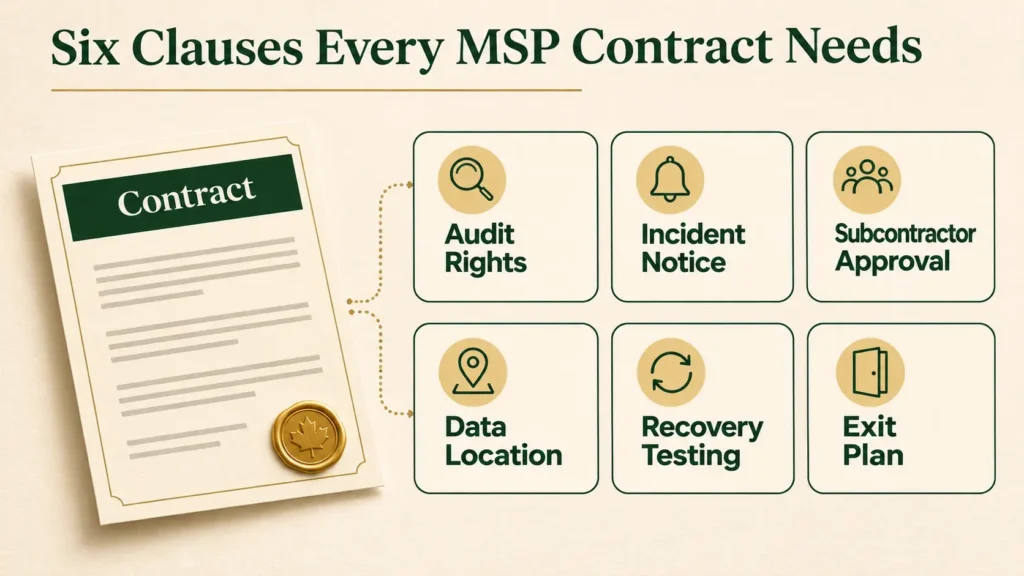
For high-risk and critical arrangements, your agreement should include, at a minimum:
- Clear scope of services and measurable service levels
- Incident notification timelines that support your regulatory reporting obligations
- Audit, access, and inspection rights for you, your auditors, and your regulator
- Notice and approval rights for material subcontractors
- Data location, ownership, segregation, and return or destruction terms
- Business continuity and recovery commitments with testing obligations
- Notice of changes in ownership, material regulatory non-compliance, or litigation
- Termination rights and a defined exit and transition plan
Your legal and compliance teams should review final terms against the guidelines that apply to your institution, since requirements vary by regulator and by the criticality of the arrangement.
How Requirements Differ by Type of Institution
Not every financial services enterprise in Canada follows the same rulebook, so how to choose an MSP for financial services depends partly on who regulates you.
- Banks, federally regulated insurers, and trust and loan companies fall under OSFI, which means B-10, B-13, E-21, and the 24-hour incident reporting advisory all shape provider requirements.
- Credit unions are generally regulated provincially. In Ontario, FSRA’s IT Risk Management Guidance, effective April 1, 2024, expects credit unions to assess third parties before contracting, include audit and access rights, test third-party compliance, and maintain exit plans.
- Provincially regulated insurers, mortgage brokerages, and pension administrators in Ontario also fall under FSRA’s guidance, which makes clear they remain accountable for outsourced IT risk.
- Investment dealers, wealth managers, and fintechs face a mix of securities, privacy, and anti-money laundering obligations, and often serve clients in multiple provinces, which makes data location and privacy assessments especially important.
A provider that already supports institutions in your regulatory category will understand these differences without a lengthy education process.
A Practical Selection Process
If you are working out how to choose an MSP for financial services in a way your board and regulators will accept, a disciplined process keeps the decision defensible:
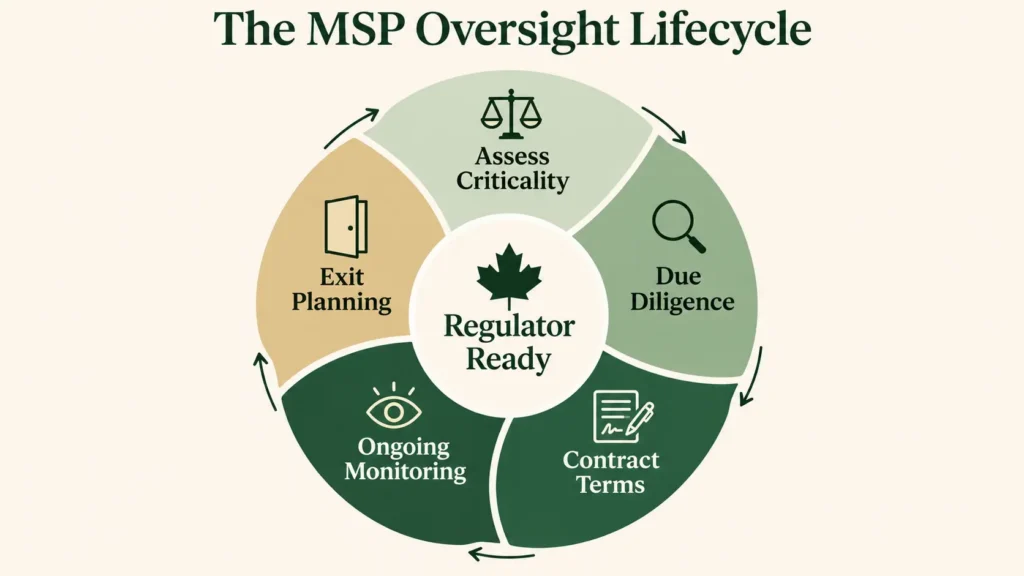
- Define scope and criticality. List the services to outsource and classify each by criticality.
- Translate regulations into requirements. Turn applicable guidelines into scored evaluation criteria.
- Issue a focused RFP. Include the questions above and request evidence, not just answers.
- Run enhanced due diligence on finalists. Review assurance reports, references, financial stability, and subcontractor lists.
- Negotiate contract terms early. Settle audit, incident, data, and exit clauses before commercial terms.
- Plan a phased transition. Move lower-criticality services first and run parallel operations for critical services where possible.
- Monitor continuously. Review performance, risk, and compliance on a set schedule, and reassess after material changes.
Choose a Partner That Strengthens Your Compliance Posture
Knowing how to choose an MSP for financial services comes down to one principle: the right provider makes your regulatory obligations easier to meet, not harder. That means fast incident escalation, open audit access, clear data locations, tested recovery, and an exit plan you never hope to use but can rely on.
AppStudio supports Canadian and North American enterprises with managed IT built around accountability, documentation, and resilience. If your institution is reviewing its current provider or preparing to outsource for the first time, connect with the AppStudio team for a practical review of your requirements and how to evaluate the providers on your shortlist.
Frequently Asked Questions
How should financial services enterprises choose managed IT services in Canada?
Financial services enterprises should choose managed IT services in Canada by first defining regulatory obligations, then evaluating providers on criticality fit, incident escalation speed, audit rights, subcontractor transparency, data location, tested resilience, and exit planning. Price and tooling should be weighed only after these requirements are met.
What does OSFI B-10 require from managed IT providers?
OSFI B-10 requires federally regulated financial institutions to apply risk-based due diligence and oversight to third-party arrangements. For high-risk and critical arrangements, it sets minimum contract provisions, including audit rights, incident notification that supports OSFI reporting, and exit planning.
Does a managed IT provider need to keep financial data in Canada?
Not every regulation strictly requires Canadian data residency, but institutions must understand and manage where their data is stored and processed. Quebec Law 25 requires a privacy impact assessment before personal information collected in Quebec is communicated outside the province, which makes Canadian hosting a practical advantage.
What questions should banks and credit unions ask a managed IT provider?
Banks and credit unions should ask how fast the provider will report incidents, whether auditors and regulators can inspect its controls, which subcontractors will access their environment, where data will be stored, when disaster recovery was last tested, and what the exit plan looks like.
How is managed IT different for credit unions?
Most credit unions are provincially regulated. In Ontario, FSRA’s IT Risk Management Guidance expects credit unions to assess third parties before contracting, secure audit and access rights, test provider compliance, and maintain exit plans, with material IT incidents generally reported within 72 hours.