
 iOS App Development
 Android App Development
 React Native
 Flutter
 Web Development
 Custom Software
 Front End Development
 Blockchain Development
 Virtual Reality
 Cloud Computing
 IoT Development
 Augmented Reality
 Write us a message
Canadian healthcare organizations protect some of the most sensitive data in the country, and they do it under rules that differ from one province to the next. A hospital network in Ontario, a clinic group expanding into Quebec and a health technology company serving Alberta custodians each answer to a different health privacy law, and each law asks something specific of IT. Understanding healthcare IT security requirements in Canada starts with those provincial differences.
The managed IT services for Canadian healthcare that fit those requirements best are the ones that produce evidence as they run:
- Identity and access management that controls and records who opens patient information
- Centralized logging and monitoring, so every access and security event is captured and reviewed
- Privacy-ready change management, so new systems are assessed before they go live
- Canadian data residency and backup, with workloads and copies kept in Canadian regions where required
- Incident response and breach tracking that supports provincial reporting
- Service provider controls that match the contract terms health privacy laws expect
Below, each one is mapped to provincial requirements, along with the evidence it should produce and the questions to ask a provider.
Healthcare IT Security Requirements in Canada, Province by Province
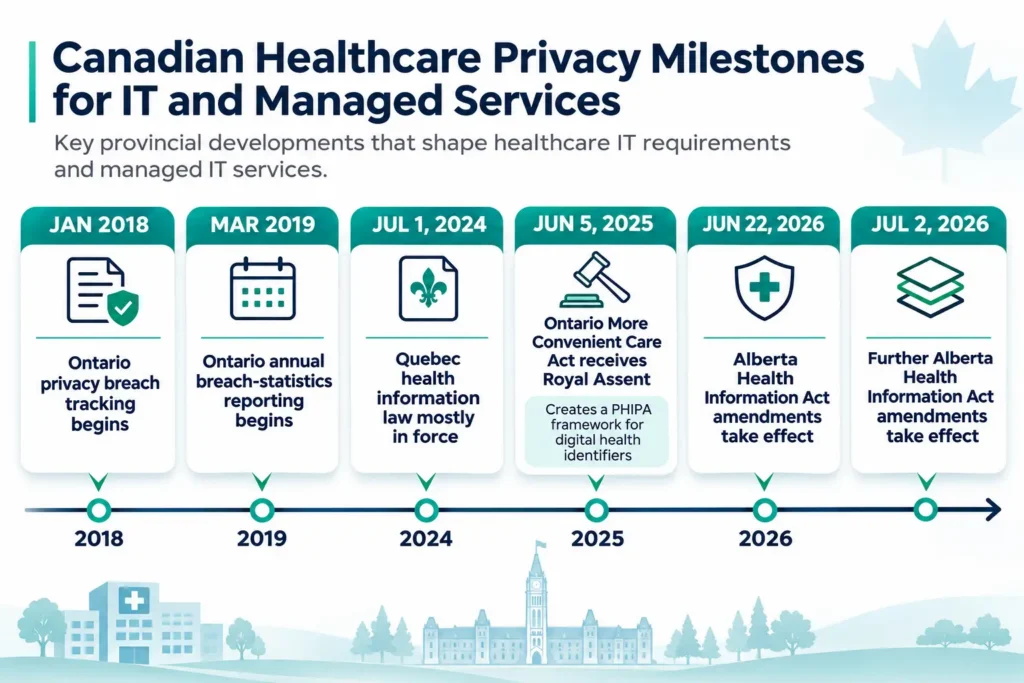
Health information in Canada is governed largely at the provincial level, and the rules keep moving. Quebec’s new law took effect in 2024, Ontario amended PHIPA in 2025, and Alberta’s Health Information Act changed in mid-2026. These three provinces show how specific the IT expectations have become.
Province | Law | What it asks of IT and service providers |
Quebec | Act respecting health and social services information, mostly in force since July 1, 2024 | Log every access to or use of health information; keep and publish a register of technology products and services; complete a privacy impact assessment before acquiring or overhauling technology or sending information outside Quebec; bind service providers by written contract |
Alberta | Health Information Act, with amendments in force June 22 and July 2, 2026 | Submit privacy impact assessments for new information systems before implementation (section 64); information managers such as EMR, AI scribe and virtual care vendors can now submit their information security policies to the Commissioner for review |
Ontario | Personal Health Information Protection Act, amended by the More Convenient Care Act (Royal Assent June 5, 2025) | Report annual privacy breach statistics to the Information and Privacy Commissioner, required since March 2019; a new framework for digital health identifiers |
Quebec. The Act respecting health and social services information requires covered bodies to:
- Protect information through reasonable safeguards
- Log all accesses to and uses of it
- Publish a register of the technology products and services they use
Service providers can receive information only under a written mandate or contract. That contract must limit use to the mandate, require immediate notice of any breach, allow audits and prohibit keeping information afterward (Blakes).
Alberta. Under the Health Information Act, custodians must submit privacy impact assessments to the Commissioner for review and comment before implementing new information systems or changing existing ones (OIPC Alberta). Amendments came into force on June 22, 2026, with further changes on July 2, 2026 (OIPC Alberta).
One change matters directly to technology providers. Information managers, including AI scribe tools, electronic medical record systems and virtual care vendors, can now submit their information security policies to the OIPC for review and comment (IAPP).
Ontario. Health information custodians began tracking privacy breaches on January 1, 2018 and have reported annual breach statistics to the IPC since March 2019 (IPC Ontario). The More Convenient Care Act received Royal Assent on June 5, 2025. It amended PHIPA to create a framework for digital health identifiers, which are unique identifiers that can be used to confirm a person’s identity (McCarthy Tétrault).
The common thread is evidence. Each law expects healthcare organizations to show what they did, not only to do it.
Matching Managed IT Services to Each Requirement
Requirement | Managed IT service that meets it | Evidence it should produce |
Record every access to health information | Centralized logging and SIEM monitoring | Searchable access logs and alert history |
Control who can see patient data | Identity and access management with MFA and role-based access | Access reviews and joiner, mover and leaver records |
Assess new systems before go-live | Change management tied to privacy review | Change records linked to completed PIAs |
Keep a register of technology in use | IT asset and software management | A current inventory of systems, apps and licences |
Keep data in Canada where required | Cloud hosting and backup in Canadian regions | Documented data locations for each workload |
Respond to and track breaches | Incident response with breach logging | Incident timelines and annual breach statistics |
Bind providers by written terms | Contracted managed service with audit rights | Signed terms covering confidentiality, notice and data return |
Logging at healthcare scale
Access logging sounds simple until you count the events. Take an illustrative hospital network of moderate size:
2,000 clinical and administrative users × 40 record accesses a day = 80,000 access events a day
80,000 × 365 = about 29.2 million access events a year
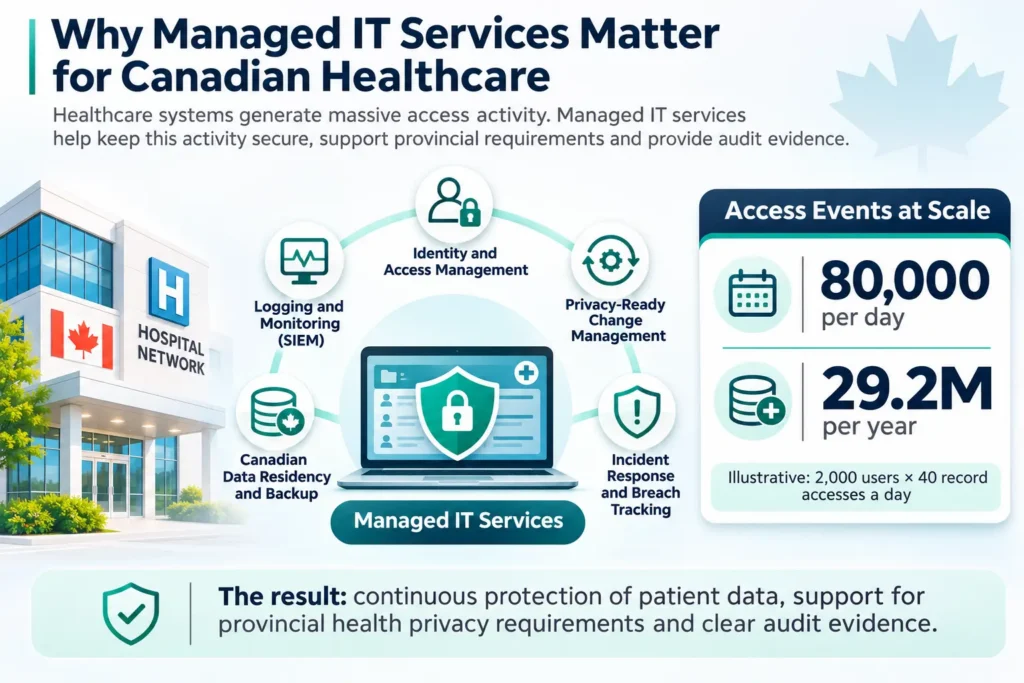
No team reviews that volume by hand. A managed logging and SIEM service collects the events centrally and keeps the history searchable for privacy investigations. It also flags unusual patterns, such as a user opening hundreds of records outside their unit.
Privacy impact assessments without delays
Alberta and Quebec both expect privacy impact assessments before new technology goes live, so IT change management and privacy review need to move together. A good managed provider documents each proposed system, its data flows and its security controls early. That way, the privacy office has what it needs to complete the assessment on time.
Alberta’s 2026 amendments add a new option for technology suppliers. An EMR, AI scribe or virtual care vendor acting as an information manager can submit its information security policies to the OIPC for review. That gives custodians another piece of evidence when they choose and approve vendors.
Example: A Clinic Group Expanding Into Quebec
This scenario is illustrative. An Ontario-based clinic group plans to open three sites in Quebec and connect them to its existing patient scheduling and records platform.
- Month 1: The managed provider documents the platform’s data flows, hosting regions and access controls, giving the privacy office what it needs for a privacy impact assessment
- Month 2: Access logging is extended to the new sites, and role-based access is set up for Quebec staff
- Month 2: The technology register is updated with every product and service the Quebec sites will use
- Month 3: The new sites go live with monitoring, backups in Canadian regions and a provider contract that includes confidentiality, breach notice, audit and data return terms
Each step produces evidence the clinic group can show regulators, auditors and patients.
Questions to Ask a Managed IT Provider
- Which provincial health privacy laws have you supported clients under?
- How do you capture and retain access logs for systems holding health information?
- How do you support privacy impact assessments when we add or change systems?
- Where will our data, backups and logs be stored, and can they stay in Canada?
- How do you track incidents so we can meet breach reporting obligations?
- Will your contract include confidentiality, breach notice, audit rights and data return terms?
- If you act as an information manager in Alberta, will you submit your information security policies to the OIPC for review?
How AppStudio Supports Canadian Healthcare Organizations
AppStudio’s managed IT services give healthcare organizations the controls and evidence provincial laws expect:
- 24/7 operations: round-the-clock help desk and network operations coverage, with urgent tickets typically getting a first reply within 10 minutes during business hours
- Identity and access: support for identity platforms including Microsoft Entra ID, Okta and Duo, plus structured onboarding and offboarding for every staff change
- Logging and monitoring: centralized logging and SIEM platforms including Splunk, Elastic and Graylog
- Asset and software tracking: lifecycle records for every device, application and licence
- Data residency: workloads placed in Canadian cloud regions where residency is required, with application migration aligned with HIPAA and PHIPA
- Backup and recovery: encrypted, immutable backups and failover planning through AppStudio’s managed backup and recovery
AppStudio earned ISO 9001 certification in 2021 and set up HIPAA-compliant delivery for healthcare clients in 2022. In 2023, it added ISO/IEC 27001 certification and SOC 2 Type II attestation (AppStudio). Most environments can start onboarding within about a week.
Frequently asked questions
Which IT services meet healthcare IT security requirements in Canada?
The best managed IT services for Canadian healthcare combine:
- Identity and access management
- Centralized logging and monitoring
- Privacy-ready change management
- Canadian data residency and backup
- Incident response with breach tracking
- Contract terms that bind the provider to confidentiality, breach notice and audit rights
Does Quebec's health information law affect IT service providers?
Yes. Under the Act respecting health and social services information, service providers can receive health information only under a written mandate or contract. That contract must limit use, require immediate breach notice, allow audits and prohibit keeping information after the mandate ends.
When do Alberta custodians need a privacy impact assessment?
Under section 64 of Alberta’s Health Information Act, custodians must prepare a privacy impact assessment for proposed information systems and administrative practices involving identifying health information. They must submit it to the Commissioner before implementation.
What changed in Alberta's Health Information Act in 2026?
Amendments came into force on June 22, 2026, with further changes on July 2, 2026. Among them, information managers such as EMR systems, AI scribe tools and virtual care vendors can now submit their information security policies to Alberta’s Information and Privacy Commissioner for review and comment.
Do Ontario health custodians report privacy breaches every year?
Yes. Ontario health information custodians have reported annual privacy breach statistics to the Information and Privacy Commissioner since March 2019. PHIPA was also amended in 2025 to add a framework for digital health identifiers.
Can healthcare data stay in Canada with a managed IT provider?
Yes. AppStudio places workloads in Canadian cloud regions where data residency is required, and documents where data, backups and logs are stored.
How quickly can a healthcare organization move to AppStudio?
For most healthcare environments, onboarding begins within about a week (5 to 7 business days). A mid-sized organization typically completes the transition over the following 2 to 4 weeks.
Protect Patient Data With Evidence You Can Show
Canadian healthcare organizations do their best work when IT runs quietly in the background and produces the evidence regulators, auditors and patients expect. The right managed IT services for Canadian healthcare make that routine, province by province.
Reserve a free 30-minute consultation with AppStudio to map your provincial requirements and see how our managed IT services would support your security and privacy program.