
 iOS App Development
 Android App Development
 React Native
 Flutter
 Web Development
 Custom Software
 Front End Development
 Blockchain Development
 Virtual Reality
 Cloud Computing
 IoT Development
 Augmented Reality
 Write us a message
There is a version of success that quietly destroys product companies. Teams ship constantly, roadmaps stay full, demos impress stakeholders, and release notes grow longer with each sprint. Yet, somewhere between the velocity metrics and the quarterly reviews, the product becomes harder to use, the codebase harder to extend, and the customers harder to retain. This is the Feature Factory at work.
What is the Feature Factory?
The term, popularized by product consultant John Cutler, describes an organizational pattern in which teams optimize relentlessly for output: features shipped per quarter, stories closed per sprint, velocity maintained at all costs. Delivery becomes the primary measure of health. The question driving decisions is not “Does this create genuine value?” but rather “Can we ship it in time for the next release?”
In isolation, shipping quickly is not the problem. Velocity is a genuine competitive advantage when directed well. The pathology emerges when speed becomes a proxy for progress, and when the act of delivery displaces the discipline of discovery, quality, and long-term architectural thinking.
“The Feature Factory does not fail loudly. It succeeds just enough, for just long enough, to make the underlying problem invisible until it is very expensive to reverse.”
The warning signs inside your organization
Feature factories rarely announce themselves. They emerge gradually through a series of reasonable-seeming decisions made under pressure. The following signals, particularly when they appear in combination, warrant serious organizational attention.
- Velocity over outcomes: Success is measured in tickets closed, not problems solved or retention improved.
- Backlog-driven strategy: The roadmap is a prioritized backlog, not a coherent strategic narrative.
- No user proximity: Discovery is compressed or skipped entirely to protect delivery dates.
- Deferred quality work: Technical and UX debt are consistently deprioritized in favor of new features.
- Post-ship abandonment: Features are rarely measured after launch. Teams move on before learning what changed.
- Engineers as executors: Engineering is treated as a build function, not a problem-solving partner.
Why this happens to high-performing teams
The Feature Factory is not a symptom of poor talent or low ambition. It frequently develops in organizations with strong engineers, capable product managers, and genuine market traction. The dysfunction typically originates in structural and incentive misalignments rather than individual failure.
When leadership evaluates product teams primarily through feature output, teams rationally optimize for that signal. When sales commitments are made before discovery is complete, engineering inherits the resulting constraints. When planning cycles are too short for proper architectural consideration, technical shortcuts accumulate. Each individual decision is defensible; the aggregate is damaging.
There is also a cultural dimension. Organizations that celebrate shipping and reward launches, but rarely discuss what was learned or what was deprioritized to ship, gradually erode the behaviors that produce durable product quality. Urgency becomes the standing operating mode. Reflection becomes a luxury teams cannot afford.
“Speed is not the problem. Speed without feedback, without quality standards, and without strategic coherence is the problem.”
The compound cost of sustained feature factory behavior
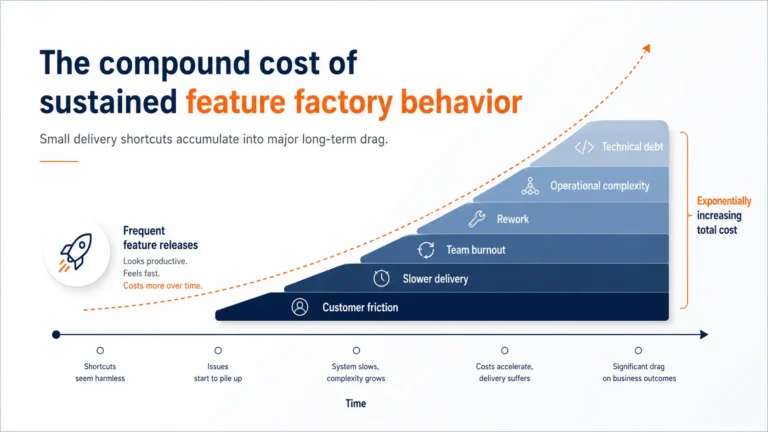
The consequences of operating as a feature factory compound over time. In the near term, teams ship frequently and morale may remain reasonably high. Over a period of 12 to 24 months, the following patterns typically emerge:
- Architecture degradation. Systems that were not designed to accommodate the features built on top of them become brittle. Development velocity slows even as headcount grows, because each new feature requires negotiating with increasing complexity.
- User experience fragmentation. Features added without a coherent product vision produce interfaces that are internally inconsistent. Users encounter friction at the seams, leading to higher support costs and lower adoption of newer capabilities.
- Strategic drift. When every stakeholder request becomes a roadmap item, the product gradually loses its clear positioning. It begins to serve all use cases poorly rather than a specific set of use cases exceptionally well.
- Engineering retention risk. Skilled engineers are sensitive to environments where quality is systematically deprioritized. Sustained feature factory culture is a meaningful contributor to attrition in technical organizations.
- Competitive vulnerability. A product that is wide but shallow is exposed to focused competitors who solve specific problems with greater depth, quality, and reliability.
What building right actually requires
The corrective is not to slow down. The goal is to redirect energy from raw output toward disciplined delivery: shipping the right things, with the right quality, at a pace the organization can sustain and learn from.
Organizations that consistently build well tend to share several structural characteristics:
- Outcome-oriented roadmaps. Strategy is expressed in terms of the customer and business outcomes teams are responsible for achieving, not lists of features to build. Features are hypotheses about how to reach those outcomes.
- Continuous discovery integrated into delivery cadences. User research, interviews, and behavioral data inform ongoing prioritization rather than being treated as a pre-phase activity that ends once planning begins.
- Quality as a non-negotiable constraint. Technical debt and UX debt are tracked and allocated deliberate capacity, rather than being treated as optional work deferred to a future cleanup sprint that never arrives.
- Engineers as partners in product decisions. Engineering involvement earlier in the discovery and shaping process produces better scoped work, more realistic timelines, and more architecturally coherent solutions.
- Measurement discipline post-launch. Every significant initiative has defined success metrics evaluated within a defined window. Teams close the loop on what shipped before moving fully to the next initiative.
- Leadership that rewards learning, not just launching. The incentive environment must make it safe to report that something did not perform as expected, and to use that learning to inform the next decision.
The organizational transition
Transitioning out of a feature factory pattern is a change management challenge as much as an operational one. Teams that have been measured by output for extended periods need explicit permission, new rituals, and visible leadership behavior before they will invest in quality and discovery work that does not immediately produce a shippable increment.
The instinct to ship is not wrong. It is a competitive asset when combined with the discipline to ship the right things, measure what happened, and build on what was learned. The organizations that sustain product-led growth over multiple years are not the ones that shipped the most features. They are the ones that built the best feedback loops and maintained the structural conditions for good decisions to compound over time.
Recognize these patterns in your organization?
Let’s talk through what a structured delivery audit could look like for your team. Request a consultation