
 iOS App Development
 Android App Development
 React Native
 Flutter
 Web Development
 Custom Software
 Front End Development
 Blockchain Development
 Virtual Reality
 Cloud Computing
 IoT Development
 Augmented Reality
 Write us a message
Every enterprise has a technology roadmap. Most of those roadmaps are lists.
They describe what will be built, in what sequence, by which quarter. They are organized by delivery milestone rather than business outcome. They are maintained by whoever has the most time to update a spreadsheet. They are reviewed in quarterly planning sessions where the primary question is whether items are on track, not whether the items are the right ones. And they are treated as commitments, contracts between engineering and the business, that create accountability for delivery while creating no accountability whatsoever for whether the delivered thing achieved anything.
This is not a technology problem. It is a governance problem. And it is producing measurable financial damage at scale.
The average large enterprise lost $104 million in 2024 to underutilized technology, disjointed strategy, and low adoption (WalkMe/SAP, 2025). 70 percent of digital transformations fail to meet their objectives (Gartner and McKinsey, 2025). 88 percent of business transformations fall short of their original ambitions (Bain, 2024). Global IT spending is forecast to reach $6.15 trillion in 2026, up 10.8 percent from 2025 (Gartner, via Trantor, March 2026). Nearly half of digital initiatives still fail to meet their business targets despite this unprecedented capital commitment (Gartner 2026 CIO Agenda, via Trantor, March 2026).
The enterprise application roadmap is where most of that failure originates. Not because the wrong technologies were chosen, not because engineering teams executed poorly, but because the roadmap was a delivery plan for an organization that needed a decision system. And nobody with genuine business accountability owned it.
This piece defines what a healthy enterprise app roadmap actually looks like, examines the ownership question with the specificity it demands, and gives leadership teams the framework to build and maintain the kind of roadmap that produces commercial outcomes rather than delivery reports.
Why Most Enterprise App Roadmaps Are Already Broken Before Development Starts
The structural failure of most enterprise app roadmaps is not visible at the point of failure. It is baked in at the point of creation.
Most enterprise app roadmaps are built as delivery artifacts. They emerge from requirements-gathering sessions, stakeholder interviews, and planning workshops where the central question is what needs to be built. The output is a prioritized list of features, organized by quarter, with dependencies mapped and resource estimates attached. It is a credible-looking document. It communicates organizational intent. It gives the engineering team a clear mandate.
What it does not do is answer three questions that determine whether any of the work it describes will matter: What specific business outcome does each item on this roadmap exist to improve? How will we measure whether that improvement has been achieved? And who is accountable for the outcome, not the delivery, the outcome?
Most roadmaps treat customer experience as something design handles or customer success owns, rather than as a strategic outcome the entire roadmap is engineered to deliver (ITONICS Innovation, Product Roadmap Alignment, December 2025). Most roadmaps are still lists pretending to be a strategy with three columns: initiative, owner, and date. This communicates what is being built but not why it matters (ITONICS Innovation, December 2025). And ProductPlan’s 2025 State of Product Report found a 5 percent increase in senior leadership deciding product strategy compared to the prior year, alongside an increase in tracking output measures such as the number of items completed on a roadmap as a key success metric, both trends pointing toward delivery accountability replacing outcome accountability at precisely the moment when outcome accountability matters most (Ant Murphy, Medium, December 2025).
A healthy enterprise app roadmap inverts this structure entirely. It starts with business outcomes and works backward to features, not forward from features to hoped-for outcomes. It treats the roadmap as a living hypothesis about the most effective path to a defined commercial goal, not as a contract between engineering and the business. And it assigns outcome ownership at the executive level before it assigns delivery ownership at the team level.
What a Healthy Enterprise App Roadmap Actually Contains
A healthy enterprise app roadmap is distinguished from an unhealthy one not by its length, its visual presentation, or its tooling but by what it makes explicit that most roadmaps leave implicit.
The Three Layers Every Healthy Roadmap Requires
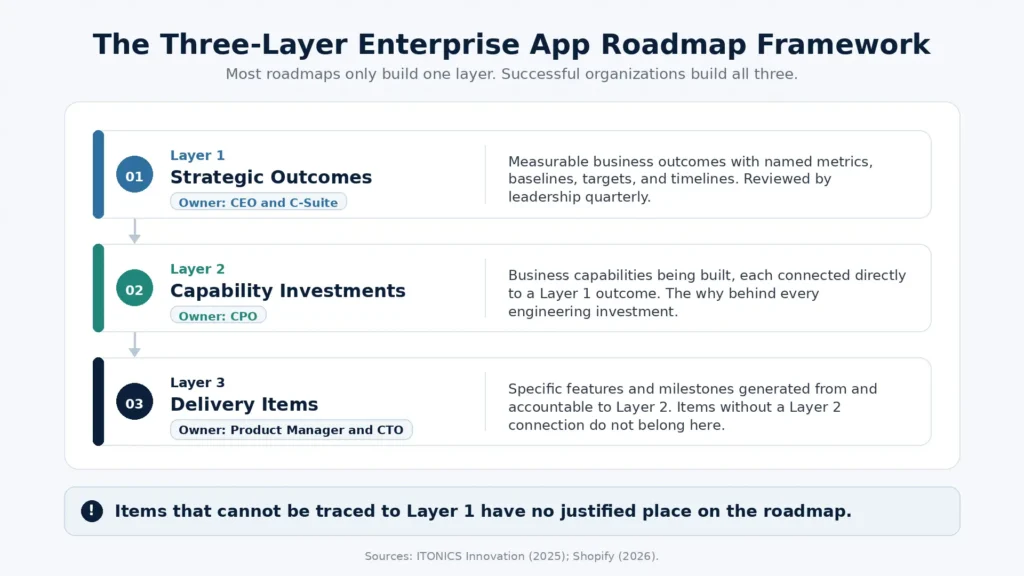
The most consistent finding in enterprise roadmap research is that successful organizations build roadmaps with three distinct layers while most companies only build one (ITONICS Innovation, Product Roadmap Alignment, December 2025).
Layer 1: The strategic outcomes layer.
This layer defines the measurable business outcomes the roadmap exists to achieve. Not “improve the customer experience” but “reduce customer support ticket volume by 30 percent within 12 months by improving self-service capability.” Not “modernize the platform” but “reduce time to deploy new features from 3 weeks to 5 days within 18 months.” Each outcome has a named metric, a baseline, a target, and a timeline. This layer is reviewed by leadership quarterly and is the reference point against which every item on the lower layers is evaluated and prioritized.
Layer 2: The capability investment layer.
This layer organizes work by the business capabilities being built or improved rather than by features or system names. Each capability investment describes what the organization will be able to do differently when the investment is complete, and maps directly to one or more outcomes in Layer 1. The capability framing is important because it maintains the connection between engineering work and business value through the inevitable evolution of feature scope that happens during development.
Layer 3: The delivery layer.
This is the layer most roadmaps consist of entirely: specific features, epics, and delivery milestones organized by quarter or sprint. In a healthy three-layer roadmap, this layer is generated from and accountable to Layer 2, which is accountable to Layer 1. Items in the delivery layer that cannot be traced to a capability in Layer 2, or a capability in Layer 2 that cannot be traced to an outcome in Layer 1, have no justified place in the roadmap.
What Each Item on a Healthy Roadmap Must Specify
The Shopify enterprise architecture roadmap framework provides a practical template for what each roadmap initiative must document to be a genuine strategic commitment rather than a delivery intention (Shopify, How to Build an Enterprise Architecture Roadmap, March 2026):
The strategic driver: which specific business goal this initiative serves. A business-readable label that connects the initiative to a Layer 1 outcome rather than a technology description.
The value hypothesis: the expected business outcome if the initiative is delivered and adopted successfully. Expressed in measurable terms: what metric moves, by how much, by when.
The KPIs: how success will be measured. Specific, pre-defined, and agreed before development begins, not identified after delivery when convenient metrics can be selected retrospectively.
The named owner: a specific individual who is accountable for the outcome the initiative is expected to produce, not just the delivery of the initiative itself.
The dependency map: what must happen before this initiative can deliver its expected value, including both technical dependencies and organizational dependencies such as process changes or capability development that the technology depends on.
The risk level and rationale: an explicit assessment of delivery risk and outcome risk, with documented reasoning rather than a generic risk register entry.
The timeline with confidence signals: near-term items with high confidence carry specific date commitments. Exploratory longer-term items carry directional timelines with explicit confidence levels rather than false precision. Leading teams signal confidence levels so that near-term work carries high confidence while exploratory bets remain flexible (ITONICS Innovation, December 2025).
What a Healthy Roadmap Excludes
A healthy enterprise app roadmap is defined as much by what it does not contain as by what it does.
It does not contain features whose primary justification is that a stakeholder requested them. It contains features whose primary justification is that they are the best available investment in a defined business outcome.
It does not contain items that cannot be traced to a Layer 1 outcome. If an item cannot be connected to a measurable business goal, it either belongs in a separate maintenance backlog or it should not be on the roadmap.
It does not contain false precision on long-horizon items. A Q3 commitment for a complex initiative that is 18 months away is not a plan. It is a guess dressed as a commitment, and it creates accountability for delivery timing at the expense of accountability for delivery quality and outcome achievement.
It does not contain items that were never formally deprioritized or removed. Roadmap accumulation, where items are added faster than they are removed or completed, is one of the most reliable signals of a roadmap that has lost strategic coherence. The cadence at which the roadmap meaningfully changes is the clearest signal of whether it is alive or whether it has quietly become decoration (AppsTek Corp, Enterprise AI Roadmap Agentic Era, 2026).
The Ownership Question: Who Actually Should Own an Enterprise App Roadmap
This is the question most organizations answer poorly, and the answer they give determines almost everything about the roadmap’s effectiveness.
The most common answer in enterprise organizations is that the CTO owns the roadmap. This is sometimes correct and often wrong, and the difference depends on what kind of roadmap is being discussed.
The product portfolio strategy, together with the product roadmap and product backlog, is owned by a product manager and product team. The technology strategy and roadmap are owned by the CTO together with senior architects (Roman Pichler, Succeeding with the Product Operating Model, Medium, April 2026). The CPO works on the what and why while partnering with the CTO on the how (Parallelhq, What Does a CPO Do, January 2026).
These are not interchangeable roles. They represent genuinely different ownership domains, and the failure to distinguish between them is one of the most consistent sources of enterprise app roadmap dysfunction.
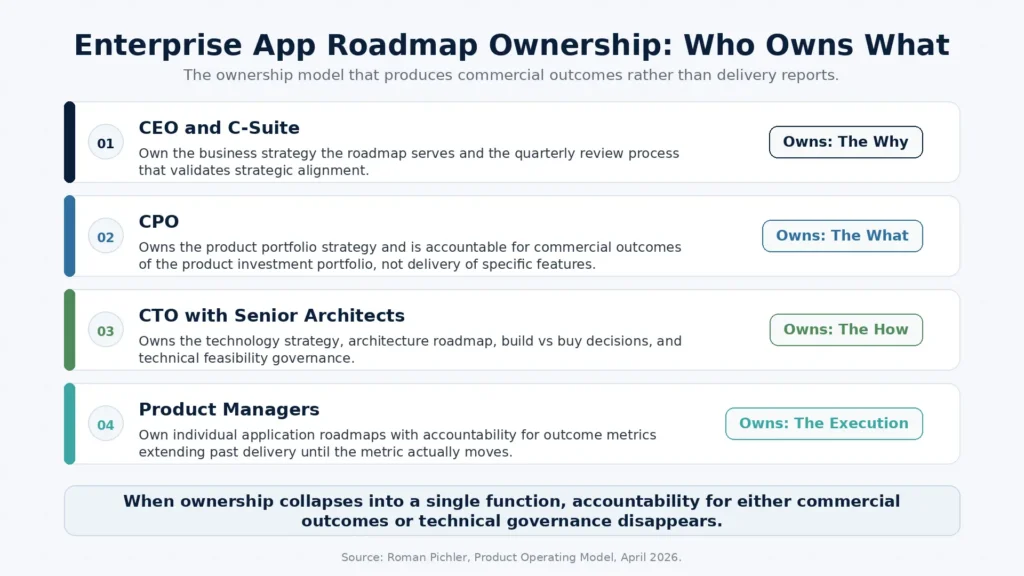
The ownership model that research and practice consistently validate:
Business strategy: CEO and C-suite.
The business strategy defines the commercial goals that technology investments exist to serve. Without C-suite ownership of this layer, the roadmap has no authoritative reference point against which to evaluate competing priorities.
Product portfolio strategy: CPO.
The CPO owns the decisions about which applications, features, and product investments best serve the business strategy. The CPO is accountable for the commercial outcomes of the product portfolio, not the delivery of specific features.
Product strategy and roadmap: Product Manager with product team.
The product manager owns the specific roadmap for their application or product area, working within the strategic context set by the CPO and in partnership with the CTO on architecture and technical approach.
Technology strategy and architecture roadmap: CTO with senior architects.
The CTO owns the technology choices, the architecture decisions, and the technical roadmap that enables the product strategy. The CTO does not own the product roadmap but is a critical input to it and a governing authority on its technical feasibility and architectural coherence.
The failure mode that produces most enterprise roadmap dysfunction is the collapse of these ownership domains into a single function: typically either “the business” (which produces a feature wishlist without technical grounding) or “engineering” (which produces a technically coherent plan without commercial accountability). Neither produces a roadmap that both the organization can deliver and the market will reward.
The CTO's Specific Role in Enterprise App Roadmap Health
The CTO’s relationship to the enterprise app roadmap is one of the most frequently mischaracterized in organizational design conversations. The CTO is not the roadmap owner in the product sense but is the most important single contributor to whether the roadmap is achievable, scalable, and architecturally coherent.
The CTO owns four specific contributions to a healthy enterprise app roadmap:
Technical feasibility governance.
Every item on the roadmap that involves significant technical complexity, architectural change, or platform dependency requires CTO-level assessment of whether the proposed approach is sound, whether the timeline is realistic, and whether the technical dependencies have been identified and sequenced correctly. This is not a veto role. It is a quality assurance role that prevents the roadmap from making commitments the organization cannot keep.
Architecture roadmap alignment.
The enterprise app roadmap exists within a broader technical architecture that has its own evolution trajectory. The CTO ensures that product roadmap investments are consistent with the architecture roadmap direction, that technical debt is being addressed at a rate that does not accumulate to a constraint on product velocity, and that platform investments are sequenced before the product features that depend on them. Technical debt accounts for 40 percent of IT balance sheets in organizations with significant legacy systems (Gartner, via SIG, 2025). A CTO who allows the product roadmap to outpace architectural health is accumulating a constraint that will appear as a product velocity problem, correctly attributed not to engineering capacity but to architecture.
Build versus buy governance.
Every significant capability on the enterprise app roadmap represents a build versus buy decision. The CTO’s role is to ensure those decisions are made with full information about total cost of ownership, integration complexity, vendor dependency risk, and long-term architectural implications, not just initial build or license cost. ERP implementations average $7.1 million and 17.4 months, running 3.6 months past plan on average, with 55 percent going over budget and 68 percent running longer than planned (Panorama Consulting Group ERP Report 2024, via CompaniesHistory.com, June 2026). The CTO who does not own the build versus buy evaluation process for major platform decisions is ceding one of the highest-leverage technical governance decisions to stakeholders who lack the information to make it well.
AI and emerging capability integration.
Gartner predicts that 40 percent of enterprise applications will integrate task-specific AI agents by the end of 2026 (Gartner, via Trantor, March 2026). Global IT spending is expected to include an 80.8 percent growth in generative AI model spending in 2026 (Gartner, via Trantor). The CTO’s role in the roadmap includes defining how AI capabilities are integrated into existing applications rather than deployed as isolated experiments, and ensuring that the AI investments on the roadmap are built on data foundations and governance frameworks that make them durable rather than brittle.
The Review Cadence That Keeps a Roadmap Healthy
A roadmap that is reviewed annually is a plan. A roadmap that is reviewed quarterly is a governance instrument. A roadmap that is reviewed continuously against real-world outcome data is a decision system.
The distinction matters because the value of a roadmap is not the document. It is the quality of the decisions made using it. And decisions made quarterly with current outcome data are structurally better than decisions made annually with lagging delivery metrics.
The portfolio is reopened to genuine scrutiny every quarter, without protection for legacy initiatives or executive favorites. Programs are killed, scope is rewritten, and capital is reallocated against current evidence (AppsTek Corp, 2026). That is the standard that distinguishes a living roadmap from a political document.
The quarterly roadmap review structure that actually works:
The review begins with Layer 1: are the business outcomes we defined still the right ones, and are we making progress against them? This is not a delivery status question. It is a strategic alignment question that requires the CPO, CTO, and relevant business unit leaders in the room with authority to change priorities.
It then moves to Layer 2: are the capability investments we are making the right response to the Layer 1 outcomes? Have we learned anything in the last quarter that would change the priority or approach of any capability investment?
It concludes with Layer 3: given the Layer 1 and Layer 2 review, are the delivery items in the next quarter’s plan still correctly prioritized? Do we have the capacity to deliver them? Are the dependencies and risks correctly identified?
Items that survive this review have been re-justified against current evidence. Items that do not survive are deprioritized, descoped, or killed, and that decision is documented with the rationale that allows future teams to understand why the priority changed.
The Red Flags That Indicate a Roadmap in Poor Health
Enterprise app roadmaps develop dysfunction in recognizable patterns. The following signals consistently appear in roadmaps that are producing delivery reports rather than business outcomes.
The roadmap has not changed in three months. A roadmap that reflects the same priorities in Q3 that it reflected in Q1, despite three months of product delivery, user feedback, market movement, and organizational learning, is a roadmap that is not being used to make decisions. It has become a reference document rather than a governance instrument.
Items cannot be traced to a business outcome. When asked why a specific roadmap item exists, the answer is a stakeholder name rather than a metric. This indicates the roadmap is being used to manage organizational relationships rather than commercial outcomes.
The delivery layer is the only layer. When the roadmap contains features and dates but no statement of the business outcomes those features are expected to produce or the metrics that will measure whether they did, the roadmap has no mechanism for learning whether the investments it represents are working.
Ownership is ambiguous or collective. When the question of who owns the roadmap produces an answer involving a committee, a shared responsibility, or a role title rather than a named individual, the accountability structure that makes roadmaps effective does not exist. When an enterprise application is deployed without a clearly designated C-suite owner accountable for its business outcomes, the initiative enters a zone of diffuse accountability that renders significant technology investments inert (AppStudio, Why Enterprise Apps Fail, 2026).
The roadmap has never had an item killed. A roadmap from which items are only added and completed, never killed or deprioritized before completion, is not a strategic prioritization tool. It is a delivery queue. The absence of killed items is the absence of the trade-off decisions that constitute genuine strategy.
The CTO and CPO are not aligned on the same document. When the product roadmap and the technology roadmap are separate documents maintained by separate teams, they drift. The product roadmap makes commitments that the technology roadmap cannot support. The technology roadmap makes investments that the product roadmap does not leverage. The gap between them is where enterprise technology budgets disappear into underutilized infrastructure and missed product opportunities simultaneously.
The Ownership Model That Produces Commercial Outcomes
Pulling the ownership model together into a practical governance structure, the following allocation reflects both the research evidence and the operational patterns of the organizations whose roadmaps consistently produce commercial outcomes.
The CPO owns the “what and why.”
Which applications and capabilities should be built, in what priority order, to achieve which business outcomes. The CPO is accountable to the CEO and board for the commercial return on the product investment portfolio. This accountability must be genuine, not nominal: the CPO’s performance assessment should include outcome metrics, not just delivery metrics.
The CTO owns the “how and when.”
How the product vision will be realized technically, what architecture decisions it requires, what the realistic timeline is given current technical constraints and team capacity, and what technical investments are needed before product investments can be made effectively. The CTO is accountable for architectural health, technical feasibility, and the platform investments that multiply the productivity of every product team building on top of them.
Named product managers own individual application roadmaps.
Within the strategic context set by the CPO and the technical context set by the CTO, individual product managers own the specific roadmaps for their applications, with explicit accountability for the outcome metrics those applications are expected to move. This accountability must extend past delivery: the product manager is not done when the feature ships. They are done when the metric moves.
The CEO and C-suite own the business strategy that the roadmap serves.
This ownership includes the quarterly review process where strategic outcomes are validated against current evidence and the authority to reallocate resources when the evidence suggests the current roadmap is not the most effective path to the business strategy it is supposed to serve.
What Distinguishes the Roadmaps That Work
The organizations whose enterprise app roadmaps consistently produce commercial outcomes do not have better engineers, bigger budgets, or superior tooling compared to those whose roadmaps consistently produce delivery reports. They have better governance.
Their roadmaps are built in three layers. Their ownership is explicit and individual, not shared and collective. Their quarterly reviews address strategic alignment before delivery status. Their items are killed when the evidence no longer supports them. Their CPO and CTO are aligned on a single shared document that represents both the product vision and the technical path to achieving it. And their definition of roadmap success is a business outcome metric that moved, not a feature that shipped.
Decentralized execution, centralized strategy, and relentless communication of the why behind every priority: that is the pattern that repeats across most successful organizations (ITONICS Innovation, December 2025). The specific tools and processes matter less than the commitment to making alignment structural rather than aspirational.
The enterprise app roadmap is not a planning artifact. It is the primary mechanism by which an organization converts its technology investment into business performance. Treating it as a delivery list is a choice to leave most of that conversion potential on the table.
If your enterprise app roadmap is producing delivery reports rather than business outcomes, the problem is governance rather than engineering. Schedule a consultation with our team. We will assess your current roadmap structure against the three-layer framework, identify the ownership gaps that are producing accountability without outcome, and help you build the governance model that converts your technology investment into measurable commercial performance.