
 iOS App Development
 Android App Development
 React Native
 Flutter
 Web Development
 Custom Software
 Front End Development
 Blockchain Development
 Virtual Reality
 Cloud Computing
 IoT Development
 Augmented Reality
 Write us a message
Replacing a legacy system is rarely the hard part. The harder challenge is moving people, not just data, onto the new platform without eroding the productivity, engagement, and trust the organization has built over years. For most large enterprises, a technically flawless cutover that loses 30% of its active users is not a success; it is an expensive failure measured in stalled workflows, support backlogs, and shadow IT.
Legacy app migration is frequently scoped as an infrastructure project: provision the new environment, port the data, validate the integrations, decommission the old system. Yet the projects that disappoint rarely fail on those dimensions. They fail because the people expected to use the new application either revert to old habits, route around the system entirely, or disengage to the point where the promised business case never materializes.
This guide examines how legacy app migration succeeds when it is treated as a behavioral and organizational program, not merely an engineering exercise. It is intended for executives who own the outcome, not the codebase, and who are ultimately accountable for the return on a multi-quarter, often multi-million-dollar investment.
Why Legacy App Migration Fails on Adoption, Not Technology
The data consistently points away from technical defects as the primary cause of failure.
- An estimated 70% of digital transformation initiatives fall short of their stated objectives, with employee resistance and inadequate change management cited as leading factors rather than infrastructure shortcomings [1].
- Roughly two-thirds of large IT projects run over budget or behind schedule, and a meaningful share deliver materially less value than projected, often because end-user adoption was assumed rather than engineered [2].
- Organizations lose an estimated $9,600 per employee, per year to unproductive change initiatives when transformation fatigue sets in across the workforce [3].
The pattern is clear: teams that migrate legacy applications tend to over-index on parity of features and under-invest in continuity of behavior. Users do not adopt a new application because it is technically superior. They adopt it because the transition preserved their ability to get work done, removed friction they recognized, and did not punish them for the change.
When adoption is treated as an afterthought, three predictable failure modes emerge. The first is reversion, where users quietly continue to rely on the legacy system or exported spreadsheets long after the official cutover. The second is workaround proliferation, where teams build unsanctioned tools to fill perceived gaps, fragmenting data and reintroducing the very risks the migration was meant to retire. The third is disengagement, where users technically log in but stop performing the higher-value tasks the new platform was designed to enable. Each of these is invisible to a status report that tracks only deployment milestones.
The Five Pillars of a Low-Risk Legacy Application Migration
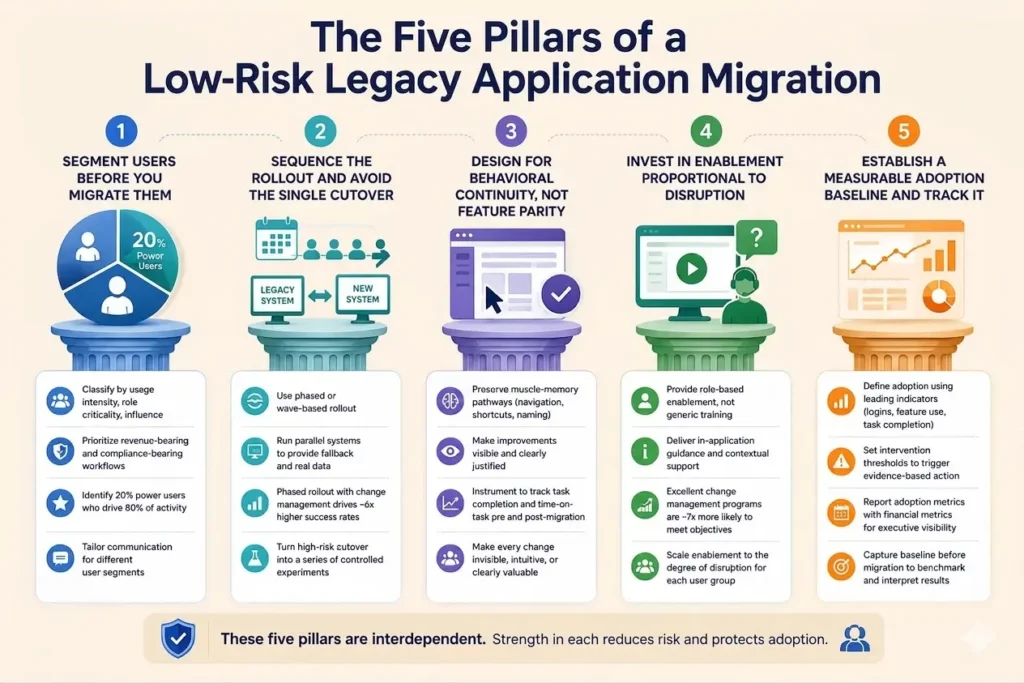
A defensible legacy application migration program rests on five interdependent pillars. Weakness in any one tends to surface as an adoption problem downstream, often weeks after the technical team has declared victory.
1. Segment Users Before You Migrate Them
Not all users carry equal risk or influence, and treating the population as homogeneous is a common and costly simplification.
- Classify the user base by usage intensity, role criticality, and organizational influence, so that effort is allocated where the consequences of failure are highest.
- Identify the 20% of power users who typically account for roughly 80% of transactional activity; their experience disproportionately shapes organizational sentiment and informal word of mouth [4].
- Map workflows that are revenue-bearing or compliance-bearing first, since failure in these areas carries direct financial and regulatory cost rather than mere inconvenience.
Segmentation also informs communication. The message that reassures a daily power user is not the message that motivates an occasional user, and a single, generic announcement tends to serve neither well.
2. Sequence the Rollout and Avoid the Single Cutover
Big-bang migrations concentrate risk into one irreversible event, leaving no room to learn before the entire organization is exposed.
- Favor a phased or wave-based rollout, where cohorts migrate sequentially and the lessons from each wave compound into the next.
- Run a parallel-run period in which the legacy and new systems operate concurrently, giving users a fallback and giving the program team real behavioral data rather than projections.
- Companies that adopt phased approaches supported by structured change management report success rates roughly six times higher than those that do not invest in it [5].
A staged rollout converts a single high stakes gamble into a series of smaller, recoverable decisions. Each wave functions as a controlled experiment, surfacing issues at a scale the organization can absorb and correct.
3. Design for Behavioral Continuity, Not Feature Parity
Feature parity is necessary but insufficient. A new application can replicate every function of its predecessor and still feel alien enough to depress adoption.
- Preserve the muscle-memory pathways, such as navigation patterns, keyboard shortcuts, and familiar naming conventions, that experienced users rely on without conscious thought.
- Where the new application improves a workflow, make the change visible and justified rather than silent, so users understand the benefit instead of experiencing only the disruption.
- Instrument the application to capture task-completion rates and time-on-task before and after migration, so any degradation is detected early through data rather than reported late through complaints.
Behavioral continuity is where engineering and change management meet. The objective is not to freeze the experience in place but to ensure that every change a user encounters is either invisible, intuitive, or clearly worth the adjustment.
4. Invest in Enablement Proportional to Disruption
Training is the most frequently under-resourced line item when enterprises migrate legacy applications, and it is often the first to be cut when timelines compress.
- Provide role-based enablement rather than generic walkthroughs, because relevance is what drives retention of new processes.
- Deploy in-application guidance and contextual support so that help arrives at the moment of need and reliance on the help desk falls rather than spikes.
- Organizations with excellent change management programs are roughly seven times more likely to meet their objectives than those with poor programs [6].
Enablement should scale with the degree of disruption a given cohort experiences. A group whose workflow changes substantially needs sustained support, while a group facing only cosmetic change needs little. Allocating the same training budget evenly across both wastes resources on one and starves the other.
5. Establish a Measurable Adoption Baseline and Track It
What is not measured cannot be managed, and certainly cannot be defended to the board when questions about return on investment arise.
- Define adoption in leading indicators such as logins, active feature use, and task completion, rather than in lagging vanity metrics like total licenses provisioned.
- Set explicit intervention thresholds, for example a sustained drop in weekly active users beyond an agreed tolerance, so that response is triggered by evidence rather than by escalation.
- Report adoption metrics on the same cadence as financial metrics so the program retains executive visibility and does not quietly drift off the agenda once deployment is complete.
A baseline captured before migration is what makes post-migration performance interpretable. Without it, every observed metric is unanchored, and the organization is left arguing about whether a given number is good or bad in the absence of any reference point.
A Practical Sequence to Migrate Legacy Applications
The following sequence consolidates the five pillars into an executable order of operations that an executive sponsor can hold a program team accountable to.
- Baseline current behavior- Capture how the legacy application is actually used, including the unofficial workarounds and exports that rarely appear in official documentation but reveal genuine user needs.
- Segment and prioritize- Identify power users, critical workflows, and high-risk cohorts, and allocate program attention accordingly.
- Pilot with a representative cohort- Validate the experience with a group that mirrors the broader population, deliberately avoiding the temptation to pilot only with the most enthusiastic adopters whose feedback will be unrepresentatively positive.
- Run in parallel- Operate both systems long enough to gather comparative data and build user confidence before any irreversible step is taken.
- Migrate in waves- Expand cohort by cohort, applying the lessons from each wave and adjusting enablement, configuration, and communication as evidence accumulates.
- Sunset deliberately- Decommission the legacy system only after adoption thresholds are met and have stabilized, not on a calendar date chosen at the start of the project.
The discipline in this sequence lies in resisting compression. Schedule pressure routinely tempts teams to skip the parallel run or collapse the waves, and those shortcuts are precisely where adoption risk re-enters a program that had otherwise been managing it well.
The Cost of Getting Adoption Wrong
The financial case for treating adoption as a first-class objective is straightforward and worth articulating in board-level terms.
- Unrealized value from poor adoption can consume a substantial portion of the total migration investment, effectively committing the organization to pay in full for a system it uses only in part.
- The global cost of failed and challenged IT projects runs into the hundreds of billions of dollars annually, with adoption and change-management failures featuring prominently in the post-mortems of those projects [2].
- Conversely, organizations that pair legacy app migration with disciplined change management capture value faster and more completely, materially shortening the payback period on the entire initiative [6].
The asymmetry is instructive. The incremental investment required to manage adoption properly, in segmentation, phased rollout, enablement, and measurement, is modest relative to the total cost of the migration. The downside of neglecting it, however, is borne against the full value of the investment. Few line items in a transformation budget offer a comparable ratio of cost to risk reduction.
Legacy app migration, done well, is ultimately a study in continuity. The technology changes while the organization’s capacity to perform is preserved and, ideally, improved. The executives who internalize this reframing, treating migration as a program of managed behavioral change rather than a technical event, are the ones whose new platforms are still fully adopted, and still delivering, long after the legacy system has been switched off.
If your legacy applications have not been assessed for migration readiness in the past year, the adoption risk is already compounding. Schedule a consultation with our team. We will evaluate your application portfolio, identify the users and workflows most at risk during transition, and deliver a prioritised migration roadmap aligned to your business objectives.