
 iOS App Development
 Android App Development
 React Native
 Flutter
 Web Development
 Custom Software
 Front End Development
 Blockchain Development
 Virtual Reality
 Cloud Computing
 IoT Development
 Augmented Reality
 Write us a message
Most mobile app problems that reach the executive team are not really technical. They are ownership problems. When a release slips, a roadmap stalls, or a feature ships that no one in the business actually asked for, the root cause is usually that no one agreed on who owns what. App ownership can sound like an operational detail to delegate downward, but in practice it is one of the few decisions only the C-suite can make, because it cuts across IT, Product, and the business at the same time.
This is not a fringe concern. In Bain & Company research published in July 2025, consumer products leaders named unclear roles and responsibilities among the key barriers to adopting a product operating model, and at one beverage company, rolling out a website and app surfaced exactly this confusion over who was responsible for what. The lesson is that ambiguity does not stay hidden. It shows up in your most visible products.
So the real question is not whether to assign app ownership, but how to structure it deliberately. This guide covers what each function legitimately owns, three operating models you can choose between, and a practical way to make the decision explicit so it holds up under pressure.
Why App Ownership Is a C-Suite Decision, Not a Delegation
When ownership is left to settle on its own, it defaults to whoever controls the budget or argues hardest. That produces a mobile app strategy that quietly drifts. IT optimizes for stability and cost, Product optimizes for user outcomes, and the business optimizes for revenue, and no single person is accountable for the trade-offs between the three. The executive team is the only body positioned to set those trade-offs in advance rather than litigate them after every release.
Strong app ownership does three things at once. It names a single accountable owner for outcomes, not just for delivery. It defines how IT, Product, and the business share decision rights. And it ties the app to business metrics rather than to activity. Bain found that companies whose executives believed their product managers had the right skills were three times more likely to report getting the right business value from their technology investments. Ownership, in other words, is about mandate and capability, not just a line on an org chart.
What IT, Product, and the Business Each Own
Clear ownership starts by separating three things that are routinely blurred together.
IT owns the platform and the guardrails: security, data, integration, reliability, and the technical standards the app must meet. This is the heart of mobile app governance, the set of rules that keep the app safe, compliant, and maintainable no matter what gets built on top of it.
Product owns the what and the why: the problems the app solves, the roadmap, prioritization, and the user experience. Product ownership is accountability for outcomes, deciding which features earn a place in the product and which do not.
The business owns the commercial result: the revenue, adoption, or efficiency the app is meant to deliver, plus the funding behind it. The business sets the targets the app is measured against and decides whether the investment is paying off.
The friction usually labeled IT vs product ownership comes from these three overlapping at the edges, especially around release timing, technical debt, and which features ship next. The fix is not to crown a winner. It is to decide, for each type of decision, who is accountable, who is consulted, and who simply needs to be informed.
Three Models for Structuring App Ownership
There is no single correct structure. Most organizations land on one of three models, and the right choice depends on the app’s maturity, its risk profile, and how much strategic weight it carries.
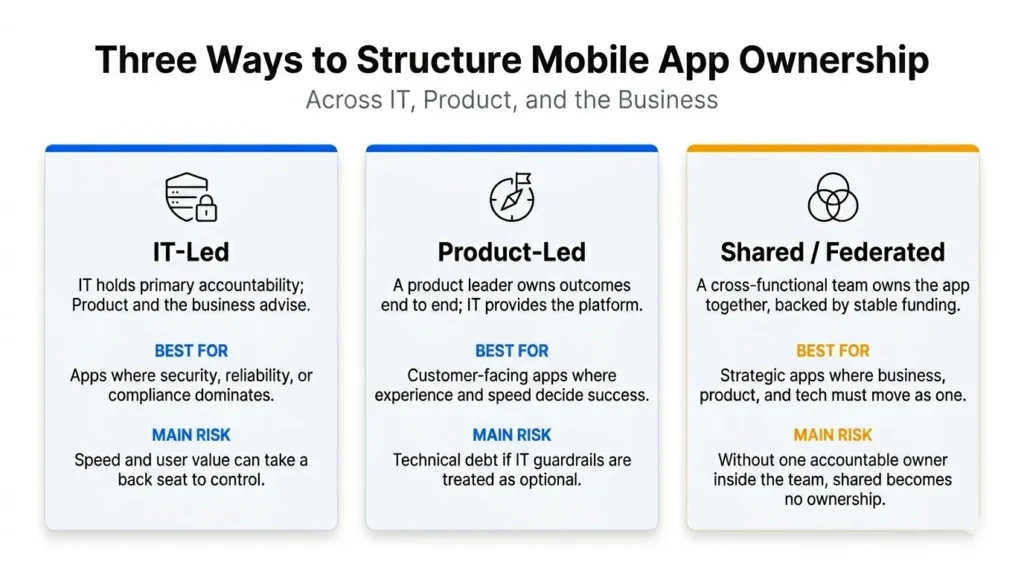
IT-led ownership
IT holds primary accountability, with Product and the business advising. This suits apps where reliability, security, or regulatory exposure dominates, such as internal enterprise tools or apps in regulated sectors. The trade-off is that user value and release speed can take a back seat to control and stability.
Product-led ownership
A product leader owns outcomes end to end, with IT supplying the platform and the business setting the targets. This fits customer-facing apps where experience and iteration speed decide success. The trade-off is that technical debt and governance gaps can build up if IT’s guardrails are treated as optional rather than as standards.
Shared or federated ownership
A cross-functional team holds end-to-end ownership together, backed by stable, ongoing funding. This is the structure that underpins the product operating model, an approach that has now spread well beyond technology companies. In Bain’s July 2025 analysis, consumer products companies using this model reported up to a 60 percent reduction in product development time and a 36 percent reduction in development costs. They were also 1.6 times more satisfied with their product model and 1.2 times more likely to get the right business value from their technology investments. The mechanism Bain credits is the integration of business and IT through persistent, cross-functional teams. The trade-off is real, though: without a single accountable owner inside the team, shared ownership can quietly become no ownership.
Concrete examples make this tangible. Walmart uses a “four-in-the-box” structure that brings business, product, user experience, and technology leaders together on every major initiative decision. Albert Heijn, the largest grocery chain in the Netherlands, ties its product teams to clear business metrics so every technology investment is judged on the impact it delivers. Both are versions of shared ownership made workable by one thing: explicit decision rights.
Make Ownership Explicit With a RACI Matrix
A model on a slide is not ownership. Ownership becomes real only when each significant decision has a named owner. A RACI matrix, which maps who is Responsible, Accountable, Consulted, and Informed, is the simplest tool for this, and building one forces the exact conversation an executive team needs to have.
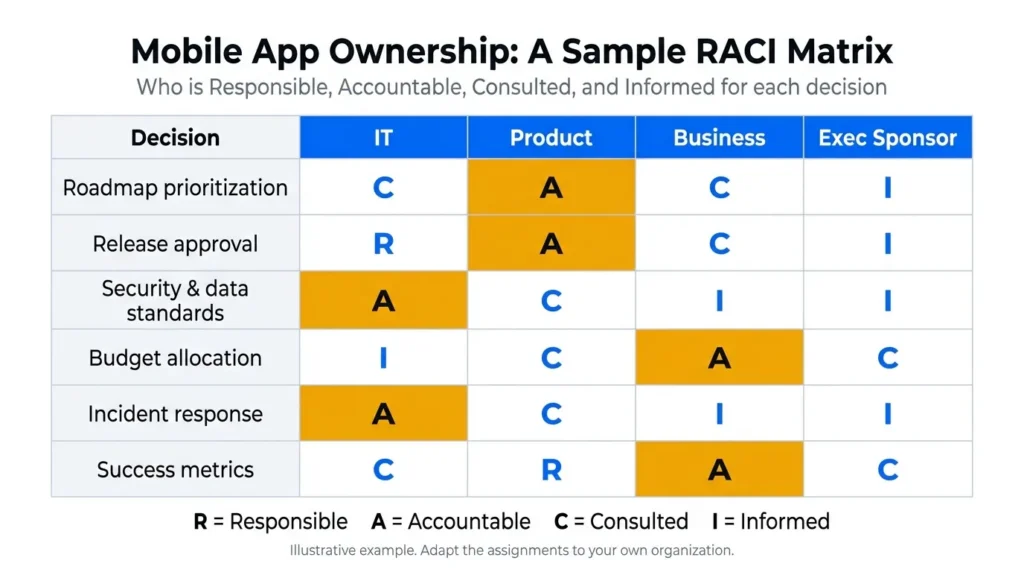
Build it around decisions, not departments. Typical rows include roadmap prioritization, release approval, security and data standards, budget allocation, incident response, and the definition of success metrics. For each row, agree on exactly one accountable owner. That discipline, allowing only a single A per decision, is what prevents the diffuse, everyone-and-no-one ownership that stalls so many apps.
This decision-rights lens has support beyond day-to-day practice. A peer-reviewed framework published in September 2025 proposed organizing product operating decisions around three questions: who holds the decision rights, what the product scope and value hypotheses are, and how the work and technology actually flow. Whatever model you choose, the “who decides” question is the one to settle first.
How to Choose the Right Model
Three factors should drive the choice. The first is risk and compliance: the higher the regulatory or security stakes, the more weight IT’s guardrails should carry. The second is how customer-facing and fast-moving the app is: the closer it sits to customers and revenue, the stronger the case for product-led or shared ownership. The third is organizational readiness, which is often the binding constraint, because shared ownership demands cross-functional skills and stable funding that not every organization has in place yet.
It is worth being honest about that last point. Standing up a product team, a product operations function, or a cross-functional squad is the visible part, and it is the part most organizations have already done. Settling who actually holds each decision inside that structure is the harder, less visible work, and it is the part that most often goes unfinished. A clear ownership decision from the leadership team is what closes that gap, and it is difficult to delegate convincingly.
Common Ways App Ownership Breaks Down
A handful of failure patterns recur across organizations, and naming them makes them easier to avoid.
- Ownership by default: It lands on whoever controls the budget rather than whoever is best placed to be accountable for outcomes.
- Ownership without authority: Someone is named accountable but cannot actually direct the people or resources needed to deliver.
- Ownership without metrics: The app has an owner but no agreed definition of success, so its real impact is never judged.
- Shared ownership with no single name: It reads well on paper and dissolves the moment a hard trade-off has to be made under pressure.
The Executive Takeaway
Structuring app ownership is not an org-chart exercise to push downward. It is a strategic choice about how IT, Product, and the business share decision rights and accountability for a product that increasingly carries real commercial weight. Choose the model that matches your risk and your readiness, make every significant decision right explicit, and tie the app to business outcomes rather than to activity. Strong business IT alignment is the result of that clarity, not a precondition for it.
Getting this structure right is faster with a partner who has set it up across IT, Product, and business teams before. If your leadership team is weighing how to assign ownership of a mobile app, we can help you pressure-test the operating model and the decision rights behind it before you commit. Book a consultation with our team to talk it through.