
 iOS App Development
 Android App Development
 React Native
 Flutter
 Web Development
 Custom Software
 Front End Development
 Blockchain Development
 Virtual Reality
 Cloud Computing
 IoT Development
 Augmented Reality
 Write us a message
The term “AI agent” is becoming the new “cloud-native.” Every software vendor, platform provider, and enterprise SaaS company is rushing to attach the label to their products. But how many of these claims actually hold up under scrutiny?
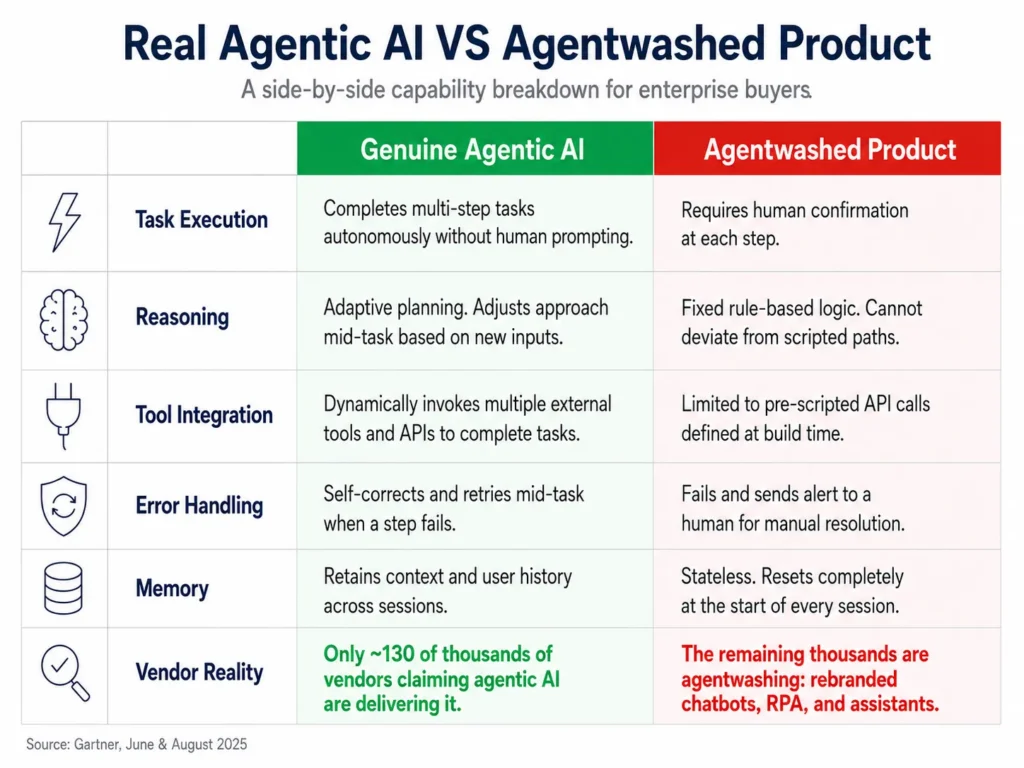
According to Gartner’s August 2025 forecast, 40% of enterprise applications will be integrated with task-specific AI agents by the end of 2026, up from less than 5% in 2025. Gartner has also explicitly named the practice driving much of this growth: agentwashing. In a June 2025 press release, Gartner estimated that only about 130 of the thousands of vendors claiming to offer agentic AI are actually delivering it.
This blog breaks down what agentwashing is, why AI agent hype is accelerating faster than actual capability, and how CTOs, CIOs, and product leaders can distinguish real enterprise AI agents from rebranded automation.
What Is Agentwashing?
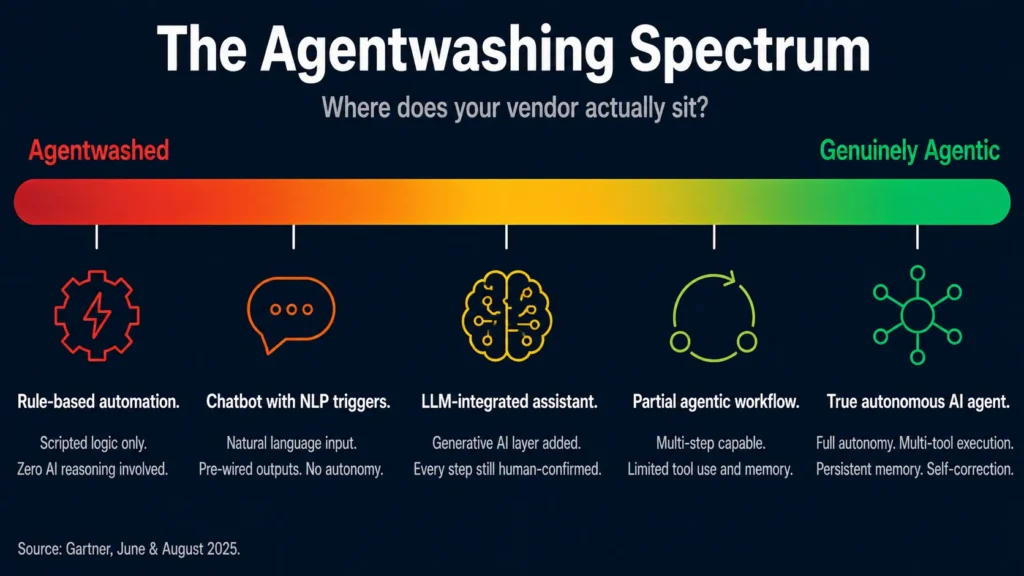
Agentwashing is the term Gartner uses to describe vendors rebranding existing products such as AI assistants, robotic process automation, and chatbots as agentic AI without delivering substantial agentic capabilities. Much like greenwashing in sustainability, AI washing involves surface-level repositioning rather than substantive capability change.
A genuinely agentic AI system is not just a chatbot with a few automation steps bolted on. Real enterprise AI agents are defined by four core properties:
- Autonomy: The system can pursue multi-step goals without constant human prompting.
- Perception: It can read, interpret, and act on inputs from its environment, including data streams, APIs, and user behavior.
- Tool use: It can invoke external tools, APIs, and systems to complete tasks.
- Adaptive reasoning: It can plan, adjust its approach mid-task, and recover from errors.
A product that routes a support ticket based on a keyword match is not an AI agent. A product that reads the ticket, queries the customer history, drafts a resolution, escalates when uncertain, and logs the outcome autonomously is moving toward genuine agentic AI behavior.
Why 40% of Enterprise Apps Will Make This Claim by End of 2026
Several forces are converging to accelerate agentwashing across the enterprise software market.
Investor and board pressure. AI automation is now a baseline expectation in enterprise software investment theses. Vendors that cannot demonstrate agentic AI capabilities risk being deprioritized in procurement cycles, regardless of how effective their core product actually is.
Low barrier to relabeling. Adding a natural language interface to an existing workflow tool and calling it an AI agent requires minimal engineering effort. Many vendors are doing exactly this to stay competitive in sales conversations.
Buyer unfamiliarity. Most enterprise buyers, including senior decision-makers, do not yet have a clear technical framework for evaluating AI agent claims. This creates an environment where vendor marketing can outrun technical reality.
Platform commoditization. The availability of large language model APIs means any development team can wrap generative AI around existing logic and present it as agentic behavior. The result is a flood of agentic AI apps that look the part in a demo but lack the underlying architecture to deliver autonomous outcomes in production.
The scale of the gap is significant. Gartner’s June 2025 analysis found that of the thousands of vendors claiming agentic AI capability, only around 130 are real. That is the operational reality of agentwashing in the current market.
The Five Most Common Agentwashing Patterns in Enterprise Apps
Understanding how agentwashing manifests in practice helps procurement and technology teams ask better questions during vendor evaluations.
1.The Chatbot Rebrand
A conversational interface is added to an existing product. The vendor markets it as an AI agent because users can type natural language queries. In reality, the system cannot take autonomous action, has no tool use capability, and simply translates user input into predefined logic paths. Gartner’s senior director analyst Anushree Verma has publicly identified this as one of the most common forms of agentwashing.
2. The Workflow Automation Upgrade
Legacy robotic process automation or rule-based workflow tools are connected to an LLM for natural language processing. The vendor claims the product is now an agentic AI platform. The underlying execution remains scripted and non-adaptive.
3. The Copilot Overstatement
Products that offer AI-assisted suggestions, next-step recommendations, or draft generation are marketed as autonomous agents. The distinction matters enormously: a copilot requires human confirmation at every step, while a true AI agent can complete multi-step tasks independently.
4. The Single-Task Wrapper
A generative AI model is wrapped around a single business function, such as invoice categorization or meeting summarization. The vendor positions this narrow capability as a full AI agent, despite the product being incapable of cross-functional reasoning or task decomposition.
5. The Integration Layer Disguise
An orchestration layer that connects multiple existing tools through API calls is rebranded as an AI agent framework. While integration value is real, the absence of reasoning, planning, and adaptive behavior disqualifies it from genuine agentic AI status.
How to Evaluate Real Enterprise AI Agents: A Decision Framework
When evaluating AI agent software for enterprise deployment, apply this five-part evaluation framework before committing to a vendor or internal build.
Evaluation Criteria | What to Ask | Red Flag |
Autonomy depth | Can the system complete a 5-step task without human input? | Requires confirmation at every step |
Tool use breadth | How many external tools and APIs can it invoke natively? | Limited to a single system or dataset |
Reasoning transparency | Can it explain its decision path? | Outputs without reasoning trails |
Error recovery | What happens when a step fails mid-task? | Crashes or requires manual restart |
Memory and context | Does it retain context across sessions and users? | Stateless, resets on every interaction |
Genuine enterprise AI agents should score well across all five dimensions. Products that score strongly on one or two but fail the rest are likely agentwashing, regardless of how they are marketed.
The Real Cost of Buying Into Agentwashing
The risk is not just a wasted software budget. Gartner predicts that over 40% of agentic AI projects will be canceled by the end of 2027, citing escalating costs, unclear business value, and inadequate risk controls as primary drivers. Enterprise teams that invest in agentwashed products face compounding costs across three dimensions.
Operational drag: Teams build processes around an AI agent that still requires significant human intervention. The promised efficiency gains do not materialize.
Technical debt: Integrating a pseudo-agent into core enterprise infrastructure creates dependencies that are difficult to reverse. When a genuine agentic AI replacement becomes available, migration complexity is significantly higher.
Competitive disadvantage: Organizations that adopt real AI agent tools, those with genuine autonomy, adaptive reasoning, and multi-tool execution, will operate with meaningfully lower operational overhead than competitors running rebranded automation under an agentic AI label. As the AI agent 2026 landscape matures, that gap will widen further.
McKinsey’s State of AI in 2025 report, published in November 2025, surfaces a related signal. While 88% of organizations report regularly using AI in at least one business function, 94% of respondents say they have not yet seen significant value from those investments. McKinsey’s data also shows that only around 23% of organizations experimenting with AI agents are scaling them, while 62% remain in pilot stage. The gap between adoption and scaled value is exactly where agentwashing thrives.
What Genuine Agentic AI Looks Like in Enterprise Contexts
To ground the evaluation framework in practice, consider what genuine AI agent software behavior looks like across common enterprise use cases.
Procurement Workflows
In a procurement workflow, a real AI agent can receive a purchase request, validate it against budget policy, identify approved suppliers, request quotes via email, evaluate responses, generate a purchase order, and flag exceptions for human review. It does this end-to-end without prompting at each step.
Customer Success
In a customer success context, a genuine AI agent monitors account health signals across CRM data, support ticket history, and product usage logs. When it identifies a churn risk pattern, it drafts a personalized outreach sequence, schedules it, and alerts the account manager with a briefing document, all autonomously.
IT Operations
In IT operations, real agentic AI monitors infrastructure alerts, cross-references runbooks, attempts remediation steps, and escalates only when predefined thresholds are breached. It logs every action with a reasoning trail for audit purposes.
The Bottom Line
These are not theoretical capabilities. They are available today in genuine AI agent platforms built on architectures that support tool use, persistent memory, and multi-step reasoning. The key is knowing how to identify and demand these capabilities during procurement.
Building Internal Capability to Evaluate AI Agent Claims
Enterprise organizations that want to avoid agentwashing need to build internal evaluation competency, not just rely on vendor demonstrations.
Three practical steps for CTOs and technology leadership teams:
Run structured proof-of-concept evaluations: Define a specific, multi-step workflow that the AI agent must complete autonomously. Set clear success criteria before the evaluation begins. Vendors that resist this type of evaluation are usually protecting capabilities that cannot deliver.
Require architecture documentation: Ask vendors to describe how their product handles task planning, tool invocation, error recovery, and memory persistence at a technical level. Vague answers or marketing language in response to technical questions is a reliable signal of agentwashing.
Benchmark against open-source agent frameworks: Publicly available AI agent frameworks from the research and developer community provide useful benchmarks for evaluating commercial claims. If a commercial product cannot match the autonomous task completion of an open-source baseline, its enterprise AI agent positioning deserves scrutiny.
The Regulatory and Governance Dimension
As AI automation becomes more embedded in enterprise operations, regulators in the EU, US, and across APAC are scrutinizing AI capability claims in enterprise software procurement. The EU AI Act, which entered staged implementation through 2025 and 2026, includes provisions affecting how AI systems are classified and marketed based on their actual functional capabilities. Agentwashed products that misrepresent automation depth may expose enterprise buyers to compliance risk if those products are used in regulated workflows.
Enterprise legal and compliance teams should include AI capability verification as a standard component of software procurement due diligence, particularly for products used in finance, healthcare, HR, and customer-facing operations.
Conclusion: Demand Real Agentic AI Before You Buy
The wave of agentwashing heading toward enterprise software buyers through 2026 is not a minor nuisance. With Gartner identifying only around 130 genuine agentic AI vendors among thousands making the claim, the procurement risk is concrete and quantifiable. Organizations that develop rigorous evaluation frameworks now, before the market reaches peak hype, will be significantly better positioned to capture the genuine value that AI agent software delivers.
The difference between a real AI agent and a rebranded chatbot is not subtle once you know what to look for. Autonomy, adaptive reasoning, multi-tool execution, and persistent memory are not aspirational features. They are baseline requirements for any product that claims the AI agent label.
If your organization is evaluating enterprise AI agents, planning an agentic AI development roadmap, or trying to separate genuine capability from vendor noise, our team can help. We work with mid-market and enterprise teams to assess, architect, and implement real AI automation solutions built on verifiable agentic capabilities. Book a consultation today and get clarity on what AI agent software can actually deliver for your specific workflows.