
 iOS App Development
 Android App Development
 React Native
 Flutter
 Web Development
 Custom Software
 Front End Development
 Blockchain Development
 Virtual Reality
 Cloud Computing
 IoT Development
 Augmented Reality
 Write us a message
Every enterprise mobile app eventually faces the same question from its leadership: how often should we ship? Push updates too rarely and you fall behind on security, user expectations, and competitor features. Push too aggressively and you risk burning out your team, destabilizing the product, and training users to dread the next update. The answer lives in a discipline that too many organizations treat as an afterthought: mobile app release management.
Getting cadence right is not about copying what a consumer-app giant does. It is about matching your release rhythm to your users, your risk tolerance, and the hard constraints the app stores impose on everyone. This guide walks through what mobile app release management involves, the platform realities that shape it, the cadence models worth considering, and a practical way to decide what fits your organization.
What Mobile App Release Management Actually Means
Mobile app release management is the coordinated process of planning, building, testing, approving, shipping, and monitoring changes to an app across its entire lifecycle. It is the connective tissue between engineering work and the version your users actually download. Done well, it turns a stream of individual code changes into predictable, low-risk releases instead of a series of anxious launches.
It helps to separate two ideas that often get blurred. General release management is a broad software practice used across all kinds of systems; mobile app release management is its specialized cousin, shaped by app-store gatekeeping, device and OS fragmentation, and the fact that you cannot instantly patch software already installed on a user’s phone. Those differences make cadence decisions materially harder on mobile than on the web, where a fix can go live in minutes.
Where release management sits in the app development lifecycle
Within the wider app development lifecycle, discovery, design, development, testing, release, and maintenance, release management governs the transition from “code complete” to “in users’ hands.” A healthy software release cycle repeats predictably: plan the scope, develop and integrate, test across devices and OS versions, submit for store review, roll out in stages, then monitor real-world behavior before starting the next cycle. Every one of those steps carries timing implications, which is why cadence cannot be set in isolation from the rest of the app development lifecycle.
Why Cadence Is a Strategic Decision, Not Just a Technical One
For a mixed group of stakeholders (engineering leads, product owners, and business sponsors), it helps to frame cadence as a business trade-off rather than a deployment detail. Faster mobile app updates mean quicker fixes, faster responses to market shifts, and steadier product momentum. But each release also consumes QA capacity, carries regression risk, and asks something of your users, who must download and adjust to every change.
There is no universally “correct” app update frequency. A banking app under strict compliance obligations should not ship at the same rhythm as an internal productivity tool. The goal of mobile app release management is to find the cadence where the value delivered outweighs the cost and risk of shipping, and to make that a deliberate choice rather than an accident of whoever merged code last.
The Platform Constraints That Shape Every Release Decision
Before choosing a cadence, enterprise teams need to respect the constraints Apple and Google impose. These are not negotiable, and they quietly set the ceiling on how fast any mobile app updates can realistically reach users.
App Store and Google Play review timelines
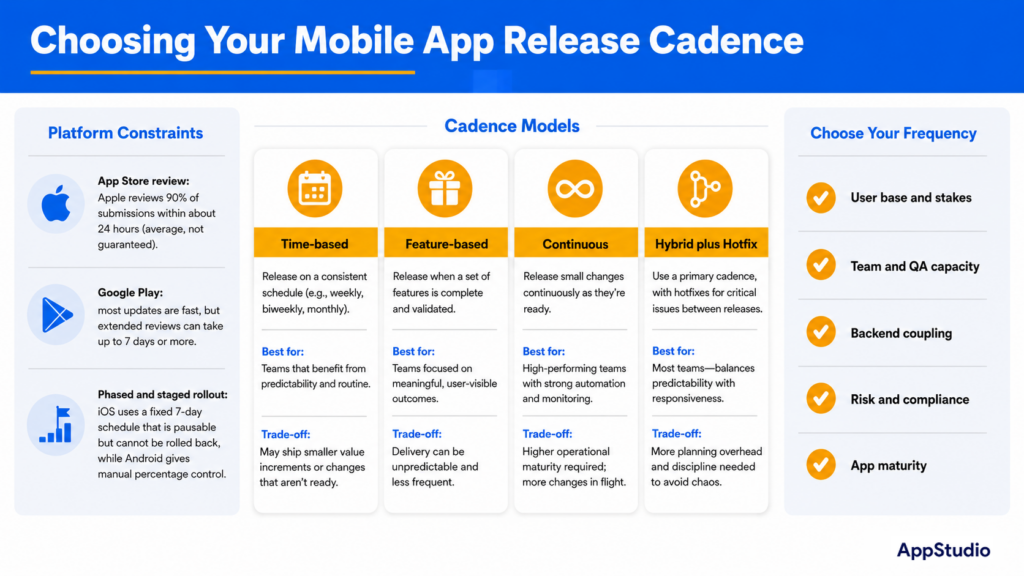
On iOS, every new version passes through App Store review. Apple states that, on average, it reviews 90% of submissions within 24 hours, but that is an average, not a guarantee, and complex apps, sensitive permissions, or first-time submissions can take considerably longer. On Android, most updates clear quickly, but Google’s own Play Console documentation warns that certain apps can face extended reviews of up to seven days or longer in exceptional cases. For a team planning tight release windows, that variability has to be built into the software release cycle, not treated as a rare edge case.
Phased release and staged rollout
Both platforms let you release gradually rather than all at once, a critical safety mechanism in mobile app release management. Apple’s phased release rolls an update out over a seven-day period to users with automatic updates enabled, selected at random, and you can pause it for up to 30 days if something looks wrong. Google Play’s staged rollout hands you manual control: you choose the exact percentage of users who receive each stage of the rollout.
One difference matters enormously for risk planning. On iOS, phased release runs on a fixed seven-day schedule you can pause but not reconfigure, and it applies to updates, not brand-new apps. More importantly, an app rollout that has already reached users cannot be rolled back at the binary level on the App Store. If you discover a serious bug mid-rollout, you can pause further exposure, but the only true fix is to ship a new, higher-versioned build through review again. That reality should shape how confident you are before any app rollout begins.
Common Release Cadence Models
Most enterprise teams settle on one of a few cadence patterns. Understanding the trade-offs among them is the core of mobile app release management.
Time-based (fixed) cadence
Here you ship on a calendar (every two weeks, monthly, or quarterly) regardless of exactly what is ready. Often called a “release train,” this model brings predictability: stakeholders know when features land, QA cycles become routine, and marketing can plan around known dates. Whatever misses the train simply catches the next one. The trade-off is that a finished feature may sit waiting for its scheduled slot.
Feature-based cadence
In this model you release when a meaningful feature or milestone is complete, rather than on a fixed date. It suits products with irregular, larger deliverables. The upside is that you ship value when it is genuinely ready; the downside is unpredictability, which makes coordination, and app-store review timing, harder to plan around.
Continuous release
Some mature teams push very frequently, backed by heavy automation, strong CI/CD pipelines, and feature flags that let them turn functionality on or off without shipping a new binary. On mobile this is powerful but constrained: store review and the seven-day phased rollout mean you can never be as instantaneous as a web service. Feature flags become essential here because they decouple “shipping code” from “releasing a feature,” giving teams web-like control despite mobile’s slower software release cycle.
Hybrid with a hotfix lane
In practice, most enterprise teams blend these approaches: a predictable time-based cadence for planned work, plus a separate fast lane for urgent security patches and critical bug fixes. This hybrid is often the healthiest form of mobile app release management, because it keeps routine releases calm and predictable while still allowing an emergency app rollout when something genuinely cannot wait for the next train.
How to Choose the Right App Update Frequency
Rather than copying a competitor, decide your app update frequency against your own context. A handful of questions do most of the work:
- User base and stakes: A large or regulated user base raises the cost of a bad release, favoring slower, more heavily tested cadences and cautious phased rollouts.
- Team and QA capacity: Frequent releases only work if testing, monitoring, and support can keep pace. Cadence should never outrun your capacity to verify quality.
- Backend coupling: If your app depends on backend services that change often, release management must coordinate the two so a mobile app update never ships ahead of the API it relies on.
- Risk tolerance and compliance: Highly regulated environments need approval gates and audit trails, which naturally lengthen the software release cycle.
- App maturity: A new app searching for product-market fit benefits from faster iteration; a mature, stable app often shifts toward slower, safer cadences.
Governance, Risk, and Security
For enterprise stakeholders, governance is where mobile app release management earns its keep. A disciplined process includes clear approval gates, defined roles for who can authorize an app rollout, and documented criteria for what “ready to ship” actually means. Without those guardrails, cadence decisions default to whoever is loudest or whoever merged last.
Versioning and traceability
Consistent app versioning is the backbone of that governance. Most teams follow semantic versioning, a MAJOR.MINOR.PATCH scheme where the numbers signal how significant each change is. Disciplined app versioning makes it possible to trace exactly which build a user is on, correlate crash reports to a specific release, and communicate clearly with stakeholders. Without reliable app versioning, incident response during a troubled app rollout quickly turns into guesswork.
Monitoring as a release gate
A release is not “done” when it ships; it is done when it proves stable in the field. Google’s Android vitals program monitors metrics such as crash rate and ANR (application-not-responding) rate, and apps that exceed Google’s “bad behavior” thresholds can lose visibility in the Play Store. That makes post-release monitoring a core part of mobile app release management: watch your key stability metrics during every phased rollout, and be ready to pause before a small problem reaches everyone.
The security-patch exception
Not every release can wait for the next scheduled train. Security vulnerabilities and critical crashes justify an expedited path, which is exactly why the hotfix lane exists. Mature release management treats these as a defined, pre-agreed process rather than a scramble, so urgent fixes move fast without bypassing the controls that keep routine mobile app updates safe.
A Practical Starting Point
If you are building a cadence from scratch, a sensible default for many enterprise apps is a monthly, time-based release for planned work, paired with an always-available hotfix lane for emergencies. Layer on a few disciplines and your mobile app release management will hold up under pressure:
- Use phased release or staged rollout for every significant update, not just the risky ones.
- Enforce strict app versioning so every build is traceable back to its exact changes.
- Treat stability metrics as a gate: watch crash and ANR rates during each app rollout before advancing to the next stage.
- Coordinate mobile and backend releases so neither ships ahead of the other.
- Always keep a build ready to ship, since you cannot roll a live release back; you can only replace it.
From there, adjust: speed up if your team and quality signals allow, slow down if releases are causing instability. Cadence is a dial you tune over time, not a decision you make once.
Getting Release Cadence Right
There is no single perfect answer to how often an enterprise mobile app should ship, only the cadence that best fits your users, your risk profile, and the platform constraints everyone works within. Strong mobile app release management is what turns that judgment into a repeatable, low-drama process: predictable releases, fast emergency response, disciplined versioning, and monitoring that catches problems early.
If your team is wrestling with release cadence, unpredictable update cycles, or an app development lifecycle that has outgrown its process, AppStudio can help you design a release strategy that fits your product and your organization. Talk to us about building a mobile app release management approach that ships confidently, at the right pace for you.