
 iOS App Development
 Android App Development
 React Native
 Flutter
 Web Development
 Custom Software
 Front End Development
 Blockchain Development
 Virtual Reality
 Cloud Computing
 IoT Development
 Augmented Reality
 Write us a message
The short answer
Managed IT services for ecommerce keep an online store available by monitoring infrastructure around the clock, fixing problems before shoppers notice them, and scaling capacity ahead of traffic spikes. A managed service provider (MSP) takes ownership of hosting, network, security, backups, and incident response under a service level agreement (SLA) with defined uptime targets and response times.
For an ecommerce business, uptime is revenue. Every minute a checkout page fails to load is a minute of lost orders, wasted ad spend, and eroded customer trust. Managed IT services turn uptime from a hope into a measured, contractually backed outcome.
Key points at a glance:
- Ecommerce downtime is expensive, and the cost rises sharply during peak sales periods.
- Most outages trace back to a small set of preventable causes: infrastructure failure, configuration changes, third-party dependencies, and cyberattacks.
- An MSP improves ecommerce uptime through 24/7 monitoring, proactive maintenance, redundancy, security, and tested disaster recovery.
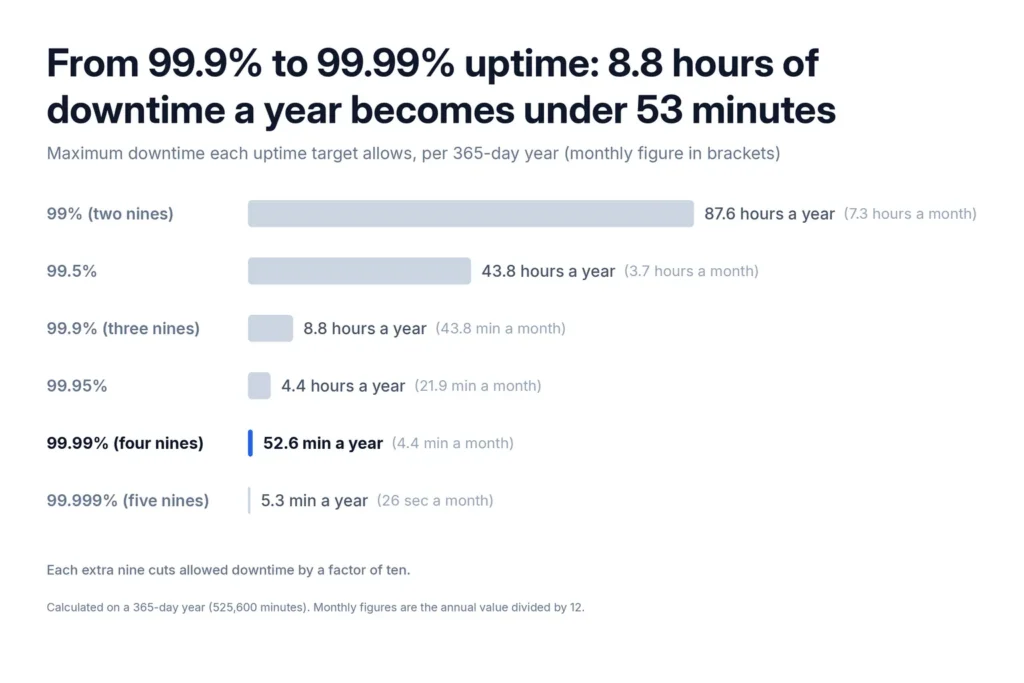
- The uptime number in your SLA matters: 99.9% still allows close to 9 hours of downtime a year, while 99.99% allows under an hour.
- The right partner is chosen on response times, peak-season readiness, and transparent reporting, not price alone.
What are managed IT services for ecommerce?
Managed IT services for ecommerce are outsourced, ongoing technology operations delivered by a specialist provider on a subscription basis. Instead of calling for help after something breaks, the provider continuously runs and protects the systems a store depends on.
A typical ecommerce MSP engagement covers:
- Infrastructure management: cloud hosting, servers, load balancers, content delivery networks (CDNs), and databases that power the storefront and checkout.
- 24/7 monitoring and alerting: synthetic checks on key customer journeys (home page, search, cart, checkout) plus server, application, and network health.
- Incident response: an on-call team with defined response and resolution times, working to restore service fast.
- Security operations: patching, web application firewall (WAF) rules, DDoS mitigation, endpoint protection, and access control.
- Backup and disaster recovery: scheduled backups, replication across regions, and tested recovery plans.
- Capacity and performance planning: load testing and scaling ahead of promotions and seasonal peaks.
- Reporting and governance: uptime reports, incident reviews, and support for compliance requirements such as PCI DSS.
The difference between managed IT services and traditional break-fix IT support is accountability. A managed provider is measured on keeping the store online, so prevention becomes part of the job rather than an optional extra.
How much does ecommerce downtime cost?
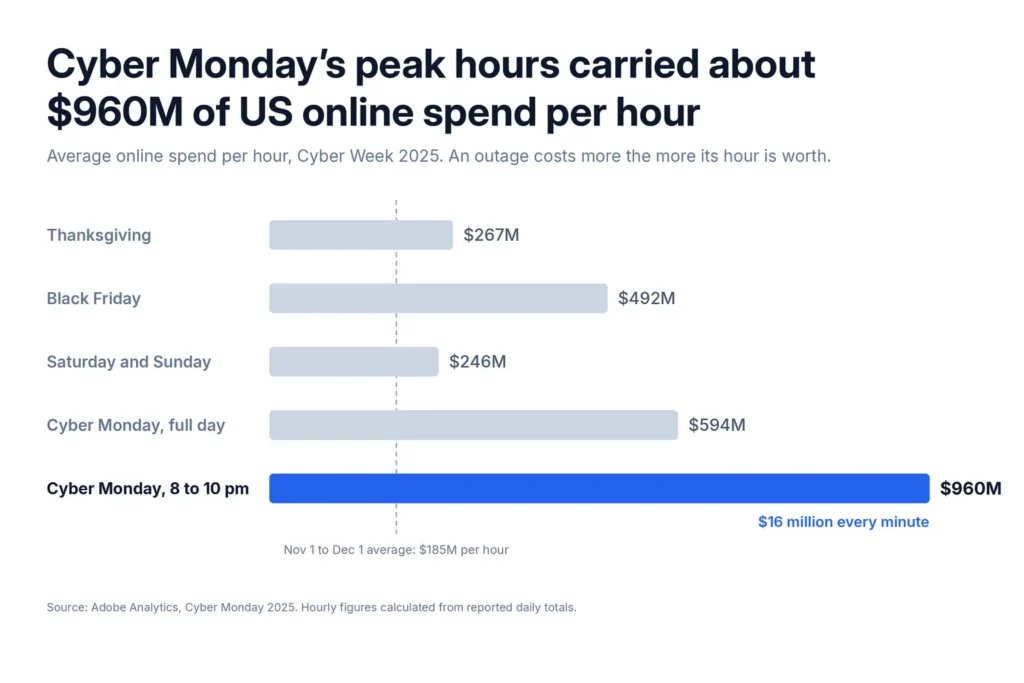
Ecommerce downtime costs far more than the sales missed while the site is dark. The full bill includes abandoned carts, paid traffic sent to an error page, emergency labour, SLA penalties from partners, and shoppers who quietly switch to a competitor.
The research is consistent on scale:
- Hourly cost: ITIC’s 2024 Hourly Cost of Downtime Survey found that a single hour of downtime costs over $300,000 for more than 90% of mid-size and large enterprises, before any litigation or penalties.
- Cost per incident: In the Uptime Institute’s 2025 annual survey, 57% of respondents said their most recent major outage cost more than $100,000, and one in five put it above $1 million.
- Cost at scale: Splunk and Oxford Economics now estimate downtime costs the Global 2000 about $600 billion a year, or roughly $300 million per company, which works out to about $15,000 per minute, according to Channel Insider’s coverage of the 2026 Hidden Costs of Downtime report.
Slow pages carry a cost too, even when the site is technically up. In the Deloitte study Milliseconds Make Millions, a 0.1 second improvement in mobile site speed lifted retail conversions by 8.4% and average order value by 9.2%. For an online store, degraded performance is a partial outage.
What causes ecommerce website downtime?
Most ecommerce website downtime comes from a short list of causes, and nearly all of them are preventable with the right processes. Splunk’s research found that 56% of downtime stems from security incidents and 44% from application or infrastructure issues, so uptime is as much a security discipline as an operations one.
The most common causes for online stores are:
1. Traffic spikes that exceed capacity:
A flash sale, influencer mention, or holiday promotion sends more visitors than servers, databases, or checkout services can handle.
2. Failed deployments and configuration changes:
A theme update, plugin upgrade, or untested code release breaks the cart or checkout. The Uptime Institute’s 2026 outage analysis identifies failure to follow established procedures as the leading driver of human error outages.
3. Third-party dependencies:
Payment gateways, tax and shipping APIs, search tools, CDNs, and cloud regions can all fail independently of your own platform. Uptime Institute reports that third-party IT and data center service providers, including cloud and internet companies, account for about two-thirds of publicly reported outages it has tracked over nine years.
4. Cyberattacks:
DDoS floods, credential stuffing, malicious bots, and ransomware can take a storefront offline or force it offline for containment.
5.Infrastructure and network failures:
Hardware faults, power issues, and connectivity problems still occur. Uptime Institute notes that outages linked to fiber and connectivity are rising and tend to last longer.
6. Avoidable housekeeping lapses:
Expired SSL certificates, full disks, lapsed domain renewals, and unpatched software cause outages that monitoring and routine maintenance would catch.
The common thread is that each of these causes gives warning signs before it becomes an outage. Catching those signals early is exactly what managed IT services are designed to do.
How do managed IT services improve ecommerce uptime?
Managed IT services improve ecommerce uptime by replacing reactive firefighting with continuous prevention, fast detection, and rehearsed recovery. Seven capabilities do most of the work.
1. 24/7 monitoring of the customer journey
Server health alone does not tell you whether customers can buy. A managed provider runs synthetic transactions that search, add to cart, and reach checkout every few minutes from multiple locations, alongside infrastructure, application, and real user monitoring. When a step slows down or fails, the on-call team is alerted before support tickets or social posts pile up.
2. Proactive IT maintenance
Patching, certificate renewals, database tuning, log rotation, and capacity checks run on a schedule rather than when something breaks. Proactive maintenance removes the housekeeping failures that cause a surprising share of avoidable outages.
3. Redundant, scalable ecommerce infrastructure
Ecommerce infrastructure management covers load balancing, auto scaling, multi-zone or multi-region deployment, CDN caching, and database replication. The goal is to remove single points of failure, so that losing one server, zone, or service degrades gracefully instead of taking the store offline.
4. Change management and safe deployments
Because failed changes are a leading cause of downtime, mature MSPs enforce staging environments, peer review, scheduled change windows, and fast rollback. During peak trading periods, many apply a change freeze so only critical fixes reach production.
5. Ecommerce cybersecurity services
Security and uptime are inseparable for online retailers. Managed security typically includes a web application firewall, DDoS mitigation, bot management, endpoint protection, vulnerability scanning, and access control aligned with PCI DSS. The stakes are high: IBM’s Cost of a Data Breach Report 2025 puts the global average cost of a breach at $4.44 million, and $10.22 million in the United States.
6. Ecommerce disaster recovery
Backups only matter if they restore. A managed provider defines a recovery time objective (RTO), how quickly the store must be back, and a recovery point objective (RPO), how much order data can be lost. It then tests restores and failover on a regular schedule, so recovery is a practiced routine rather than an improvisation.
7. Incident response and continuous improvement
When an incident does occur, a defined escalation path, clear customer communication, and a blameless post-incident review keep the same failure from happening twice. Over time, this feedback loop is what lifts uptime from good to excellent.
What uptime percentage should an ecommerce store target?
Most ecommerce businesses should target at least 99.9% uptime for the storefront and 99.99% for revenue-critical paths such as cart, checkout, and payments. The difference sounds small, but each additional nine cuts the downtime you are allowed by a factor of ten.
Two details matter when you compare uptime numbers:
- Availability compounds across dependencies. If checkout relies on three services that each run at 99.9%, the combined availability is roughly 99.7% (0.999 x 0.999 x 0.999), which allows about 26 hours of downtime a year. Redundancy and graceful degradation are how managed providers protect the end-to-end figure.
- Exclusions change the real number. Many SLAs exclude scheduled maintenance, third-party failures, or incidents under a few minutes. A 99.99% promise with broad exclusions can deliver less than a 99.9% promise without them.
The right target is a business decision. Weigh the revenue you would lose in the allowed downtime against the cost of the redundancy needed to remove it, and set stricter targets for the hours and pages that carry the most revenue.
What should an ecommerce SLA include?
An ecommerce SLA should define what “up” means for your store, how fast the provider must respond when it is not, and what happens if commitments are missed. A strong SLA uptime guarantee is specific, measurable, and tied to the customer journey rather than to a single server.
| SLA element | What good looks like for ecommerce |
| Uptime definition | Measured on key journeys (home, search, product, cart, checkout), not just server ping |
| Uptime target | Separate targets for the storefront and for checkout and payments |
| Measurement method | Independent external monitoring, with the data shared with you |
| Response time | Minutes, not hours, for critical incidents, 24/7/365 |
| Resolution or workaround time | Defined per severity level, with escalation paths named |
| Exclusions | Narrow and listed explicitly, with maintenance outside your peak trading hours |
| RTO and RPO | Documented recovery targets, tested at least annually |
| Peak-season terms | Change freeze, extra on-call staff, and pre-event load testing |
| Reporting | Monthly uptime, incident, and root cause reports |
| Service credits | Clear credit tiers if targets are missed |
Service credits rarely cover the revenue lost in an outage, so treat them as a signal of commitment rather than compensation. The real value of an SLA is the operating discipline it forces on both sides.
How do you prepare an online store for traffic spikes?
Preparing an online store for traffic spikes means testing beyond your expected peak, removing bottlenecks before the event, and staffing for fast response while it runs. Peak events concentrate revenue into a few hours, and in 2025 the five days from Thanksgiving to Cyber Monday generated $44.2 billion in US online sales, according to Adobe. Mobile carried 57.5% of Cyber Monday sales, so peak traffic scalability has to be proven on mobile journeys first.
A managed IT partner typically runs peak readiness in five stages:
- Forecast and plan, well ahead of the event: Agree on expected traffic and order volumes with marketing, review last year’s incidents, and confirm that hosting, CDN, and payment provider limits can absorb the forecast with headroom.
- Load test the full journey: Simulate realistic traffic through search, product pages, cart, and checkout, including third-party calls, and fix the first bottleneck each test reveals.
- Harden and freeze: Pre-scale infrastructure, warm caches, tighten WAF and bot rules, verify backups, and apply a change freeze so only critical fixes reach production.
- Run a war room during the event: Staff a dedicated on-call team, watch real-time dashboards for conversion rate and checkout errors, and keep pre-approved playbooks ready for scaling, failover, and degraded modes.
- Review and improve: Compare forecast with actual load, document every incident and near miss, and feed the lessons into next season’s plan.
The same playbook works for smaller moments that can still break a store: a product drop, a TV feature, or an email campaign to a large list.
Should an ecommerce business use an MSP or in-house IT?
For most growing ecommerce businesses, a managed service provider or a hybrid model delivers better uptime per dollar than a fully in-house team. Genuine 24/7 coverage requires several people on rotation, plus specialists in cloud, security, and databases, which is hard to justify until a business reaches significant scale.
| Factor | In-house IT | Managed IT services | Hybrid model |
| 24/7 coverage | Requires a full on-call rotation | Included in the service | MSP covers nights, weekends, and peaks |
| Specialist depth | Limited to the people you hire | Shared bench of cloud, security, and network experts | Internal owners, external specialists |
| Cost model | Salaries, tools, training, turnover | Predictable monthly fee | Mix of both |
| Peak-season scaling | Stretches the same team | Extra capacity planned in | MSP adds surge support |
| Platform and business knowledge | Deep | Builds over time | Retained internally |
| Accountability for uptime | Internal targets | Contractual SLA | Shared, clearly split |
A hybrid approach often works best for mid-market retailers: keep product and platform ownership in-house, and let a managed partner run monitoring, security operations, infrastructure, and after-hours response.
How to choose a managed IT services partner for ecommerce
Choose a managed IT services partner for ecommerce on proven ecommerce experience, transparent uptime data, and peak-season readiness, not on the lowest monthly fee. Use these questions in every evaluation:
- Have you supported stores on our platform (for example Shopify Plus, Adobe Commerce, BigCommerce, Salesforce Commerce Cloud, or a custom build) through a major sales event?
- How do you monitor the checkout journey, and can we see the same dashboards you do?
- What are your guaranteed response and resolution times for a critical checkout outage at 9 pm on a holiday?
- Which incidents are excluded from your uptime guarantee?
- When did you last test a full restore or failover for a client, and how long did it take?
- How do you manage changes and code releases during peak trading periods?
- Which security services are included, and how do you support PCI DSS compliance?
- What does a monthly report include, and how are root causes tracked to closure?
- Can you share references from ecommerce clients of a similar size?
A provider that answers these questions with specifics, data, and examples is one that treats your uptime as its own.
Uptime is a revenue strategy
For an online business, every page that fails to load is a customer who may not come back. The data is clear that downtime is expensive, that it is most expensive exactly when demand is highest, and that most of it is preventable with the right monitoring, maintenance, security, and recovery discipline.
Managed IT services for ecommerce turn that discipline into a standing capability. Instead of hoping the store holds up on its biggest day, you know what your uptime target is, how it is measured, who responds when something drifts, and how quickly the business recovers if it fails.
The best time to strengthen your uptime is before the next peak, not during it. Start by mapping the journeys that carry your revenue, measuring how available they really are today, and comparing that with the downtime your business can afford. If the gap is wider than you would like, a conversation with an experienced managed IT partner is a practical next step toward a store that stays open whenever your customers are ready to buy.
Keep your store online when it matters most. Zazz’s managed IT services team helps ecommerce businesses monitor, secure, and scale the systems behind every sale, so peak traffic becomes an opportunity instead of a risk. Talk to our managed IT team about where your uptime stands today and what it would take to close the gap.
Frequently asked questions
What is ecommerce uptime?
Ecommerce uptime is the percentage of time an online store is available and working for shoppers, including browsing, cart, and checkout. It is usually measured monthly or annually and expressed as a percentage, such as 99.9%.
What is a good uptime percentage for an ecommerce website?
A good baseline is 99.9% for the storefront, which allows about 8.8 hours of downtime a year. Revenue-critical paths such as checkout and payments should aim for 99.99%, which allows under 53 minutes a year.
How much does an hour of ecommerce downtime cost?
It depends on revenue and timing, but the cost is significant for most businesses. ITIC’s 2024 survey found that an hour of downtime costs over $300,000 for more than 90% of mid-size and large enterprises, and costs rise sharply during peak sales periods.
What is included in managed IT services for ecommerce?
Most plans include 24/7 monitoring, incident response, infrastructure and cloud management, security operations, backup and disaster recovery, capacity planning for peak traffic, and regular uptime and incident reporting under an SLA.
Can managed IT services prevent all downtime?
No provider can guarantee zero downtime. Managed IT services reduce how often outages happen, shorten how long they last, and limit their impact through redundancy, monitoring, tested recovery, and disciplined change management.
How quickly should an MSP respond to an ecommerce outage?
For a critical incident affecting checkout or site availability, response should be measured in minutes, around the clock, with a named escalation path and regular status updates until service is restored.
Do managed IT services help with PCI DSS compliance?
Yes. Managed providers commonly support PCI DSS through patching, access control, logging, vulnerability scanning, and network security, though the merchant remains responsible for its overall compliance.