
 iOS App Development
 Android App Development
 React Native
 Flutter
 Web Development
 Custom Software
 Front End Development
 Blockchain Development
 Virtual Reality
 Cloud Computing
 IoT Development
 Augmented Reality
 Write us a message
The budget was approved. The vendor was selected. The kickoff happened with genuine organizational enthusiasm. And then, somewhere between the signed statement of work and the delivery date, the numbers stopped matching the plan.
This is not an unusual story. It is the dominant story of enterprise app development.
Only 43 percent of projects are completed within their original budget (McKinsey, via Apollo Technical, 2026). Large IT projects run an average of 45 percent over budget and 7 percent over time while delivering 56 percent less value than predicted (McKinsey and University of Oxford, cited by multiple 2025 and 2026 sources). Only 31 percent of software projects succeed on time, on budget, and within full scope, with 50 percent challenged and 19 percent failing outright (Standish Group CHAOS Report, 2020). Organizations waste an average of 11.4 cents for every dollar spent on projects due to poor performance, translating to roughly $2 trillion wasted globally every year (PMI Pulse of the Profession, 2023). One in six IT projects has a cost overrun of 200 percent or more, creating what researchers describe as black swan financial events that can completely derail a company’s investment roadmap (Harvard Business Review, cited by Humanr.ai, April 2026).
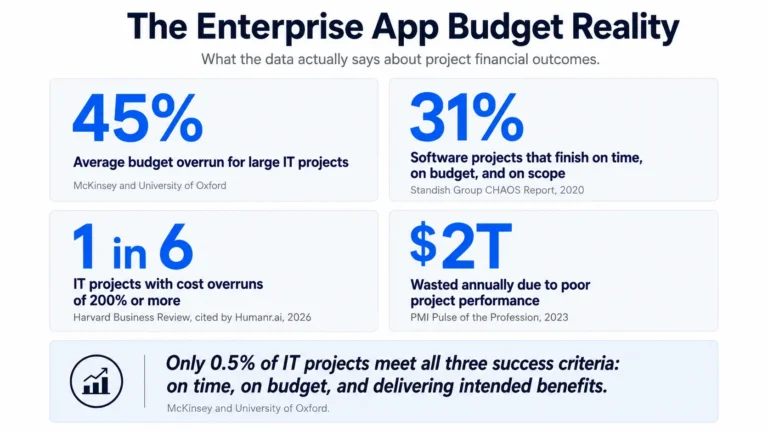
These are not the statistics of an industry with isolated execution problems. They are the statistics of an industry with structural ones, and those structural problems repeat across projects, vendors, organizations, and sectors with remarkable consistency. Understanding precisely which problems produce budget overruns, and at what stage of the project lifecycle they originate, is what separates the organizations that consistently deliver on budget from those that consistently discover the real cost only after the invoice arrives.
Why the Budget Was Wrong Before a Line of Code Was Written
The most important insight in enterprise app development budget management is also the most consistently ignored: most overruns do not originate during delivery. They originate during planning. By the time engineers are building, the budget failure has already been baked in.
Projects that spent less than 5 percent of total program costs on the requirements process experienced 80 to 200 percent cost overruns. Projects that invested 8 to 14 percent in requirements processes experienced less than 60 percent overruns (NASA Cost and Economic Analysis Branch, cited by PMI library). That finding, from one of the most rigorous project cost databases available, establishes the direct financial return on requirements investment: spending more at the planning stage predictably reduces overrun at the delivery stage. Yet most organizations do not internalize this relationship, continuing to compress planning timelines in the interest of starting delivery sooner, and paying for that compression throughout the rest of the project lifecycle.
75 percent of all IT projects fail due to errors in the setup phase, meaning the project is structurally compromised before a single line of code is written (BITKOM e.V., cited by Rockstar Developer University, March 2026). The setup phase errors that produce overruns are not random. They cluster around a specific set of failure modes that appear in project post-mortems with such consistency that predicting them in advance is entirely possible with the right governance framework.
The Eight Most Common Reasons Enterprise App Projects Go Over Budget
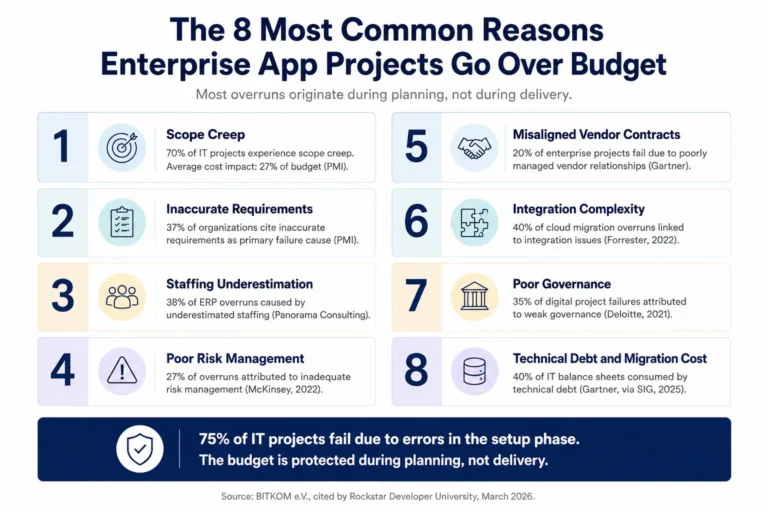
1. Scope Creep: The Dominant Budget Killer
Scope creep is the gradual, often unacknowledged expansion of project scope beyond what was agreed at the outset. It is the most documented cause of enterprise app budget overruns and the one with the clearest preventive mechanism: a formal change control process.
Over 70 percent of software development and IT projects experience scope creep according to the Standish Group CHAOS Report (cited by StopScopeCreep, March 2026). The average cost overrun attributable to scope creep is approximately 27 percent. On a $10 million enterprise app project, that is $2.7 million in unplanned costs from scope expansion alone (PMI data, cited by StopScopeCreep, March 2026). 52 percent of projects suffer from uncontrolled scope expansion largely due to a fundamental lack of initial executive governance (PMI research on software scope creep, cited by Humanr.ai, April 2026). And projects with no formal change control process are twice as likely to fail compared to those with one in place, yet only 44 percent of organizations consistently use a change control process (Wellingtone PPM Intelligence Report, cited by StopScopeCreep, March 2026).
Scope creep does not usually arrive as a single dramatic demand. It arrives as reasonable-sounding incremental additions: a new report someone realized they needed, an integration that was not in the original scope but makes sense to include while the team is already in the system, a design enhancement requested after the first demo, a compliance requirement that was not identified during planning. Each addition seems small. Each addition is justified by genuine business logic. Together they constitute a project that is substantially larger than what was budgeted, delivered by a team that was never resourced for its actual scope.
Projects without formal change management processes are 35 percent more likely to exceed costs or miss deadlines (PM Study Circle, October 2025, citing PMI research). The change control process is not bureaucratic overhead. It is the mechanism that makes the budget mean something after it is approved.
What prevents scope creep from driving overruns:
- A formally documented scope baseline signed by all stakeholders before development begins, specific enough that additions and exclusions are unambiguous
- A change control board with authority to approve or reject scope additions, with documented financial impact assessed before any change is approved
- A budget contingency reserve specifically allocated for approved scope changes, separate from the delivery budget, so that approved additions do not simply consume delivery contingency
- Executives who understand that “adding a feature” is not a neutral decision and who model the discipline of treating scope changes as budget decisions rather than product decisions
2. Inaccurate or Incomplete Requirements
Scope creep and requirements failure are related but distinct. Scope creep is unauthorized expansion of known scope. Requirements failure is the more fundamental problem of never having accurately understood the scope in the first place.
Among organizations that experienced ERP budget overruns, 38 percent said the reason was that the original staffing for the project was underestimated, nearly 35 percent said the initial project scope was expanded, and about 34 percent cited technical issues (NetSuite, citing Panorama Consulting ERP data, April 2026). Unclear requirements account for 39 percent of project failures according to PMI data (cited by StopScopeCreep, March 2026). 66 percent of organizations report frequent project delays caused by unclear requirements (Wellingtone State of Project Management, cited by ProProfs Project, 2026). And 37 percent of organizations cite inaccurate requirements as the primary reason for project failure (PMI Pulse of the Profession, 2014, still cited as a foundational benchmark across 2025 and 2026 sources).
The financial consequence of poor requirements is not linear. The cost to fix a requirements error during planning is a fraction of the cost to fix it during development, which is a fraction of the cost to fix it after deployment. IBM research identified this cost multiplier as far back as the 1970s and the relationship has been consistently confirmed across subsequent research: requirements errors caught early cost roughly 1 times the fix cost. Caught during development, they cost 10 times. Caught after release, they can cost 100 times or more.
Requirements failures take several specific forms in enterprise app projects:
Under-specified requirements that describe what the system should do at a conceptual level without specifying the precise behavior expected in each scenario, leaving engineers to make assumptions that turn out to be wrong.
Requirements defined by one stakeholder group without validation from the people who will actually use the system daily. Projects with user involvement in requirements gathering have 40 percent higher success rates than those driven purely by executive mandates (PMI Pulse of the Profession 2025). The executive who defines requirements and the employee who uses the system often have materially different understandings of what is needed.
Requirements that do not account for integration complexity. The most reliably underestimated cost in enterprise app development is the complexity of integrating the new application with existing systems. IDC research found that 40 percent of BI project overruns were due to data integration costs (IDC 2022, cited by Gitnux project failure statistics). Integration work that was not scoped because existing systems were not adequately inventoried and assessed during requirements gathering becomes discovery work billed at full development rates.
Requirements that do not account for non-functional requirements. Performance under load, security controls, compliance requirements, and disaster recovery architecture are all non-functional requirements that carry significant development cost but are frequently absent from requirements documents because stakeholders focus on what the system does, not how it behaves under specific conditions.
3. Underestimated Staffing and Resource Requirements
The third most common cause of enterprise app budget overruns, cited by 38 percent of organizations who experienced ERP overruns, is that the original staffing for the project was underestimated (Panorama Consulting ERP data, via NetSuite, April 2026).
Staffing underestimation takes several forms. The most common is optimistic allocation: assuming senior engineers will be fully available for the project when they are actually carrying ongoing operational responsibilities that will compete for their time. A senior engineer allocated at 80 percent capacity who is actually available at 50 percent due to unplanned operational demands produces a staffing gap that requires either extended timeline or additional headcount.
The second form is skills gap underestimation. Large IT projects frequently require specialized skills in specific technology domains, integration patterns, or compliance frameworks that the allocated team does not fully possess. IBM research identified team skills gaps as a factor in 40 percent of agile project failures (IBM, 2017, cited by Gitnux software failure statistics). When skills gaps are discovered mid-project, the options are expensive: external specialist consultants brought in at premium rates, extended timelines while team members develop the required skills, or technical shortcuts that create debt requiring later remediation.
The third form is vendor staffing misrepresentation. In many enterprise app projects, the team presented during vendor selection, including the senior architects and experienced engineers who built the proposal, is not the team that delivers the project. The delivered team carries more junior profiles at lower cost to the vendor, with the capability gap showing up as longer development cycles, more defects, and more client-side review overhead. Gartner’s data on vendor-related IT failures notes that 20 percent of enterprise projects fail because of poorly managed vendor relationships and misaligned contract structures (Gartner, cited by Humanr.ai, April 2026).
4. Inadequate Risk Management and Contingency Planning
McKinsey’s 2022 analysis attributes 27 percent of project overruns and failures to inadequate risk management (McKinsey 2022, cited by Gitnux project failure statistics, May 2026). The pattern is consistent: risks that were predictable are not identified, risks that were identified are not actively managed, and when they materialize the project absorbs the cost through budget overrun rather than drawing from pre-planned contingency.
Enterprise app projects carry a specific category of risk that is reliably underestimated: third-party dependency risk. When the project depends on an external API, a data feed from a legacy system, a vendor-delivered component, or a platform service from a cloud provider, any delay or defect in that dependency propagates directly into the project timeline and budget. The project team built to the available interface, discovered it does not behave as documented, and is now blocked while the upstream issue is resolved at no acceleration obligation on the third party’s part.
Data quality risk deserves specific attention because it is the most consistently underestimated source of project overruns in enterprise app development involving data migration or integration. IDC research found that poor data quality and data integration cost organizations materially more than planned on data-centric projects (IDC 2020, cited by Gitnux project failure statistics). When the data that the new application depends on turns out to be cleaner in documentation than in reality, data remediation work that was never in scope becomes a prerequisite for delivery.
Each additional year a project runs increases cost overruns by 15 percent (McKinsey, cited by Rockstar Developer University, March 2026). The time dimension of risk is itself a cost multiplier, meaning that risks which extend the timeline compound the budget impact of every other overrun driver simultaneously.
5. Vendor Contract Structure That Misaligns Incentives
This is the budget overrun driver that most organizations discover only after the damage is done, because it is embedded in the contract structure that was agreed before delivery began and that shapes every subsequent commercial interaction with the delivery partner.
In the vast majority of runaway software projects, the budget overrun is actively driven by a third-party systems integrator or development shop operating under a time-and-materials contract. When the meter is running, vendors have zero incentive to finish faster, zero financial exposure to scope creep decisions made by the client, and full benefit from every additional hour of work generated by requirement changes, integration complexity discoveries, or design evolution (Humanr.ai, April 2026).
Time-and-materials contracts are not inherently wrong for enterprise app development. They are appropriate when the scope is genuinely uncertain and the flexibility to adjust as discovery occurs is more valuable than the cost predictability of a fixed-price structure. They become a budget management failure when they are used for work whose scope could reasonably have been defined, simply because neither the client nor the vendor invested the time required to define it. The comfort of starting quickly under a T&M arrangement converts the investment in upfront requirements and scope definition into a continuous stream of billable hours that accumulates without a natural stopping point.
Milestone-based payment structures that tie vendor payments to specific, measurable deliverables accepted by the client create the incentive alignment that time-and-materials structures lack. The vendor is motivated to reach defined milestones because payment is contingent on it. The client has defined what acceptance looks like before delivery begins. And scope changes require explicit agreement from both parties before they generate additional charges.
The contract structures that protect the budget:
- Fixed-price contracts for work whose scope is well-defined and stable, with explicit change order governance for any additions
- Milestone-based payment tied to client-accepted deliverables rather than calendar dates or phase completions
- Explicit rate cards for change order work agreed at contract execution, not negotiated under deadline pressure when scope changes arise
- Key personnel commitment with approval rights for substitution, ensuring the team that won the work is the team that delivers it
- Data ownership and portability provisions that prevent vendor lock-in from becoming a negotiating leverage point at contract renewal
6. Integration Complexity That Was Not Scoped Accurately
Enterprise apps do not operate in isolation. They integrate with existing ERP systems, CRM platforms, data warehouses, legacy applications, and third-party services. The complexity and cost of those integrations is one of the most reliably underestimated dimensions of enterprise app project budgets.
The integration problem compounds as the number of systems requiring connection grows. Using the n(n-1)/2 formula for point-to-point integration connections, an application connecting to ten existing systems requires 45 integration connections, each with its own authentication model, data schema mapping, error handling logic, and maintenance burden (enterprise integration research, verified sources). Organizations average 897 applications, yet only 28 percent are integrated with formal governance (MuleSoft 2025 Connectivity Benchmark Report). The integration surface area that a new enterprise app must navigate is frequently far larger and far less well-documented than the pre-project assessment assumed.
Integration failures are among the most expensive mid-project discoveries because they typically surface late in the development cycle, when the new application’s core functionality has already been built against integration assumptions that turn out to be incorrect. Rebuilding integration layers after core development is substantially more expensive than designing integration correctly from the start. Forrester research found that 40 percent of cloud migration overruns were linked to integration issues (Forrester 2022, cited by Gitnux project failure statistics). IDC found that 40 percent of BI project overruns were due to data integration costs (IDC 2022, cited by Gitnux).
What integration cost underestimation specifically involves:
- API documentation that accurately describes the interface but not the actual behavior of the system under production load conditions
- Data quality in source systems that is substantially worse than assumed during scoping, requiring remediation work before integration can proceed
- Legacy systems without formal APIs that require custom middleware or data extraction processes not included in the original scope
- Synchronization requirements between systems that were not identified during planning, requiring event-driven architecture or scheduled reconciliation processes that add substantial engineering complexity
- Compliance requirements governing data flows between systems that impose additional logging, encryption, or access control requirements on the integration layer
7. Poor Governance and Slow Decision-Making
High decision latency teams achieve only 18 percent project success rates compared to 63 percent for teams that make decisions quickly (Standish Group CHAOS Report, cited by Rockstar Developer University, March 2026). The governance dimension of enterprise app budget management is not about oversight bureaucracy. It is about the speed and quality of the decisions that the project requires from organizational leadership throughout delivery.
Enterprise app projects generate a continuous stream of decisions that require business authority: what to do when a requirement turns out to be technically infeasible as specified, how to handle a discovered conflict between two stakeholder requirements, whether to accept a vendor’s proposed workaround for an integration issue or insist on the originally specified approach, how to prioritize competing items when sprint capacity is insufficient for everything planned. When those decisions are slow, the engineering team fills the gap with assumptions, and assumptions that turn out to be wrong become rework that was never budgeted.
Deloitte’s 2021 report attributes 35 percent of digital project failures to weak governance structures (Deloitte 2021, cited by Gitnux project failure statistics, May 2026). The Chaos Report 2020 identifies lack of executive sponsorship as the top cause contributing to 30 percent of project failures (Standish Group, cited by Gitnux). Governance failures produce budget overruns in three specific ways: decisions delayed until blockers have compounded, decisions made at the wrong level of authority requiring subsequent reversal, and decisions made without adequate technical input from the engineering team producing requirements that cannot be implemented as specified.
8. Technical Debt From Previous Systems and Underestimated Migration Cost
When a new enterprise app replaces or integrates with legacy systems, the technical debt those legacy systems carry becomes the new project’s problem. Data that is structurally inconsistent across source systems must be reconciled before migration. Business logic that was never documented because it lived in the heads of engineers who have since left must be reverse-engineered before it can be replicated. Workarounds built on top of architectural limitations in the old system must be identified and either carried forward or redesigned.
Technical debt accounts for 40 percent of IT balance sheets in organizations with significant legacy systems (Gartner, via SIG, 2025). 51 percent of companies dedicate more than a quarter of their total annual IT budget to technical debt remediation (vFunction, 2024 survey). When a new enterprise app project budget does not include an explicit, well-scoped allocation for addressing the legacy technical debt that the project must navigate, that debt does not disappear. It surfaces as discovery work billed at development rates throughout the project lifecycle.
Data migration in particular is one of the most consistently underestimated cost categories in enterprise app projects. The assumption at scoping is that data will migrate cleanly from old to new system. The reality discovered during execution is that data quality issues require remediation, data models in the old system do not map cleanly to the new one, and business validation rules that must be satisfied before migration can be declared complete are more complex than anticipated. For ERP implementations, data migration problems alone frequently account for 15 to 25 percent of total implementation cost overruns when they were initially treated as a low-complexity data transfer exercise.
The Budget Overrun Pattern by Project Stage
Understanding when overruns originate is as important as understanding why they occur. Most enterprise app projects experience budget pressure at predictable stages, and the stage at which pressure first appears often reveals the root cause.
The Enterprise App Budget Overrun Pattern:
Project Stage | Common Budget Pressure Source | Root Cause Category | Prevention Mechanism |
Planning and requirements | Underinvestment in requirements definition | Requirements failure | Invest 8-14% of total project budget in requirements process (NASA research) |
Design and architecture | Integration complexity discovery | Scope and technical underestimation | Comprehensive integration inventory before design begins |
Development sprint 1 to 3 | Scope additions from stakeholder demos | Scope creep | Change control process operational before first sprint |
Development sprint 4 onwards | Staffing gaps and velocity shortfall | Resource underestimation | Validated capacity planning with actual rather than theoretical team availability |
Integration and testing | Data quality and integration issues | Integration complexity underestimation | Data quality assessment before integration development begins |
UAT and acceptance | Requirements misalignment discoveries | Requirements failure | User involvement in requirements and acceptance criteria definition |
Go-live and hypercare | Change management and adoption failures | Change management underinvestment | Change management budget included in original project budget |
What the Organizations That Deliver on Budget Do Differently
The organizations that consistently deliver enterprise app projects within budget are not fortunate. They are disciplined about a specific set of practices at the planning stage that most organizations skip or compress.
They invest in requirements definition before they start the clock on delivery. They scope integration complexity explicitly rather than treating it as a delivery team problem to discover during execution. They negotiate contracts that align vendor incentives with delivery outcomes rather than billable hours. They establish change control governance before the first sprint rather than after the first stakeholder demo reveals features that were not in the original plan. They include data quality assessment in the project scope rather than treating data migration as a simple transfer exercise. And they maintain executive sponsorship that is active, decision-capable, and consistently present rather than delegated to a steering committee that meets monthly.
Only 0.5 percent of IT projects meet all three success criteria of on time, on budget, and delivering intended benefits (McKinsey and University of Oxford, cited by Rockstar Developer University, March 2026). That figure is not a statement about the difficulty of software development. It is a statement about how rarely organizations invest in the planning practices that make on-budget delivery achievable.
The budget is not protected during delivery. It is protected during planning, by the quality of requirements gathered, the accuracy of scope defined, the rigor of integration complexity assessed, the honesty of risk identified, and the precision of contracts negotiated before a single engineer is engaged.
Everything that happens after that is either the benefit of having done those things well or the cost of having done them poorly.
If your enterprise app project is approaching budget pressure or you are planning a significant application investment and want to build a budget framework that reflects the actual cost of delivery rather than the optimistic case, schedule a consultation with our team. We will help you identify the specific risk categories most relevant to your project context, scope the integration complexity accurately before it surfaces as a delivery surprise, and structure the engagement in a way that protects your budget from the overrun patterns that most projects do not escape.