
 iOS App Development
 Android App Development
 React Native
 Flutter
 Web Development
 Custom Software
 Front End Development
 Blockchain Development
 Virtual Reality
 Cloud Computing
 IoT Development
 Augmented Reality
 Write us a message
Every technology leader eventually faces the same recurring question in the budget cycle: continue funding an existing application, or commit to rebuilding it. This decision is frequently framed around age, yet age alone is a weak predictor of risk. The more relevant question is the widening gap between what a system is capable of delivering and what the business now requires of it.
This article examines the available data on enterprise application lifespans, quantifies the financial and operational cost of delaying modernization, and outlines a structured framework that C-suite leaders can apply when evaluating whether to maintain, modernize, or rebuild a given system.
The Average Lifespan of an Enterprise Application
There is no single, universally accepted figure for enterprise application longevity, but several independent data points converge on a consistent pattern.
- Smaller and mid-sized applications, generally those under 100,000 lines of code, have an average useful life of 6 to 8 years .
- Large, complex enterprise systems, exceeding one million lines of code, average 12 to 14 years in service. This extended lifespan is driven less by technical durability and more by the cost and operational risk associated with replacement, which discourages organizations from retiring these systems even when they are functionally outdated.
- ERP systems, a useful proxy for core enterprise infrastructure, average 6.4 years of age, with an estimated 5.3 years of remaining useful life under current conditions. For long-term capital planning, CIOs in large enterprise and federal environments often budget for ERP systems to remain in service for 15 to 20 years, reflecting the scale of investment required to deploy and stabilize them.
- Deployment model materially affects longevity expectations. On-premises systems average 7.9 years old, with only 3.4 years of estimated life remaining. Cloud-based systems, by comparison, average 4.3 years old but are projected to remain useful for 6.5 years, nearly double the runway of their on-premises counterparts.
The practical implication for leadership is that calendar age is an unreliable signal in isolation. A ten-year-old, well-architected cloud-native platform may carry less modernization risk than a four-year-old on-premises system built on a rigid, monolithic foundation. What matters is the trajectory of remaining value and the system’s capacity to absorb future change, not simply how long it has been in production.
The True Cost of Keeping an Aging Application in Service
The financial argument for modernization is frequently understated, largely because the associated costs are distributed across multiple budget lines rather than appearing as a single, visible expense.
- The average global enterprise loses more than $370 million annually as a direct result of inefficiencies in modernizing outdated systems, according to research conducted by Savanta on behalf of Pegasystems, drawing on a survey of more than 500 IT decision-makers. Of that figure, approximately $134 million stems from time lost during slow, resource-intensive legacy transformation efforts, $58 million is attributable to failed modernization initiatives, and $56 million reflects the ongoing cost of maintaining and integrating legacy systems.
- Technical debt now accounts for an estimated 21% to 40% of total IT spending at the average organization, based on Deloitte’s 2026 Global Technology Leadership Study.
- According to McKinsey research, 30% of CIOs believe more than 20% of their technology budget is consumed resolving technical debt rather than funding new strategic initiatives, with most organizations reporting a diversion in the range of 10% to 20%.
- The challenge is most acute in heavily regulated and public-sector environments. U.S. federal agencies allocate approximately 79% of a $105 billion-plus annual IT budget to operations and maintenance of existing systems, and only 3 of 10 previously identified critical legacy systems have been modernized since 2019.
- At a global scale, total technical debt liability has been estimated at $1.52 trillion, as reported by the Wall Street Journal and cited across multiple industry analyses.
The pattern across these figures is consistent: the cost of inaction is not absent, it is simply reallocated. Budget that might otherwise fund innovation is instead consumed by the ongoing maintenance of systems that are no longer delivering proportional value, often without that trade-off being explicitly visible to the board.
Legacy Infrastructure as a Barrier to AI and Digital Strategy
For executive teams currently evaluating AI investment, this is arguably the most consequential data point in the entire discussion.
- Organizations operating with fragmented or legacy systems are 30% more likely to experience delays in AI implementation, primarily due to an inability to integrate with modern data platforms, according to McKinsey.
- 68% of organizations report that legacy systems are actively obstructing their AI adoption efforts.
- Nearly one-third of IT leaders report that up to 25% of their legacy systems are entirely unable to support AI tools and workloads.
- 88% of IT leaders express concern about the effect of technical debt on their organization’s competitive position, with 29% characterizing that concern as “significant” or “clear”.
The implication is direct: if an organization’s AI roadmap assumes the current application estate can support it, that assumption warrants explicit validation rather than default acceptance. Many AI initiatives stall not because of model selection or data science capability, but because the underlying systems were never designed to expose data or logic in a way modern AI tooling requires.
The Hidden Productivity Cost to Engineering Organizations
Beyond direct financial expenditure, aging applications quietly consume engineering capacity that would otherwise be directed toward growth and innovation.
- Developers spend an average of 42% of their working week, roughly 17 of 41 hours, on maintenance and technical debt, with legacy system upkeep cited as the primary contributing factor.
- Organizations that proactively manage technical debt achieve 20% to 40% faster time-to-market on new digital initiatives compared to those that do not.
- Engineering teams burdened by high technical debt operate 30% slower than teams working with well-managed systems.
- Conversely, organizations that systematically reduce technical debt free their engineers to spend up to 50% more time on work directly tied to business outcomes, and these lower-debt organizations report 20% higher revenue growth relative to their higher-debt peers.
This productivity gap rarely appears as a single line item in a financial report. Instead, it manifests as missed delivery deadlines, slower onboarding for new hires, and a persistent sense among technical leadership that capacity is consumed by maintenance rather than progress.
Recognizing When an Application Has Crossed the Threshold
Rather than relying on a fixed age threshold, enterprise leaders should evaluate applications against a set of operational signals that indicate the system has moved from a manageable asset to an active liability.
- Maintenance consumes a disproportionate share of the application’s budget. Industry benchmarking from Gartner, Forrester, and Deloitte places legacy maintenance at 60% to 80% of total IT spend across enterprise application portfolios.
- Integration with modern data, cloud, or AI tooling requires significant custom engineering, rather than standard interfaces or APIs.
- Specialized talent for the platform is scarce or commands a premium. Legacy specialists frequently command 30% to 50% above modern-stack compensation, reflecting a shrinking and largely non-replenishing talent pool.
- Security patching or compliance posture has fallen behind, creating audit exposure or requiring manual workarounds that would not be necessary on a modern platform.
- Business requirements are evolving faster than the system can reasonably accommodate, whether driven by new products, new markets, or new regulatory obligations.
- Critical business logic is concentrated in the knowledge of a small number of long-tenured staff, with limited documentation to support continuity.
When three or more of these signals are present concurrently, the application has typically crossed from “aging but serviceable” into territory that warrants a formal modernization or replacement evaluation.
A Decision Framework: Maintain, Modernize, or Rebuild
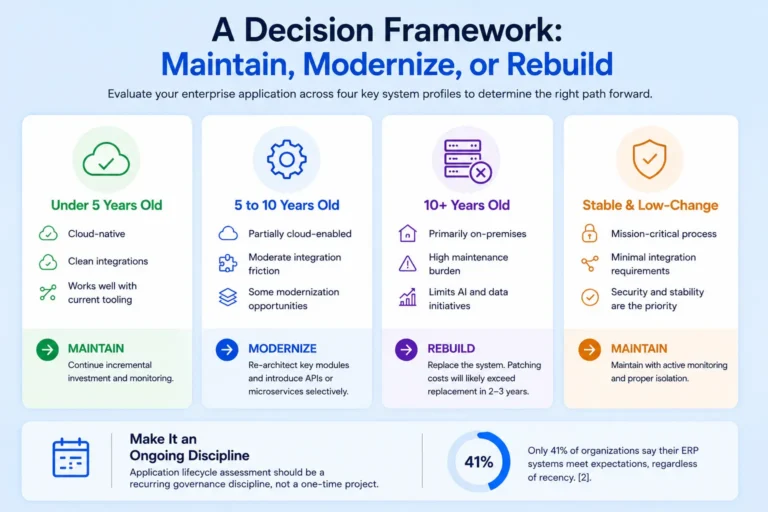
Four broad system profiles emerge in practice, each warranting a distinct response:
- Under 5 years old, cloud-native, integrates cleanly with current tooling. The recommended path is to maintain the system, continuing incremental investment and routine monitoring rather than pursuing structural change.
- 5 to 10 years old, partially cloud-enabled, with moderate integration friction. These systems are typically strong candidates for incremental modernization, re-architecting specific modules and introducing API layers or microservices selectively rather than undertaking a full rebuild.
- 10 or more years old, primarily on-premises, with a high maintenance burden that constrains AI or data initiatives. In this profile, rebuilding or replacing the system is usually the financially sound path, since the cost of continued patching is likely to exceed the cost of replacement within 2 to 3 years.
- Supports a stable, low-change, mission-critical process with minimal integration requirements. Here, age is less relevant than security and stability. The appropriate response is to maintain the system with active monitoring, provided it remains appropriately isolated from broader digital initiatives.
This decision should not be treated as a one-time exercise tied to a major budget cycle. Leading organizations approach application lifecycle assessment as a recurring governance discipline rather than an isolated modernization project. Deloitte’s research supports this distinction: only 41% of organizations report that their ERP systems meet expectations, regardless of how recently those systems were deployed. The gap between organizations that appear digitally modern and those that derive genuine strategic value from their technology investments is frequently a function of governance rigor, not system age.
The Questions Worth Raising at the Board Level
Reframing this issue for executive and board-level discussion shifts the emphasis away from a single, less productive question, “how old is this application,” toward a set of questions with direct strategic relevance:
- What proportion of our current IT budget is funding maintenance versus innovation, and has that ratio shifted meaningfully over the past three years?
- Can our current application estate realistically support our AI and data strategy over the next 24 to 36 months?
- What is the realistic financial and reputational cost of a security or compliance failure on this platform, compared to the cost of a planned modernization?
- If a competitor modernized this same function today, what would the cost of our continued inaction look like in 18 months?
Enterprise applications rarely fail according to a predictable schedule. Instead, they degrade quietly, through declining engineering velocity, rising maintenance spend, and strategic initiatives that stall on integration limitations, until the cumulative gap becomes too significant to defer. Organizations that manage this risk effectively are those that revisit these questions on a deliberate, recurring basis, well in advance of the system forcing the conversation on its own terms.
Conclusion
There is no fixed expiration date that applies uniformly across an enterprise application portfolio. The data makes clear that lifespan expectations vary considerably by system size, deployment model, and industry, ranging from 6 to 8 years for smaller applications to 15 to 20 years for large, well-governed ERP platforms. What determines whether a system remains an asset or becomes a liability is not its age in isolation, but the combination of rising maintenance cost, shrinking specialist talent, weakening security posture, and its capacity to support the organization’s data and AI strategy going forward.
The financial and operational evidence is consistent: deferring modernization does not eliminate cost, it redirects it from planned investment into unplanned maintenance, lost engineering productivity, and constrained strategic flexibility. For C-suite leaders, the more useful discipline is to treat application lifecycle review as a recurring governance function rather than a one-time technology decision. Organizations that build this habit are better positioned to modernize on their own timeline and their own terms, rather than being forced into a reactive rebuild after a system failure, security incident, or competitive gap makes the decision for them.
Not sure whether your enterprise app needs a rebuild, modernization, or just targeted improvements? Book a free consultation with our team to assess your application’s performance, scalability, security, and long-term maintainability. We’ll help you identify the right modernization path based on your business goals, technical challenges, and future growth plans.