
 iOS App Development
 Android App Development
 React Native
 Flutter
 Web Development
 Custom Software
 Front End Development
 Blockchain Development
 Virtual Reality
 Cloud Computing
 IoT Development
 Augmented Reality
 Write us a message
For decades, governance and compliance in software delivery have operated as a parallel system. While engineering teams pursued velocity through agile methodologies, continuous integration pipelines, and cloud-native architectures, compliance functions operated through documents, checklists, sign-off meetings, and quarterly audits. The result was predictable. Two organizational gears spinning at different speeds, with friction accumulating at every interface between them.
The most sophisticated enterprises have concluded that this model is no longer tenable. Regulatory expectations are intensifying. Software release frequencies have accelerated by orders of magnitude. The attack surface continues to expand as organizations adopt distributed architectures, third-party services, and AI-enabled capabilities. Manual approaches to software development governance simply cannot operate at the speed or scale that modern delivery demands.
The response from leading organizations is a fundamental architectural shift known as governance as code. By expressing policies, controls, and compliance requirements as machine-readable artifacts that execute automatically within the app development lifecycle, these enterprises are achieving something that previously seemed contradictory: faster delivery and stronger governance simultaneously.
This article examines what governance as code actually means in practice, why it has emerged as the operating model of choice for high-performing engineering organizations, and how leaders can begin building this capability within their own full life cycle application development environments.
What Governance as Code Actually Means
Governance as code is the practice of codifying organizational policies, regulatory requirements, security controls, and architectural standards as executable code that integrates directly into software delivery and infrastructure provisioning workflows. Rather than maintaining a code of governance in PDF documents reviewed during periodic audits, organizations express it in declarative configuration files, policy engines, and automated tests that run continuously as part of the build, deploy, and runtime pipelines.
The concept builds on the broader philosophy of treating operational concerns as software artifacts, following the same trajectory that Infrastructure-as-Code established for cloud provisioning and Configuration-as-Code established for system management. Policy engines such as Open Policy Agent, HashiCorp Sentinel, and AWS Cedar have matured significantly, providing the technical foundation for enterprise-scale implementations. On top of these foundations, organizations are building comprehensive software development governance frameworks that span everything from data classification and access management to architectural conformance and licensing compliance.
The defining characteristic of governance as code is that compliance is no longer something that happens after development is complete. It is woven into the fabric of how software is conceived, written, tested, deployed, and operated across the full life cycle application development model.
Why the Traditional Code of Governance Has Reached Its Limits
To understand why governance as code is gaining momentum, it is worth examining the structural limitations of the model it replaces.
The traditional code of governance relies heavily on point-in-time verification. Audits occur quarterly or annually. Security reviews happen at predefined stage gates. Architecture review boards convene weekly or monthly. Between these checkpoints, however, software changes continuously. By the time an audit identifies a deviation, the system has often evolved through dozens of additional releases, each potentially compounding the original issue.
Manual governance also scales poorly with organizational complexity. A central compliance team that effectively oversees 20 applications cannot maintain the same depth of insight across 500 applications, particularly when those applications span multiple cloud providers, programming languages, and deployment models. The traditional response has been to add headcount, but this approach has obvious limits and creates its own friction in the form of bottlenecks and delayed approvals.
Perhaps most critically, the document-based model creates a translation problem. Policies are written in natural language by legal, compliance, and security teams. Engineers must then interpret these documents and apply them in technical contexts across the application development life cycle. This translation is error-prone, inconsistent across teams, and difficult to verify systematically. When regulators ask whether a control is implemented correctly, organizations often struggle to provide evidence that satisfies modern expectations.
Governance as code addresses each of these limitations by making compliance continuous, scalable, and verifiable through compliance automation rather than human attention.
The Strategic Advantages of Embedding Compliance Across the Application Development Life Cycle
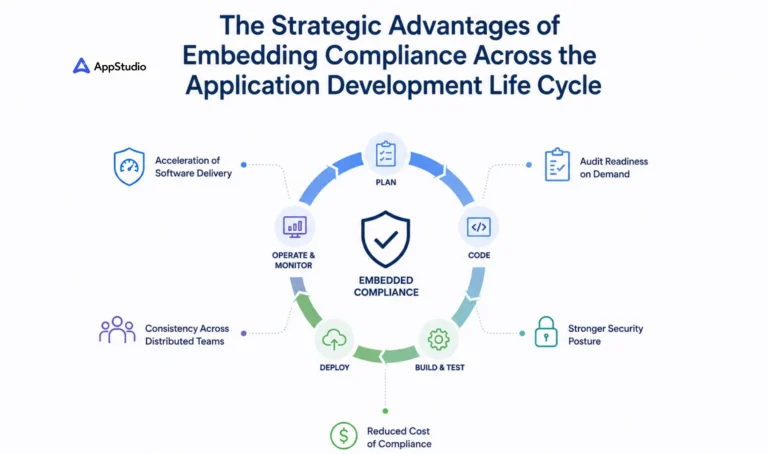
Organizations that have successfully implemented governance as code report substantial benefits across multiple dimensions of their engineering operations.
Acceleration of Software Delivery
When policy checks execute automatically within continuous integration pipelines, teams receive feedback within minutes rather than waiting days or weeks for manual reviews. Issues are identified at the point of authorship, when they are easiest and least expensive to fix. The compounding effect on delivery velocity is significant. Several large financial services and healthcare organizations have reported reductions of 40 to 70 percent in the time required to move a new application from concept to production deployment within their app development lifecycle.
Consistency Across Distributed Teams
Modern enterprises operate engineering organizations distributed across geographies, business units, and technology stacks. Expressing software development governance as code ensures that the same controls apply uniformly regardless of where development happens. A policy that requires encryption of sensitive data fields, for example, is enforced identically whether the application is being built in a centralized platform team or in a business unit operating semi-autonomously.
Audit Readiness on Demand
Because policy evaluations generate machine-readable evidence as a byproduct of their execution, compliance automation produces comprehensive audit trails at any moment. Regulators increasingly expect this kind of continuous attestation rather than periodic snapshots. Financial services firms operating under regimes such as DORA, banking organizations subject to OCC supervision, and healthcare entities navigating HIPAA expectations are finding that a codified approach to governance dramatically reduces the burden of audit preparation while improving the quality of evidence produced.
Reduced Cost of Compliance
The economics of compliance automation are compelling. While the initial investment in policy engines, tooling, and process redesign is meaningful, the ongoing operational cost of governance falls substantially. Time previously spent on manual reviews, evidence gathering, and remediation of late-discovered issues is redirected toward higher-value activities. Compliance teams shift from reactive enforcement to proactive policy authorship and continuous improvement.
Stronger Security Posture
When security policies are enforced at every commit, build, and deployment, the window in which a vulnerability or misconfiguration can exist in production shrinks dramatically. This is the foundational premise of the DevSecOps movement, and governance as code represents its most mature expression. Organizations that have invested in this capability typically report measurable improvements in mean time to detect and mean time to remediate across their application portfolios.
The Building Blocks of a Governance as Code Implementation
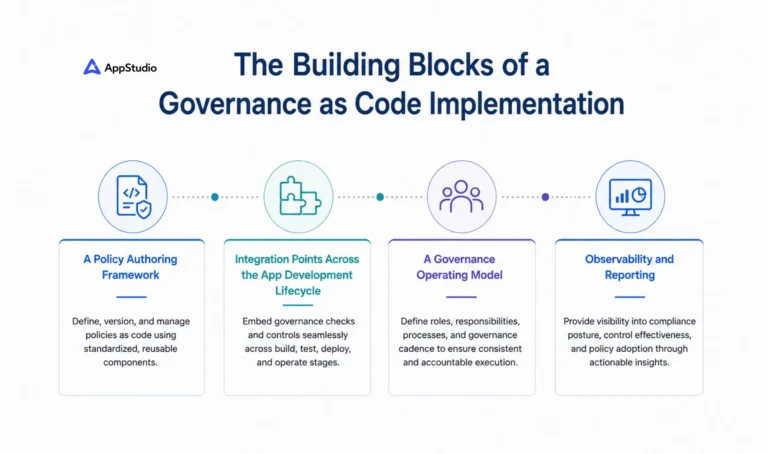
Implementing governance as code at enterprise scale requires several interlocking components, each of which must be designed with care.
A Policy Authoring Framework
The foundation of any governance as code program is a structured way to express policies. Organizations typically standardize on one or two policy engines such as Open Policy Agent with Rego, HashiCorp Sentinel, or cloud-native tools like AWS Cedar. The choice depends on the existing technology ecosystem, the skills available, and the breadth of use cases anticipated. Equally important is establishing conventions for how policies are organized, versioned, tested, and documented, treating them with the same rigor applied to production application code.
Integration Points Across the App Development Lifecycle
Effective implementations integrate policy evaluation at multiple stages of the app development lifecycle. Pre-commit hooks catch issues before code is even shared. Pull request checks validate proposed changes against governance requirements. Build pipelines verify that produced artifacts comply with security and licensing policies. Deployment pipelines confirm that infrastructure configurations meet architectural standards. Runtime controls continuously evaluate operational behavior against expected norms. Each integration point reinforces the others, creating defense in depth across the full life cycle application development model.
A Governance Operating Model
Technology alone is insufficient. Successful programs establish clear ownership for policy authorship, exception management, and continuous improvement. Compliance and security teams shift from gatekeepers to enablers, partnering with engineering to translate regulatory requirements into executable policies. Engineering teams take greater accountability for compliance outcomes because they have the tools and feedback necessary to act on them. Exception processes are themselves codified, providing transparent pathways for handling legitimate edge cases without compromising the integrity of the overall framework.
Observability and Reporting
Governance as code generates enormous quantities of evidence and signals. Organizations need robust observability platforms to surface meaningful insights from this data. Dashboards should provide real-time visibility into compliance posture across applications, business units, and regulatory domains. Executives need summary views that translate technical metrics into business risk. Auditors need detailed evidence trails that support specific control attestations.
Practical Considerations for Enterprise Adoption
Organizations beginning their governance as code journey should approach implementation with realistic expectations and a phased strategy.
Start with a constrained scope that demonstrates value quickly. A common entry point is infrastructure provisioning, where Infrastructure-as-Code tooling provides a natural integration point for policy enforcement. From this foundation, expand into application security policies, data governance controls, and architectural standards over successive iterations across the application development life cycle.
Invest meaningfully in the cultural transition. Many organizations underestimate the change management required when compliance functions begin operating as code authors and engineering teams begin owning compliance outcomes. Cross-functional working groups, joint training programs, and shared performance objectives help bridge the cultural gaps that have historically separated these functions.
Treat policies as products. The most mature organizations apply product management discipline to their software development governance frameworks. Policies are designed with their users in mind, tested against realistic scenarios, instrumented for feedback, and continuously refined based on operational experience. This product orientation distinguishes high-performing programs from those that simply codify existing manual processes without rethinking them.
Plan for exceptions thoughtfully. No policy framework can anticipate every legitimate variation in business need. Build clear, auditable pathways for handling exceptions, including time-bounded waivers, escalation procedures, and review processes that ensure exceptions do not silently become the norm.
The Trajectory of Compliance Automation in Modern Software Delivery
Looking ahead, several trends suggest that governance as code will become even more central to enterprise software strategy over the coming years.
The expansion of regulatory frameworks around AI, data sovereignty, and operational resilience will increase the volume and complexity of compliance obligations. Manual approaches will be increasingly infeasible at the scale these regimes demand. Organizations that have already built compliance automation capabilities will adapt to new requirements far more efficiently than those still relying on a document-based code of governance.
The maturation of large language models is also reshaping how policies are authored and maintained. Emerging tooling allows compliance professionals to express requirements in natural language while AI assistants translate them into policy code, dramatically lowering the technical barrier to participation. Over time, this is likely to expand the population of contributors and accelerate iteration cycles.
Finally, the convergence of platform engineering, internal developer platforms, and software development governance is creating new opportunities for embedding compliance into the developer experience in ways that feel less like constraint and more like assistance. Developers receive intelligent guidance at the moment of decision rather than discovering issues weeks later. This evolution promises to dissolve the historical tension between governance and velocity entirely.
Conclusion: The Strategic Imperative
The shift to governance as code represents one of the most consequential transitions in enterprise software practice in the past decade. It addresses long-standing tensions between speed and control, between centralized oversight and distributed accountability, between regulatory expectation and operational reality. The organizations that recognize this shift and invest accordingly are building durable advantages that compound over time.
For senior IT and compliance leaders, the questions to ask are direct. How quickly can your organization demonstrate compliance with a new regulatory requirement? How confidently can you attest to controls across your application portfolio at any given moment? How much engineering capacity is currently consumed by manual governance activities that could be transformed through compliance automation? The answers to these questions will reveal both the opportunity and the urgency.
Governance as code is no longer an experimental practice confined to leading-edge technology companies. It is becoming the standard operating model for any enterprise that takes both compliance and full life cycle application development seriously. The path forward requires investment, cultural commitment, and disciplined execution. The returns, in resilience, velocity, and strategic flexibility, justify that commitment many times over.
Every organization’s path to governance as code looks different, shaped by its regulatory environment, engineering culture, and existing controls. If you are thinking through where to begin or how to mature an existing program, we would welcome a conversation to understand your context and share what we have seen work. Talk to our team.