
 iOS App Development
 Android App Development
 React Native
 Flutter
 Web Development
 Custom Software
 Front End Development
 Blockchain Development
 Virtual Reality
 Cloud Computing
 IoT Development
 Augmented Reality
 Write us a message
Yes, AppStudio can manage cloud infrastructure and disaster recovery for Canadian companies. It runs and secures AWS, Microsoft Azure and Google Cloud environments, provides backup and disaster recovery as a service with tested recovery targets, and keeps data in Canadian regions to support PIPEDA, Quebec’s Law 25 and sector rules such as OSFI Guideline B-13.
This matters because recovery gaps remain common. In 2025, 25% of large Canadian businesses were affected by a cyber security incident (Statistics Canada), yet only 43% of businesses said they kept backups of digital information as part of their cyber risk arrangements. The sections below explain how AppStudio closes those gaps.
What Cloud Infrastructure Services Does AppStudio Offer?
AppStudio provides managed cloud services Canada organizations use to plan, build and run their environments on AWS, Microsoft Azure and Google Cloud, including hybrid and multi-cloud setups (AppStudio). One team covers migration, daily operations and security, so there is a single accountable owner when something goes wrong.
Cloud migration and setup (AWS, Azure, Google Cloud)
- Assessment of current workloads and a phased migration plan
- Landing zones: the secure foundation of accounts, networks and permissions
- Provisioning and capacity planning sized to real demand
- Cost controls and spending limits from the first day
Ongoing monitoring and managed support
- 24/7 monitoring, with incident response when thresholds are breached
- Reliability engineering to keep critical applications available
- Operation of container platforms such as Kubernetes
- Monthly reporting on performance, incidents and service levels
Security and access management
- Continuous scanning for misconfigured cloud settings
- Identity and access controls for administrator accounts
- Compliance monitoring against agreed control frameworks
- Escalation to managed detection and response for confirmed threats
AppStudio reports ISO 27001 and ISO 9001 certification (AppStudio), and its teams work from offices in Toronto and Vancouver.
How Does AppStudio Handle Disaster Recovery?
AppStudio delivers disaster recovery as a service Canada organizations can rely on when primary systems fail, combining protected backups, replicated environments and regular testing. The aim is predictable recovery: knowing in advance how much data could be lost, how long restoration will take, and who makes each decision during an incident.
The stakes are significant. The average data breach in Canada cost CA$6.98 million in 2025, up 10.4% in one year (IBM Canada), and 1 in 5 organizations said their most recent major outage cost more than US$1 million (Uptime Institute).
Automated backups and replication
- Automated, monitored backups of servers, endpoints and cloud applications
- Encrypted copies that can’t be altered or deleted, kept separate from live system credentials
- Backup for Microsoft 365 and Google Workspace data
- Replicated systems ready to start in a second region if the primary environment fails
Recovery Time Objective (RTO) and Recovery Point Objective (RPO) explained
- RPO is how much data you can afford to lose, measured as the time since the last good copy.
- RTO is how quickly a system must be running again after an outage.
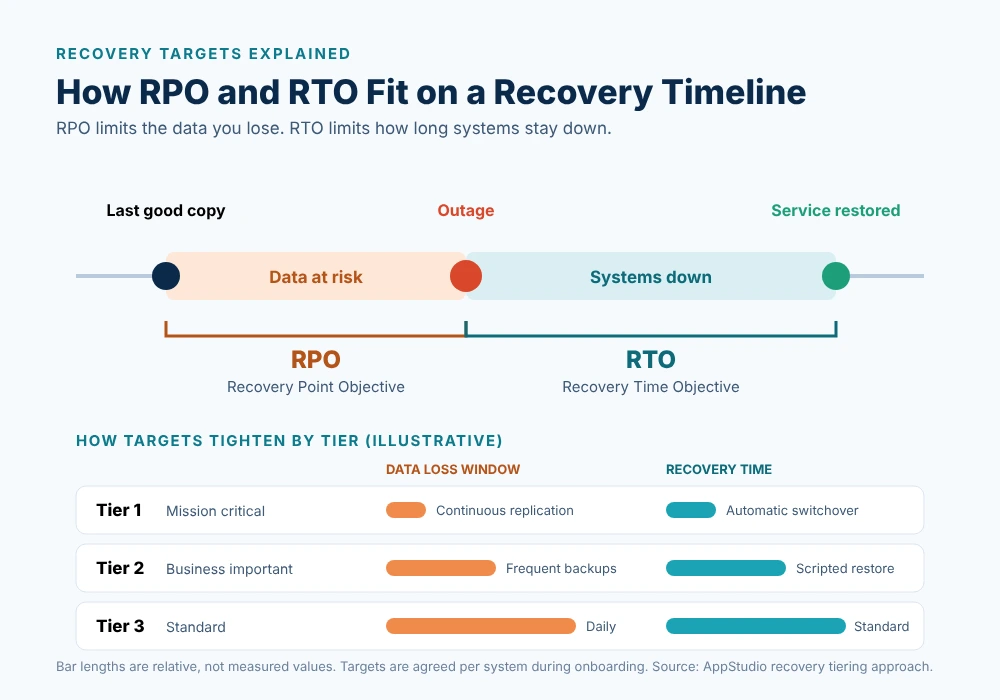
AppStudio sets both for each system based on business impact. For most critical systems, it says it can restore service in a few hours or less by switching automatically to the recovery environment .
Tier | Example systems | Typical approach |
Tier 1: mission critical | Customer platforms, payments, ERP | Continuous replication and automatic switchover to a second region |
Tier 2: business important | Internal applications, reporting | Frequent backups with scripted restore |
Tier 3: standard | Archives, development environments | Daily backups with standard restore |
Failover testing and DR drills
- Scheduled restore tests for critical systems, with documented results
- Switchover exercises that rehearse moving to the recovery environment
- Quarterly reviews of recovery targets as systems change
- Test records that support audit and insurance requirements
Each test ends with a short report covering actual recovery times against targets, any issues found and the fixes applied. Over time, these reports show leadership whether recovery capability is improving and where further investment is needed.
Does AppStudio Support Canadian Data Residency Requirements?
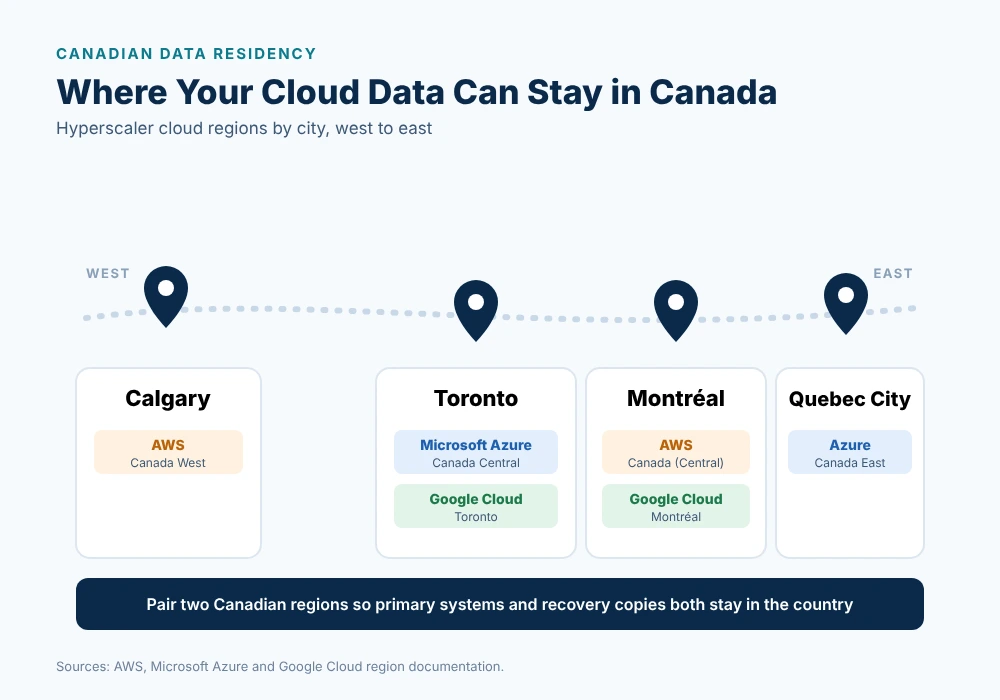
Yes. Data residency is usually the first question in any cloud disaster recovery Canada discussion, and AppStudio designs environments so that live systems, backups and recovery copies can all remain in Canada. Clients choose where backups are stored and how long they’re kept, from Canadian cloud regions to copies held on site.
Hosting data in Canadian regions (e.g., Toronto, Montreal)
- AWS: Canada (Central) and Canada West (Calgary), with at least three availability zones per region (AWS)
- Microsoft Azure: Canada Central in Toronto, with three availability zones, paired with Canada East in Quebec (Microsoft)
- Google Cloud: Montréal, with three zones (Google Cloud), and Toronto
- Supporting data: logs, monitoring data and backup replicas are mapped so they don’t leave Canada unintentionally
PIPEDA compliance
- Organizations remain accountable for personal information processed by service providers, including in backup and recovery environments.
- Breaches posing a real risk of significant harm must be reported to the Privacy Commissioner and to affected individuals.
- Organizations must keep a record of every breach of security safeguards for 24 months (Breach of Security Safeguards Regulations).
Provincial rules (Quebec Law 25, PHIPA, Alberta PIPA)
- Quebec’s Law 25 requires a privacy impact assessment before personal information is sent outside Quebec (Quebec Law 25).
- Ontario’s PHIPA governs how health information custodians collect, use and protect personal health information, including in backups.
- Alberta’s PIPA requires private-sector organizations to notify the Information and Privacy Commissioner of breaches that pose a real risk of significant harm.
Which Canadian Industries Does AppStudio Support?
AppStudio supports regulated and high-availability sectors where downtime and data exposure carry direct financial and legal consequences. Large organizations are the most exposed: 63% of large Canadian businesses held cyber insurance in 2025, and insurers increasingly expect tested recovery plans as a condition of cover.
Healthcare
- Encrypted storage tied to Canadian regions for patient data
- Recovery planning that supports PHIPA and similar provincial health privacy laws
- High availability for clinical and patient-facing systems
Finance and fintech
- Testing and documentation that support OSFI Guideline B-13, in effect since January 1, 2024 (Torys)
- Tier 1 recovery for payment and customer platforms
- Evidence packs for internal audit and regulators
Retail and e-commerce
- Capacity planning for seasonal peaks
- Protection for order, payment and inventory systems
- Controls aligned with PCI DSS requirements
Government and public sector
- Environments locked to Canadian regions to meet residency mandates
- Documented recovery procedures for essential public services
- Reporting suited to public accountability and audit cycles
- Bilingual documentation and support where required
What Does Cloud and Disaster Recovery Management Cost for Canadian Businesses?
Cost depends on what you protect and how quickly it must recover. Pricing is usually monthly, based on the size of the environment and the recovery tier of each system. The useful comparison isn’t the monthly fee alone, but the fee against the cost of an outage or breach you’d otherwise absorb.
Pricing factors (workload size, RTO/RPO, compliance level)
- Workload size: number of servers, data volumes and cloud accounts in scope
- Recovery targets: continuous replication for Tier 1 costs more than daily backups for Tier 3
- Compliance level: audit evidence, data residency controls and regulated-sector reporting add effort
- Coverage hours: 24/7 monitoring and response cost more than business-hours support
- Data movement: transfer between regions and long-term storage add to the total
A short business impact analysis keeps cloud disaster recovery Canada budgets proportionate. It shows which systems justify continuous replication and which can rely on daily backups, so spending follows business risk instead of being spread evenly across every workload.
In-house vs. managed DR: a cost comparison
Cost line | In-house DR | Managed DR with AppStudio |
24/7 coverage | About four to five staff per role, since a week has 168 hours | Included in the service |
Tooling and backup storage | Bought and maintained separately | Included or passed through at agreed rates |
Testing and documentation | Competes with daily priorities | Scheduled and reported |
Specialist skills | Hard to hire and retain | Shared across a wider team |
Staffing risk | Turnover and coverage gaps sit with you | Sits with the provider |
For context, Canadian businesses spent an average of $54,772 on cyber security prevention in 2025. Recovery capability should be budgeted alongside that spending, not after an incident.
How Does AppStudio Compare to Other Cloud Providers in Canada?
Canadian organizations typically choose between four types of partner for cloud infrastructure management Canada needs. Each suits different priorities, and many enterprises use more than one. The table compares the main options on the factors that matter most for recovery, residency and day-to-day accountability.
Factor | AppStudio | Cloud platform tools only | Global systems integrator | Regional IT provider |
Who runs recovery | AppStudio team | Your internal team | Integrator team | Provider team |
Canadian data residency | Designed in | Possible, you configure it | Varies by contract | Varies |
24/7 monitoring | Included | Tools only | Usually included | Often limited |
Application knowledge | Strong where AppStudio builds or supports the apps | Your team | Varies | Limited |
Best for | Cloud-first and hybrid organizations wanting one accountable partner | Organizations with mature in-house cloud teams | Large multinational transformation programs | Smaller, office-based environments |
Whichever option you consider, ask each provider the same questions in writing:
- Which Canadian regions will host live systems, backups and recovery environments?
- What RPO and RTO will you commit to for each tier, and will they be in the contract?
- When did you last run a full failover test, and can we see the results?
- Are backups isolated from the credentials used to run live systems?
Organizations needing large on-site teams in every province, or extensive mainframe support, may be better served by a national provider or global systems integrator.
How Do You Get Started with AppStudio’s Cloud and DR Services?
AppStudio onboards clients in phases, so protection starts well before a full program is complete. Monitoring of most cloud environments and backup of critical systems typically begin within days, and full disaster recovery is usually in place within 2 to 4 weeks for a typical environment.
Step-by-step onboarding process
- Assessment: review current cloud environments, backups and recovery plans.
- Business impact analysis: rank systems and agree RPO and RTO for each tier.
- Residency and compliance mapping: confirm Canadian regions and applicable regulations.
- Initial protection: start monitoring and back up critical systems within days.
- Disaster recovery build: set up replication and recovery environments over 2 to 4 weeks.
- First failover test: prove recovery against the agreed targets. Ongoing operations: 24/7 monitoring, monthly reporting and quarterly reviews.
Clients can choose a fully managed model, or a co-managed model in which AppStudio adds 24/7 coverage to an internal IT team.
Frequently Asked Questions
These are the questions Canadian executives most often ask when evaluating a partner for cloud infrastructure and disaster recovery for Canadian companies. The answers summarize AppStudio’s approach. Confirm specific commitments, such as recovery targets and onboarding dates, in your own proposal and service agreement before signing.
Is my data stored in Canada?
It can be. AppStudio uses Canadian cloud regions for live systems, backups and recovery environments wherever residency rules or company policy require it.
How quickly can AppStudio restore my systems after an outage?
Recovery times are agreed per system. For most critical systems, AppStudio says it can restore service in a few hours or less through automatic switchover.
Can AppStudio manage a hybrid or multi-cloud environment?
Yes. AppStudio manages AWS, Azure and Google Cloud, including environments that combine cloud with on-premises systems.
Does AppStudio help with compliance audits?
Yes. AppStudio provides test records, configuration reports and documentation that support audits under PIPEDA, Law 25, OSFI Guideline B-13 and frameworks such as SOC
What happens to my data if I leave?
Exit terms are agreed in the contract, including return of data, configurations and documented recovery procedures, with transition support to your next provider.
Conclusion / Next Steps
AppStudio manages cloud infrastructure and disaster recovery for Canadian companies from first assessment through 24/7 operations. It combines Canadian data residency, recovery targets set by business impact, and regular testing that gives boards, auditors and insurers the evidence they need, with managed cloud services Canada organizations can scale over time.
Choosing a partner for cloud infrastructure and disaster recovery for Canadian companies is ultimately a risk decision. Strong cloud infrastructure management Canada programs, backed by tested disaster recovery as a service Canada teams can report on, reduce the cost and duration of outages.
Book a free cloud and disaster recovery assessment with AppStudio to map your recovery targets, residency requirements and gaps.